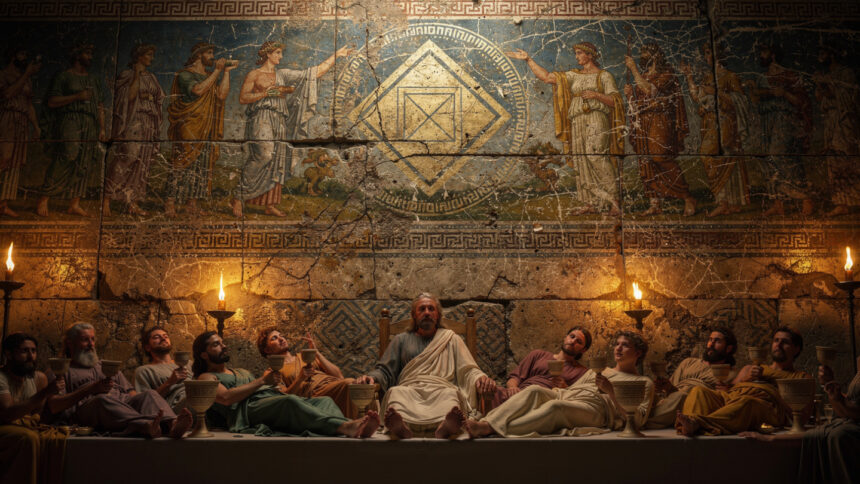





In Epirus or in the shadowed ridges of the Peloponnese, winter was never treated as an ending. There was no tradition of imagining the dark months as a void to be endured until the light returned. The land simply continued forward, narrowing into colder stone and quieter fields, and it was in this narrowing that Hermes Psychopompos became most present in Greek religious thought. He was understood as the god of thresholds, not a judge presiding at the end of the road but the one who knew how to move a soul, a season, or a traveler through change without damaging what passed through it.
For the ancient Greeks, the soul was not meant to confront its final transition alone. Death required a guide who understood both the world of the living and the territory beyond it, and this role belonged specifically to Hermes, the god of roads and passage. Popular memory often reduces him to a quick messenger or a trickster, but the epithet Psychopompos names a far graver responsibility, one bound up with the same seasonal logic that governed Persephone’s descent into the underworld each year.
The God Born in Motion
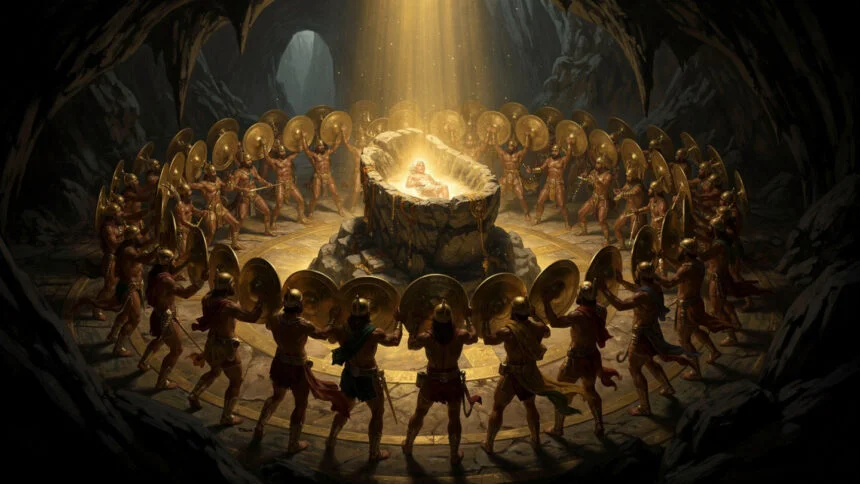
Hermes entered mythology already in motion. Born to Zeus and Maia in a cave on Mount Cyllene, he left his cradle before the day had fully begun. His theft of Apollo’s cattle and his creation of the lyre were not simply acts of mischief but expressions of a logic that treated boundaries as skills to be learned rather than limits to obey. From the beginning, he moved easily between divine and human worlds. Neither Olympus nor the earth alone could contain him. Roads, markets, and dreams became his domains. He spoke to gods and to the dead with the same ease. This ability to navigate different realms without losing coherence was central to Greek spiritual imagination.

His title Psychopompos, guide of souls, named his most serious responsibility. He escorted the dead to the underworld, not through force but through presence. Death was understood as a transition that required a companion who knew the route. Hermes carried the kerykeion, his staff, which symbolized safe passage and continuity. Through him, identity and memory were preserved across boundaries. Ancient art often shows him leading figures calmly toward the unseen. These scenes are marked by composure rather than fear. The guide is already waiting, seated near the edge of the boundary, prepared for the journey to unfold without rupture.
The most direct literary evidence for this role appears at the opening of Book Twenty-Four of the Odyssey, where Hermes gathers the souls of the slain suitors and leads them down through the gates of the sun and the land of dreams to the meadow of asphodel, the pale flower field the Greeks imagined as the resting place of the ordinary dead. Homer describes the souls following him with the same helpless docility as bats disturbed from a cave, squeaking and fluttering behind their guide because they have no other way of understanding where they are going. It is one of the few extended scenes in Greek epic devoted entirely to the mechanics of the god’s most solemn function, performed without ceremony, without judgment, simply as a task that belongs to him alone among the Olympians.
Liminality as a Lived Reality
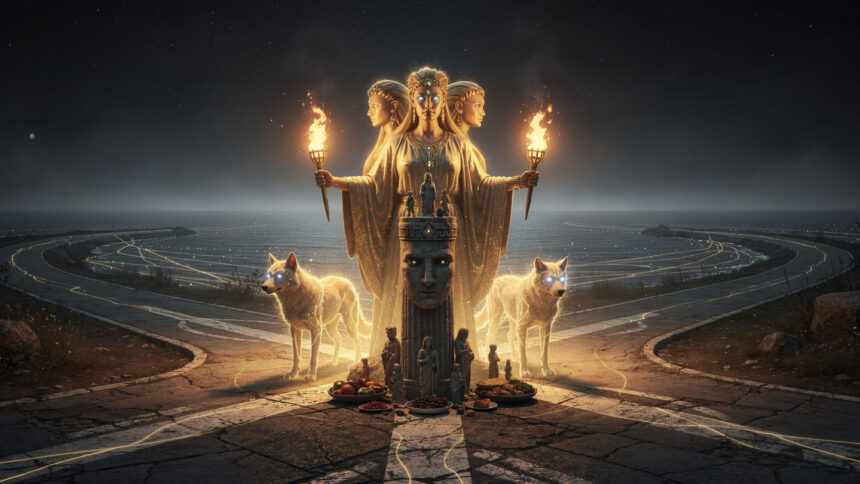
Hermes presided over liminal spaces: crossroads, doorways, and the borderlands between waking and sleep. His winged sandals represented motion without disruption. The Greeks placed hermai, stone pillars bearing his head, at entrances to cities and homes. These markers did not block movement but acknowledged it. A crossing left unrecognized was considered dangerous, while one that was named and honored remained whole.

The scale of this practice in Athens is what made the mutilation of the hermai in 415 BCE, on the eve of the Sicilian Expedition, such a profound civic shock. Almost every herm in the city, hundreds of stone markers standing at doorways and crossroads, was found defaced overnight, its face and genitals broken away. The Athenians treated the act not as vandalism but as a religious emergency capable of dooming the entire military campaign about to sail, and the investigation that followed consumed the city’s political energy for months. Nothing illustrates more clearly how seriously the boundary-markers of Hermes were taken than the panic that followed their desecration on the largest scale in the historical record.
This awareness extended to the seasons. Winter functioned as the Mediterranean’s great interval. Light diminished, growth retreated into the soil, and the visible world entered a period the Greeks associated with withdrawal rather than absence. Hermes governed all who crossed boundaries, travelers, merchants, speakers, even thieves, because exchange itself belonged to him. His association with winter ran through his connection to Persephone specifically: it is Hermes, in the Homeric Hymn to Demeter, who is sent by Zeus into the underworld to retrieve her, the same psychopomp who guides souls down performing the rarer and more difficult task of guiding one back up.
Winter in the Attic Calendar
The ancient calendar moved at a different pace from modern timekeeping. It began in midsummer with Hekatombaion, and the winter months included Poseideon and Gamelion. No major festival in this period was dedicated to Hermes directly, yet his presence permeated the season through rituals of thresholds and household observances, since liminal periods naturally belonged to him regardless of which month the calendar assigned them to.

This absence of a dedicated winter festival is itself informative. Unlike Demeter and Persephone, whose mother-daughter drama gave the winter months a clear narrative structure enacted through the Eleusinian calendar, Hermes required no festival because his function was continuous rather than seasonal. He did not arrive at winter and depart with spring. He was present at every threshold the year contained, which meant the Greeks did not need to schedule him. He was simply there, at every gate, every crossroads, every deathbed, whenever the crossing occurred.
Travel as Sacred Passage
In Greek culture, travel was never merely geographic. Leaving one place and arriving in another altered the traveler’s identity. Hermes protected this movement because it carried risk. Change without ritual led to confusion. This was why gates and boundaries were marked and honored. Recognition restored meaning and transformed ordinary movement into sacred passage.

Travelers making significant journeys, merchants departing for foreign ports, colonists founding new cities, commonly made offerings at hermai before setting out, treating the god’s blessing as a practical precaution rather than a formality. The same god who guided the dead to their permanent destination was invoked to guide the living safely to a temporary one and, just as importantly, back again. This dual function, psychopomp for the final journey and patron for every provisional one, is what distinguishes Hermes from every other Olympian: he is the only god whose domain is the crossing itself rather than a fixed place, a possession, or a single sphere of human activity.
The God Who Remains at Every Threshold
Later Greek and Roman tradition preserved this function long after the classical religious calendar had faded. Hermes, under his Roman name Mercury, retained his psychopomp role into late antiquity, and the image of a winged guide leading souls through darkness survived, in transformed shapes, into the Christian and post-classical imagination that followed the collapse of the old religion. Few Greek gods left as clear a functional descendant in later Western thought as the figure who first learned to move between worlds without losing coherence in either one.

The winter light over Epirus and the Peloponnese still falls the way it fell when the hermai stood watch at every crossroads. The land rests. The vines hold their sap. The old Greek calendar assigned this god no single festival because it needed none. Hermes is imagined still moving along mountain paths and narrow streets, present at every threshold the year contains, exactly as he was in the epic that first placed him at the gates of the sun, leading the fluttering shades of the dead toward the meadow where they belonged.
At Olympus Estate, Mythic Essays moves through the deeper currents of the Greek tradition. Hermes Psychopompos was not a judge at the end of the road but the one who knew how to move a soul through change without damaging what passed through it. Born on Mount Cyllene, he left his cradle before the day had fully begun. In Book Twenty-Four of the Odyssey he gathers the souls of the slain suitors and leads them, fluttering and helpless as disturbed bats, down through the gates of the sun to the meadow of asphodel. He was also, in the Homeric Hymn to Demeter, the god sent to retrieve Persephone from the underworld, the rarer task of guiding a soul back up rather than down. The Greeks placed hermai at entrances to cities and homes not to block movement but to acknowledge it, and the mutilation of Athens’s hermai in 415 BCE, on the eve of the Sicilian Expedition, triggered one of the most serious religious panics in the city’s history. No winter festival was dedicated to Hermes because none was needed. He belonged to every threshold the year contained.