
Greece rewards preparation.
This is the first thing that distinguishes the encounter with Greece as a civilization from the encounter with Greece as a destination, and it is the distinction that this article is organized around. The destination-Greece is real and genuinely beautiful: the islands and the beaches and the summer light and the food and the outdoor tables and the quality of the Greek summer that has attracted visitors since the northern Europeans first discovered it in the eighteenth century. This version of Greece is available without preparation and without prior knowledge and it delivers what it promises.
The civilization-Greece requires something different: the willingness to arrive having read enough to know what you are looking at, to slow down enough to look at it seriously, and to accept that the most significant encounters with the ancient world are not the ones organized for the convenience of the visitor but the ones that the visitor has prepared themselves to find. The Lion Gate at Mycenae is not more impressive than the photographs suggest. It is the same size as the photographs suggest. What the photographs cannot convey is what the Lion Gate meant in the world that built it, and what it means now in the world that discovered it, and those meanings are available only to the visitor who arrives with enough context to receive them.
What follows is a serious itinerary: not a list of sites but an account of what each site is, what the visitor needs to know before arriving, and what the site will give the visitor who arrives prepared.
Before You Go | What to Read
The itinerary begins at home, in the reading that makes the landscape legible when you arrive.
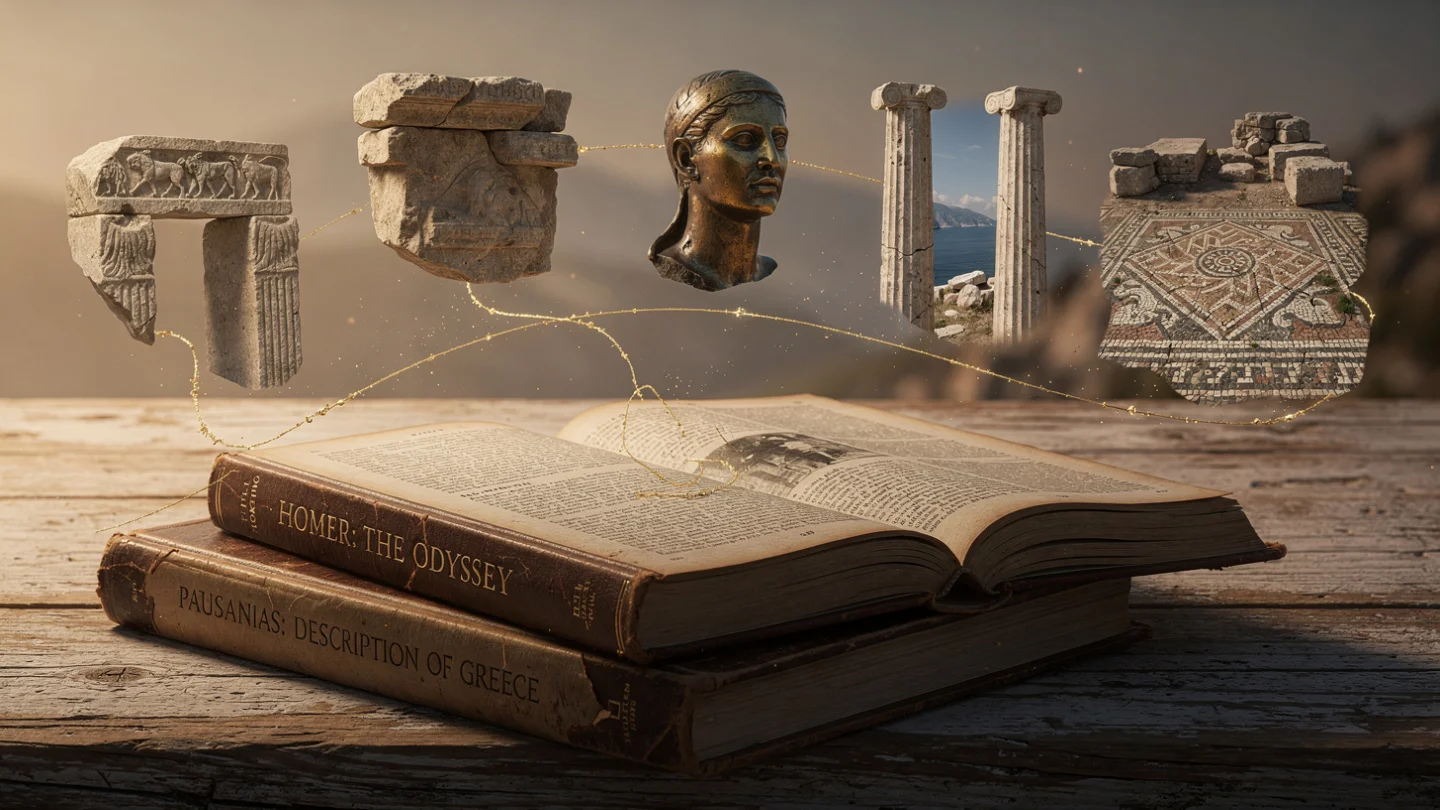
Homer’s Iliad and Odyssey are the foundational texts for everything the visitor will encounter at the Bronze Age sites: Mycenae, Tiryns, Pylos. The Iliad is not easy and the Odyssey is more immediately accessible. Start with the Odyssey if the Iliad feels daunting, and return to the Iliad after seeing Mycenae, when the quality of the world the poem describes will have acquired the material dimension that the palace archaeology provides. The Richmond Lattimore translations are the most faithful to Homer’s qualities. The Emily Wilson Odyssey is the most readable modern English version.
Hesiod’s Theogony and Works and Days are the texts that give the mythological tradition its systematic form: the Theogony is the account of the divine genealogy and the succession of cosmic orders, the Works and Days is the account of the agricultural calendar organized around the constellations and the seasons. Both are short. Both are essential for the visitor who wants to understand what the sanctuaries were for and what the festivals were celebrating.
Thucydides’ History of the Peloponnesian War is the text for Athens and the classical period: the account of the war between Athens and Sparta that ended the fifth century BCE’s extraordinary cultural production is also the account of what Athenian democracy was, how it argued with itself, and what it looked like from the inside during its most catastrophic failure. Book II’s Funeral Oration of Pericles is the most concentrated surviving account of what Athens believed about itself.
Plutarch’s Lives, particularly the lives of Pericles, Themistocles, Lysander, and Alexander, give the major figures of the classical and Hellenistic periods the biographical depth that the archaeological record alone cannot provide. Pausanias’s Description of Greece, written in the second century CE, is the ancient travel guide to the same sites the visitor will encounter: the visitor at Olympia or Delphi or Epidaurus who has read Pausanias’s description of what was there in his time is reading across nineteen centuries to a person who stood in the same place for the same reasons.
Athens | What the Acropolis Actually Is
The Acropolis is not primarily a monument to Greek civilization’s beauty, though it is beautiful. It is the material evidence of a political and theological moment: the period between the Persian Wars and the beginning of the Peloponnesian War, approximately 479 to 431 BCE, in which Athens controlled the Delian League’s treasury and used the allied funds to build the buildings that constituted the most ambitious architectural program in the ancient world.
The Parthenon was built between 447 and 432 BCE under the direction of Pheidias, with Ictinus and Callicrates as the architects, and the qualities of its construction, the optical refinements that the building incorporates to counteract the visual distortions that perfectly straight lines and right angles would produce in a building of this scale, are the most direct material evidence for the quality of intellectual attention that the fifth century Athenian tradition brought to every problem it engaged with. The columns are not straight: they bulge slightly in the middle, the entasis, to prevent the optical illusion of inward concavity that perfectly straight columns would produce. The stylobate, the platform on which the columns stand, is not flat: it curves slightly upward toward the center to prevent the optical illusion of sagging that a perfectly flat horizontal line produces at this scale. The columns are not vertical: they lean slightly inward, toward a point several kilometers above the building, to prevent the optical illusion of outward splaying that perfectly vertical columns produce when seen from below against the open sky.
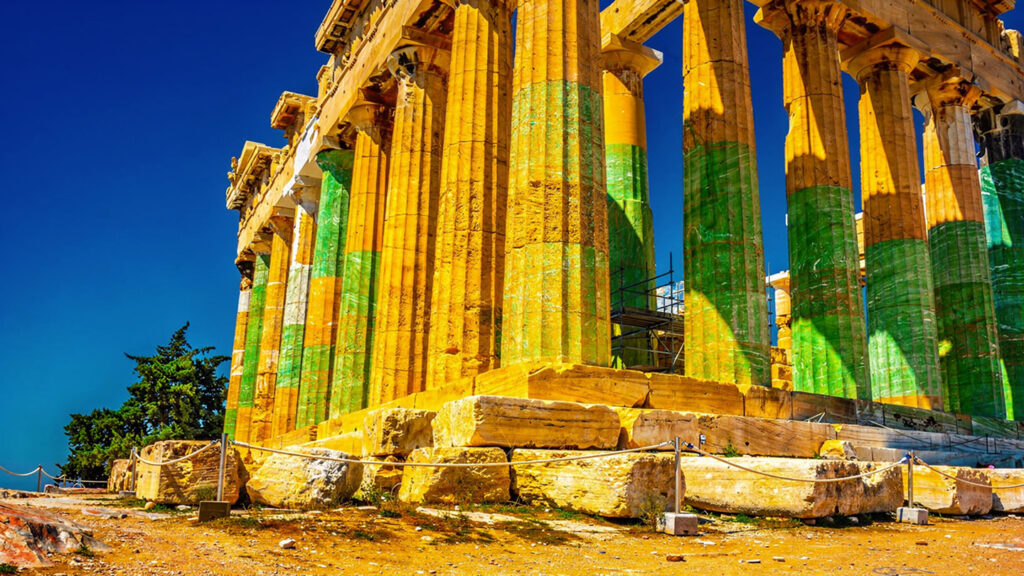
None of these refinements are visible to the naked eye. They are present only in the measurements. The building looks right because the building has been built to be slightly wrong in every dimension that would produce a visual distortion if it were built to be exactly right. This is the intelligence that the Parthenon embodies: not the intelligence of the grand gesture but the intelligence of the meticulous correction, the intelligence that solves the problem that most people would not know existed.
The Acropolis Museum, which houses the surviving sculptural program of the Acropolis in the purpose-built building at the hill’s base, is the visit that many visitors shortchange in the interest of spending more time on the hill itself. The museum visit should come before the hill, not after: understanding what the pediment sculptures depicted, what the frieze was showing, and what the relationship between the mythological program of the building and the political history of the city was, makes the hill visit incomparably richer than the hill visit made without this context.
The Areopagus, the rock immediately west of the Acropolis, is the site whose name appears in the Aeschylean Oresteia as the hill where Athena established the first jury trial, in the New Testament as the place where Paul preached to the Athenians, and in Athenian legal history as the seat of the council that adjudicated homicide cases. It is accessible by a scramble up worn rock and it commands the view across the agora, which is the view that gives the city’s spatial logic its most legible form: the civic and commercial center of the ancient city in relation to the sacred hill above it.
Delphi | The Site That Rewards the Earliest Arrival
Delphi is the site that most completely combines the quality of the landscape with the quality of the ancient institution it housed, and the combination is most available in the early morning of the first day of the visit before the tour coaches arrive from Athens.
The sanctuary is positioned on the slope of Mount Parnassus above the valley of the Pleistos, which is the valley filled with the ancient olive grove that extends from the mountains to the sea at Itea on the Gulf of Corinth. The atmospheric combination of the Phaedriades cliffs rising above the sanctuary, the olive valley below it, and the Gulf of Corinth in the distance at the view’s limit is the combination that makes Delphi the most dramatically sited of the major Greek sanctuaries, and the dawn light on the Phaedriades and the mist in the olive valley below are the quality of the early morning that the afternoon visit on the day of arrival from Athens cannot provide.
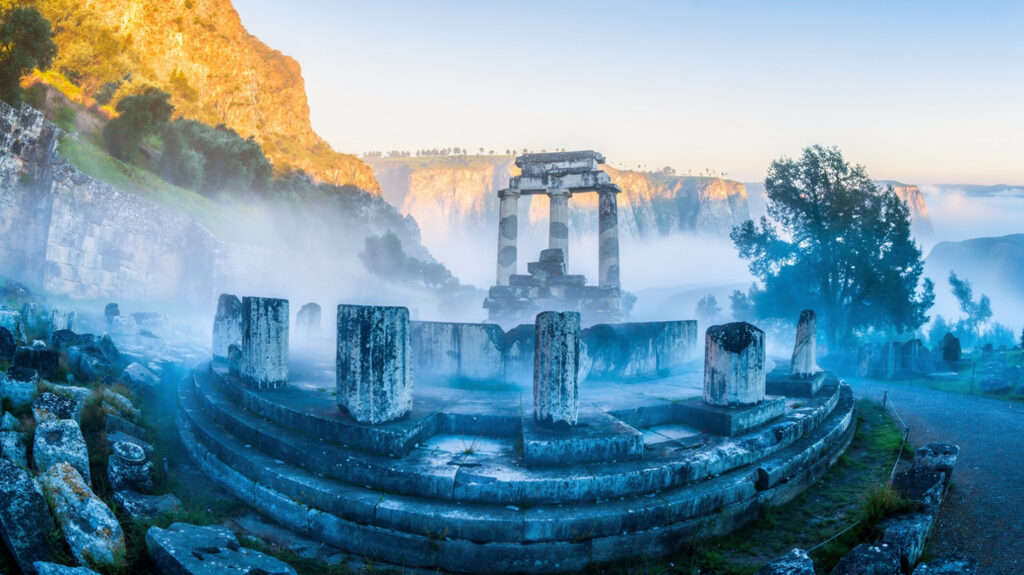
The oracle at Delphi was the institution that governed the major decisions of the Greek world for approximately six centuries, from the eighth century BCE when the sanctuary developed its Panhellenic authority through the end of the classical period. The Pythia, the priestess through whom Apollo spoke, gave her responses in the form of ambiguous utterances that the sanctuary’s professional interpreters, the prophetes, rendered into hexameter verse for the consulting party. The ambiguity was not deception: it was the appropriate form for a communication from the divine to the human, which was necessarily uncertain at the point of delivery because the future was contingent on the choices that the human parties would make in response to what the oracle said.
The Treasury of the Athenians, the small building partway up the Sacred Way whose reconstruction in the early twentieth century gives it the most completely restored appearance of any building in the sanctuary, was built from the spoils of the Battle of Marathon to thank Apollo for the Athenian victory. The inscription on its south wall records the names of Athenians who distinguished themselves in the Persian Wars: the visitor who reads the names is reading the same names that Aeschylus, who fought at Marathon, would have known.
The theater above the sanctuary seats 5,000 and is still used for performances during the European Cultural Centre of Delphi’s annual festival in late June and early July. The stadium above the theater, the site of the Pythian Games, is the furthest point in the sanctuary that most visitors reach, and the furthest from the tour coach timing: a visitor who walks to the stadium in the early morning will have it to themselves.
The Delphi Archaeological Museum at the sanctuary’s entrance holds the Charioteer, the bronze statue of approximately 470 BCE that is among the most completely preserved large-scale bronze sculptures of the classical period. The Charioteer’s glass eyes and the quality of the bronze’s preservation, the original surface visible rather than the oxidation of most ancient bronzes, make the encounter with him the most direct encounter with the original quality of fifth century BCE bronze sculpture available anywhere in Greece.
Mycenae | The Archaeology of the Heroic Age
Mycenae, the palace city whose destruction around 1150 BCE the Greek oral tradition processed into the mythology of the Trojan War‘s aftermath, is the archaeological site that gives the visitor the most direct material encounter with the world that Homer’s poetry describes, and the site where the shock of that encounter is most powerful.
The Lion Gate, the entrance to the palace citadel through which Agamemnon would have walked if Agamemnon existed, is not large by the standards of later Greek monumentality. It is large by the standards of what the human hand could move into place in the thirteenth century BCE, and the quality of the architecture, the three monolithic lintel stones above the gate passage, each weighing tens of tons, placed there by human labor without mechanical assistance, is the quality that the later Greeks processed as the work of the Cyclopes: walls so massive that they could only have been built by giants.
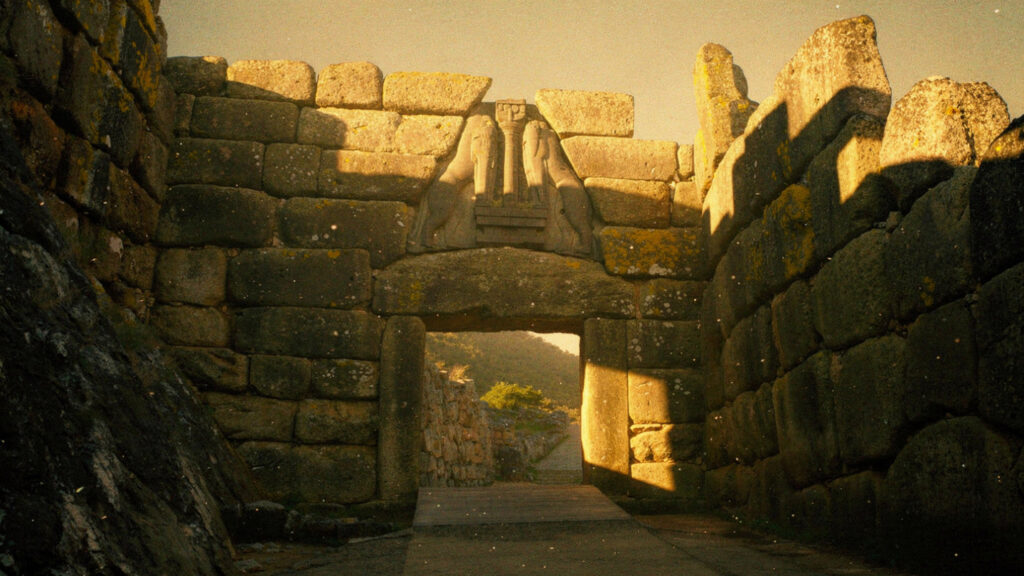
The shaft graves in Grave Circle A, immediately inside the Lion Gate, were the graves that Heinrich Schliemann excavated in 1876 and from which he telegraphed the Greek king that he had found Agamemnon’s gold. He had not found Agamemnon: the shaft graves predate the period of Mycenaean cultural supremacy that the Trojan War mythology describes by approximately three centuries. He had found something more astonishing: the grave goods of the Early Mycenaean elite, gold death masks and inlaid bronze daggers and amber beads from the Baltic and ostrich eggs from Africa, which documented the extraordinary wealth and trading reach of the earliest Mycenaean palace culture.
The Treasury of Atreus, the tholos tomb of approximately 1250 BCE outside the citadel walls, is the building that most completely expresses the Mycenaean tradition’s achievement in architecture: a corbelled vault 13.2 meters in diameter and 13.5 meters high, built without mortar, whose structural integrity depends entirely on the geometry of the corbelling and the earth mounding above it that generates the compressive force that keeps the vault in place. For a thousand years after its construction, it was the largest domed space in the human world.
The National Archaeological Museum in Athens holds the gold finds from Mycenae’s shaft graves, including the death masks, and the visit to Mycenae is incomplete without the museum visit: the objects that Schliemann excavated and that document the material culture of the Bronze Age Aegean elite are in Athens, not at the site, and the site without the objects is the architecture without the culture that created it.
Olympia | The Sacred Enclosure and What It Was For
Olympia was not a city. It was a sanctuary: a sacred enclosure in the valley of the Alpheus in the western Peloponnese that was inhabited only during the festival period of the Olympic Games, every four years, when the athletes and the spectators and the officials descended on the site and the population of the sanctuary swelled to tens of thousands.
The Games were sacred to Zeus, and the combination of athletic competition and religious observance that the Olympic festival combined is the dimension of the ancient Games most completely absent from the contemporary Olympic tradition. The Olympic truce, the diplomatic arrangement that suspended hostilities between the Greek city-states for the duration of the festival and allowed safe passage to the athletes and the spectators traveling to Olympia, was not a humane gesture of sporting brotherhood but a religious obligation: the violation of the truce was a violation of Zeus’s authority, and the Greek states that observed it were observing a divine command rather than a voluntary diplomatic convention.
The Altis, the sacred enclosure at the site’s center, contained the Temple of Zeus and the Temple of Hera and the sacred grove of wild olive trees from which the victors’ crowns were cut. The Temple of Zeus, which was one of the largest temples in the Greek world and which housed Pheidias’s chryselephantine statue of Zeus, ranked by the ancient world as one of the Seven Wonders, was destroyed by a series of earthquakes and floods in the Byzantine period and its columns now lie where they fell, the massive drum sections arranged in lines across the temple floor.
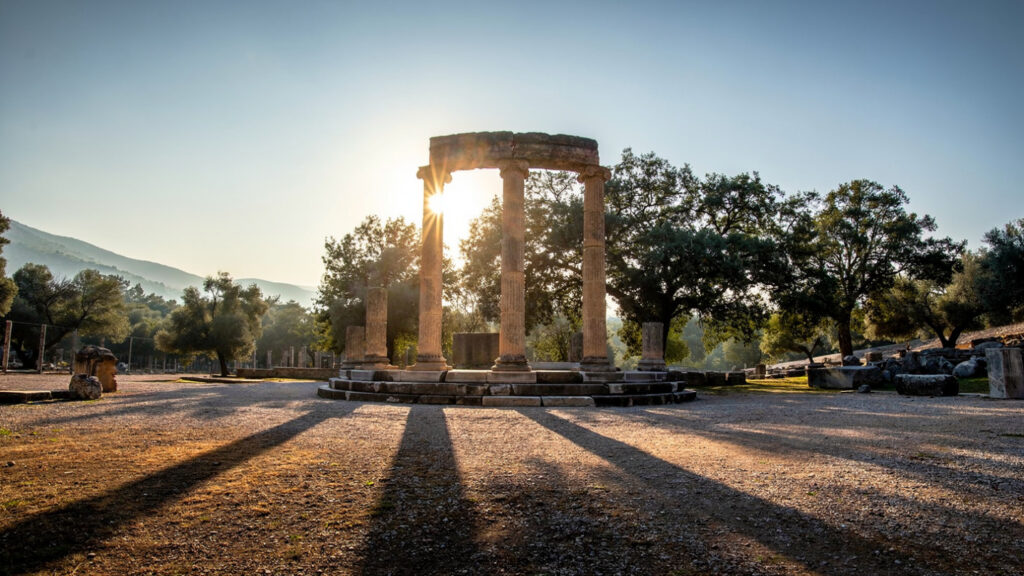
The Olympia Archaeological Museum holds the surviving sculptural program of the Temple of Zeus: the pediment sculptures showing the preparations for the chariot race of Oinomaos and the battle of the Lapiths and Centaurs, and the metopes showing six of the twelve labors of Heracles. The east pediment’s central figure, the standing Apollo with his arm extended in command, is among the most powerful surviving examples of early classical sculpture in its combination of physical authority and formal restraint.
The ancient Stadium, whose 192-meter running track is the length of one stade, the unit from which the word stadium derives, is accessible through the tunnel that leads from the sanctuary to the running track. Standing on the track in the early morning before the visitors arrive is standing on the ground where the ancient world’s most celebrated athletes competed for the victory that made their names permanent in the tradition.
Epidaurus | The Best-Preserved Ancient Theatre in the World
Epidaurus is visited primarily for its theatre, which is the most completely preserved ancient theatre in the Greek world and the site of the most immediate encounter with what Greek theatrical performance was capable of. The theatre seats approximately 14,000 and its acoustics are the acoustics that the site’s geology and the curvature of the cavea produce: a coin dropped at the orchestra, the performance space at the cavea’s base, can be heard clearly in the back row. The Georgia Institute of Technology studied the site’s acoustics in 2007 and identified the filtering effect of the theatre’s limestone seating as the mechanism: the seats absorb low-frequency sounds while reflecting higher frequencies, which suppresses the ambient noise of the audience and allows the actor’s voice to reach the back row without electronic amplification.
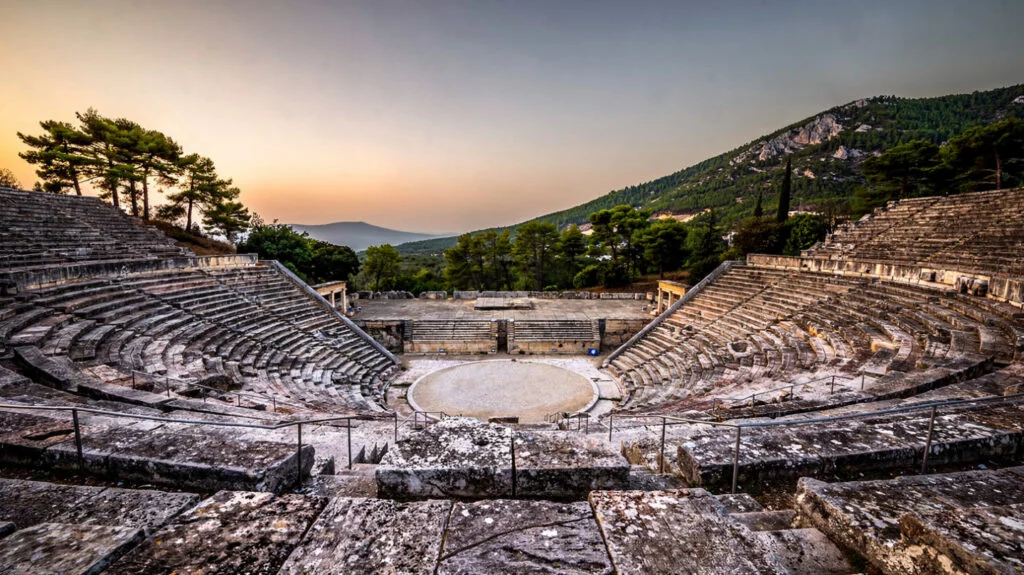
The Epidaurus Festival, which runs from June through August each year and presents ancient Greek tragedy and comedy in the ancient theatre, is the encounter with the performance tradition in its original setting that the visit to the theatre alone cannot provide. The Oresteia of Aeschylus or the Bacchae of Euripides performed in the Epidaurus theatre on a summer night, with the quality of the acoustic and the quality of the Greek summer night sky above the open cavea, is the experience that the ancient audiences who built the theatre were building toward and that the contemporary production makes available again.
The sanctuary of Asclepius, the healing deity whose cult at Epidaurus was the most celebrated in the ancient world, is the larger context within which the theatre operated: the patients who came to Epidaurus for the god’s healing underwent a ritual of incubation in the abaton, the sleeping hall where the god was understood to appear in dreams and prescribe the treatment, and the theatre performances were part of the therapeutic program that the sanctuary offered. The combination of dramatic performance and physical healing was not accidental: the ancient world understood that what happened in the theatre could affect the condition of the body, which is the insight that the contemporary field of psychoneuroimmunology is recovering through entirely different methods.
Dion | The Sacred City at the Mountain’s Foot
Dion, the ancient Macedonian city at the foot of Mount Olympus that served as the sacred city of the Macedonian kings and the site of their most important religious festivals, is among the least visited of the major Greek archaeological sites and among the most rewarding for the visitor who makes the journey.
The archaeological park at Dion is organized around the open-air excavation of a city that was occupied from the archaic period through the early Byzantine period and that preserves a layering of historical periods in a single landscape that the more famous single-period sites cannot match. The sanctuary of Zeus Hypsistos, the sanctuary of Demeter with its marble cult objects still in place, the Roman baths with their mosaic floors in the condition of partially excavated partially preserved archaeological work, and the quality of the agricultural plain between the Macedonian mountains and the Aegean coast that gives the landscape its character, are together an encounter with what a working ancient city actually was rather than what the monument-organized visits to the major sanctuaries present.
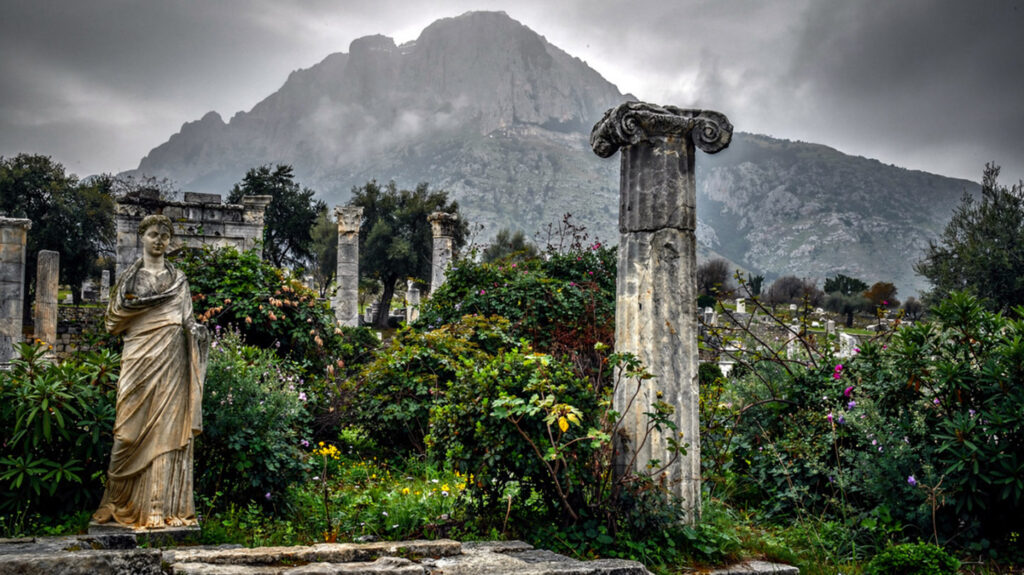
The Dion Archaeological Museum, in the modern village adjacent to the archaeological park, holds the finds from the Dion excavations including the hydraulic organ of the first century BCE, the earliest surviving musical instrument of its kind, and the marble heads of the philosophers whose portraits the excavation recovered. The museum is small enough to be visited without the crowd management that the National Archaeological Museum in Athens requires.
The Itinerary in Practice
The sites described here constitute a fourteen‑day itinerary if each is given the time it deserves. Three days in Athens include the Acropolis Museum, the Acropolis, the Archaeological Museum, and the Agora. Two days in Delphi allow for the early morning visit to the sanctuary and the afternoon at the Corycian Cave above. Two days in the Peloponnese cover Mycenae, Tiryns, and Nafplio. Two days at Olympia provide the necessary time for the sanctuary and the museum. One day at Epidaurus is sufficient for the theater and the Asklepieion. Two days at Dion and the foot of Mount Olympus complete the northern section. Two additional days are reserved for travel between these regions and for the inevitable discoveries that no planned itinerary accommodates.
The Peloponnese, Athens, and Delphi are interconnected by a road network that makes self-driving the most flexible option. Dion and Mount Olympus require a separate leg to the north, most naturally organized as a direct rail or road journey from Athens to Thessaloniki followed by a local journey to the Olympus region.
The reading that the article’s opening section recommends is not optional preparation for this itinerary. It is the itinerary’s first phase. The visitor who has not read Homer before seeing Mycenae has seen a very impressive collection of ancient stones. The visitor who has read Homer before seeing Mycenae is standing in the ruins of the world the poems describe, and the distance between those two experiences is the distance between a destination and a civilization.
At Olympus Estate, Wanderlust Greece guides you across the sacred and storied terrain of the Hellenic world. The serious engagement with Greece begins before you arrive, in the reading that makes the landscape legible when you get there. The Lion Gate at Mycenae is not more impressive than the photographs suggest. What the photographs cannot convey is what the gate meant. That meaning is available only to the visitor who arrives prepared. Start with the Odyssey. Book the flight. Go slowly.