

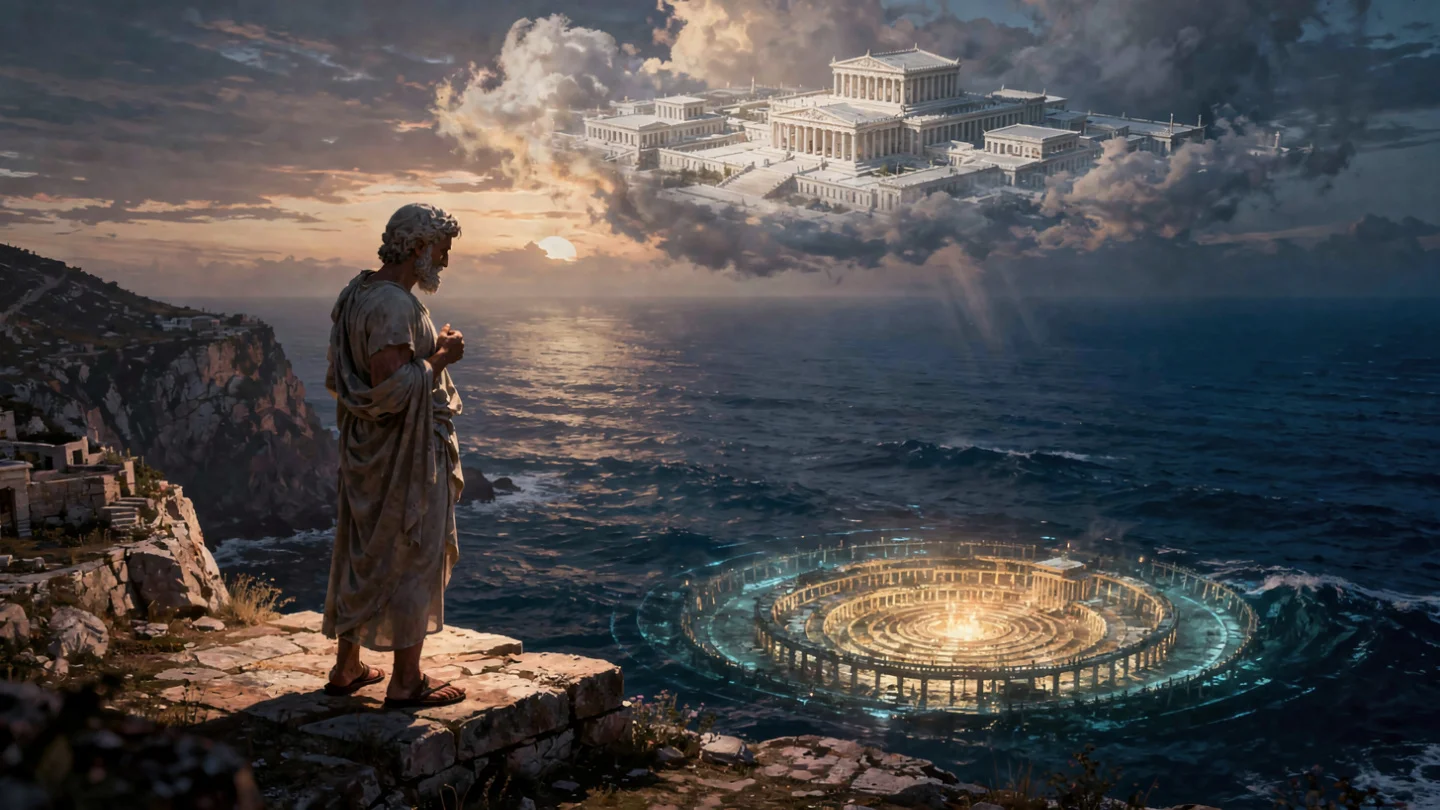
Plato was not writing about a city.
He was writing about what happens to the forces that the gods defeated but could not destroy, and what happens to the civilisation built on top of them.
The Atlantis of the Timaeus and Critias, the two late dialogues in which Plato presents the story through the voice of an Egyptian priest speaking to Solon of Athens, has generated two thousand years of treasure-hunting and geographic speculation that has almost completely obscured what the text is actually doing. The search for a real Atlantic island, for a sunken Bronze Age civilisation, for the geological event that might have inspired the myth, has proceeded in parallel with almost no serious engagement with the question of why Plato, who was not a geologist or a folklorist but a philosopher, chose to describe a city whose spatial organisation maps with extraordinary precision onto the cosmological architecture he had inherited from Hesiod.
The concentric rings of Atlantis are not an architect’s innovation. They are a philosopher’s argument. And the argument is about containment.
What Hesiod Built First
The Theogony describes the defeat of the Titans in terms whose spatial logic Plato will later repeat in a different register.
Zeus and the Olympians defeated the Titans in a ten-year war whose violence was cosmic in scale: the earth burned, the sea boiled, the sky shook, the roots of the underworld were shaken by the impact of the fighting. When the Olympians prevailed, they faced the problem that defines every victory over a force that cannot be annihilated but only subdued. The Titans were not destroyed. They were too fundamental for destruction. They were the generation of divine beings that preceded the Olympian order, the embodiment of the raw elemental forces that the cosmos contained before consciousness and reason and the divine will of Zeus organised it into something navigable.
You cannot unmake an elemental force. You can only contain it.
Hesiod describes the containment: a bronze fence encircling Tartarus, iron gates, the earth and the barren sea forming walls above it, the Titans sealed in the abyss beneath the roots of both. The structure is layered, with each layer adding to the security of what lies at the centre. Poseidon maintains the bronze gates.
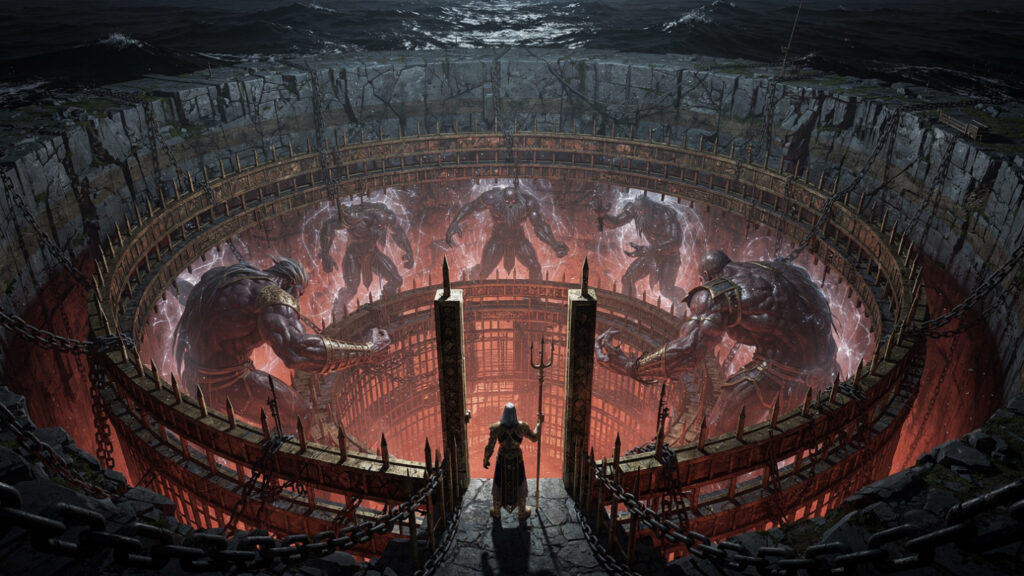
The spatial grammar here is: rings of enclosure around a volatile centre. Multiple barriers. Each barrier adding a level of separation between what is inside and what the world outside would become if what is inside were to get out.
Plato, writing two centuries after Hesiod, inherits this spatial grammar and rebuilds it at the scale of a city.
The City That Should Not Work
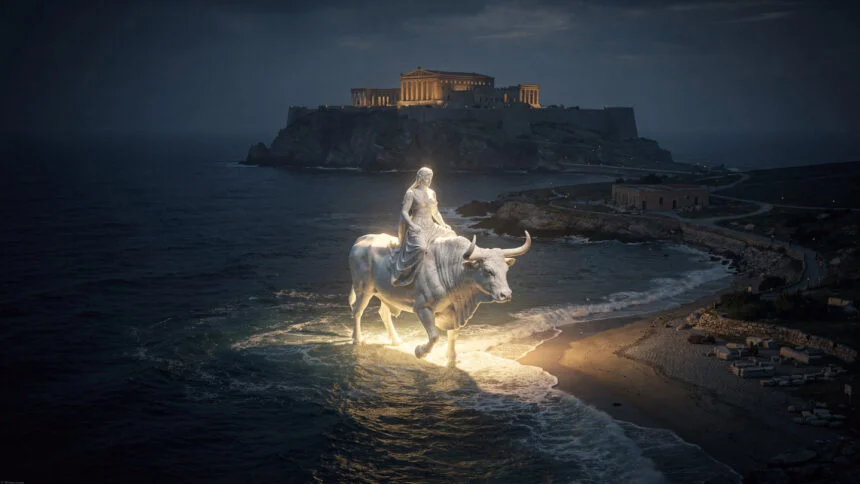
Poseidon creates Atlantis by isolating the hill where his mortal lover Cleito lives: he surrounds it with alternating rings of water and land, three of water and two of land, carving them from the surrounding earth with what Plato describes as divine engineering. The city grows outward from this concentric foundation, the most sacred and most ancient space at the centre, the later developments layering outward ring by ring.
As urban design, this configuration produces significant practical problems. Concentric rings restrict movement between districts. They make overland transport inefficient. They create a geometry that consistently returns to its own centre rather than connecting outward to the wider world the city trades with. They are the geometry of the fortification rather than the geometry of the commercial city.
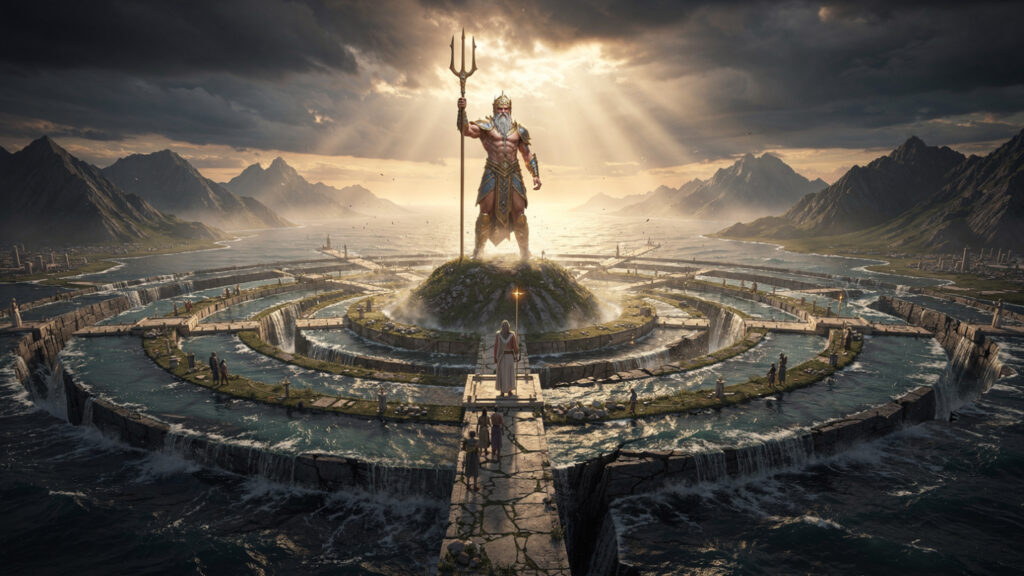
Plato understood this. He was a careful reader of the intellectual heritage he belonged to, and the city planning of the ancient world was not obscure to him. The concentric geometry of Atlantis is not a failure of imagination. It is a philosophical choice. Its model is not found in the city planning heritage but in the cosmological lore of Hesiod.
The violent, elemental force at the centre. The layers of containment around it. The divine architect who built the containment. The concentric structure is the structure of Tartarus, scaled up and given a human civilisation as its surface.
What lives at the centre of Atlantis? Plato says Cleito, and later her descendants, and the great temple of Poseidon. What lives at the centre of Tartarus? The Titans.
The two texts are in conversation. Plato is not repeating Hesiod. He is asking what a world looks like that was built on top of the problem Hesiod described.
Poseidon as the Architect of Containment
The choice of Poseidon as the founder and divine patron of Atlantis is not arbitrary. This argument becomes clearer when Poseidon is understood as the deity he was in archaic Greek mythology rather than the figure he became in popular imagination.
The Poseidon of the early tradition was not primarily a god of sailing and sea commerce. He was Ennosigaios, the earth-shaker. His domain was the deep geological movement of the earth’s crust, the seismic force that splits mountains and opens fissures and causes the land to convulse. His trident was not a fishing implement but the instrument of crustal rupture, the tool that drives into the earth and tears it.
This is precisely the domain required for the task of containing Titans. The Titans as Hesiod describes them are elemental forces: Kronos as the force of deep time, Iapetus as the force of the mortal span, Hyperion as the force of the sun before Apollo disciplined it into reason and light. These are not beings that can be imprisoned by the authority of the sky. Zeus’s lightning operates in the upper atmosphere. The containment of chthonic forces requires chthonic authority.
Poseidon is the deity whose power reaches into the deep structure of the earth, whose domain includes the geological violence that the Titans embody at the mythological level. If anyone among the Olympians was capable of building a structure that would hold the primordial against its will, it was the earth-shaker, whose authority is the authority of geological force itself.
He built Atlantis. He maintained its rings. He chose the location in the deep Atlantic, beyond the Pillars of Heracles, at the furthest accessible edge of the known world.
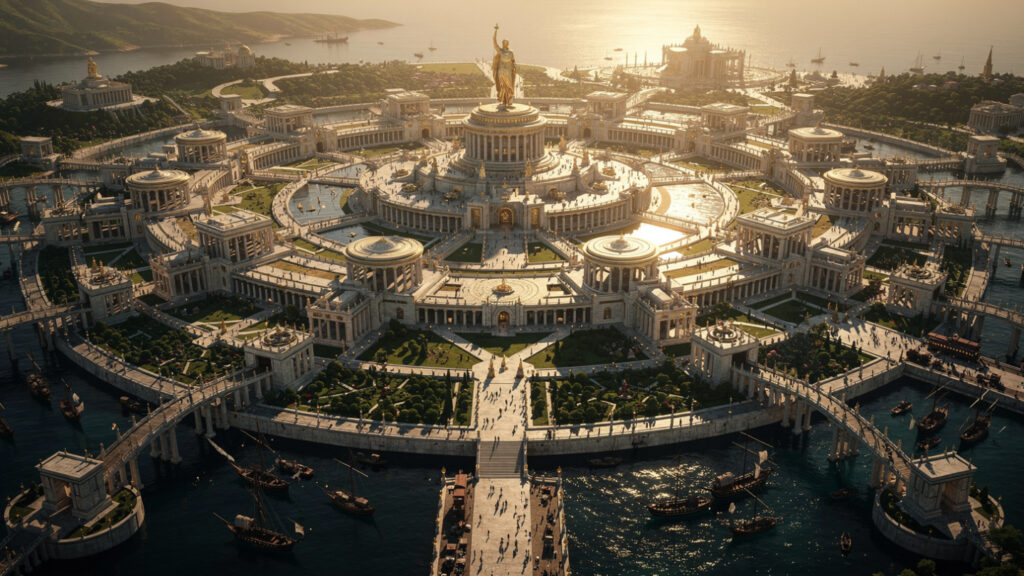
The Pillars of Heracles were understood in the ancient world as the boundary between the navigable world and what lay beyond it. Plato places Atlantis beyond that boundary deliberately. The city that is the container of the old world’s forces is placed where the world ends, at the edge of what is known and governable. This is not geographic imprecision. It is philosophical precision.
The Human Civilisation on Top of the Vault
The Atlanteans, in Plato’s account, were the descendants of Poseidon and Cleito: part divine, part mortal, the offspring of a god who built a containment system and then chose to live inside it with a woman he loved.
For many generations, the divine blood held. The Atlanteans were wise, moderate, possessed of a virtue proportionate to their divine inheritance. They maintained the conditions of the city with the reverence that the city’s original purpose required. They were, in the mythological logic of the narrative, the guardians of the container, the human face of the containment system, the civilisation whose moral quality was the living expression of the structure’s integrity.
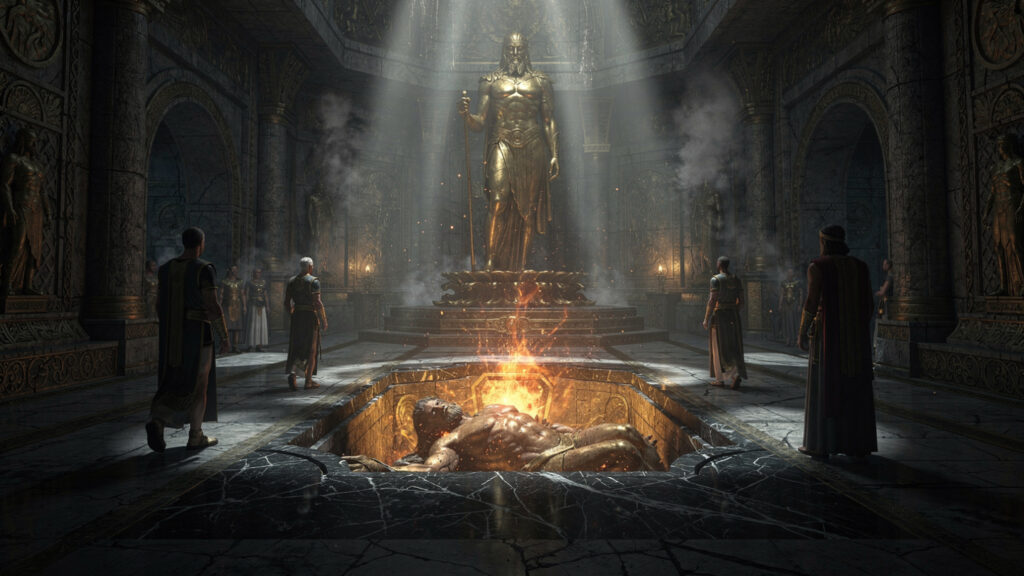
Then the divine blood diluted. Human nature, less capable of the sustained virtue that divine nature could maintain, began to assert itself. Plato describes the corruption in terms that are explicitly about proportion: the Atlanteans began to acquire more than their portion allowed, to seek dominion over territories that were not theirs, to subordinate the divine inheritance to the human appetite for accumulation and power.
This is, at the philosophical level, the same mechanism that Nemesis governs. The distribution has been violated. The portion has been exceeded. The structure that depends on the maintenance of proportion has been put under the pressure of disproportionate ambition.
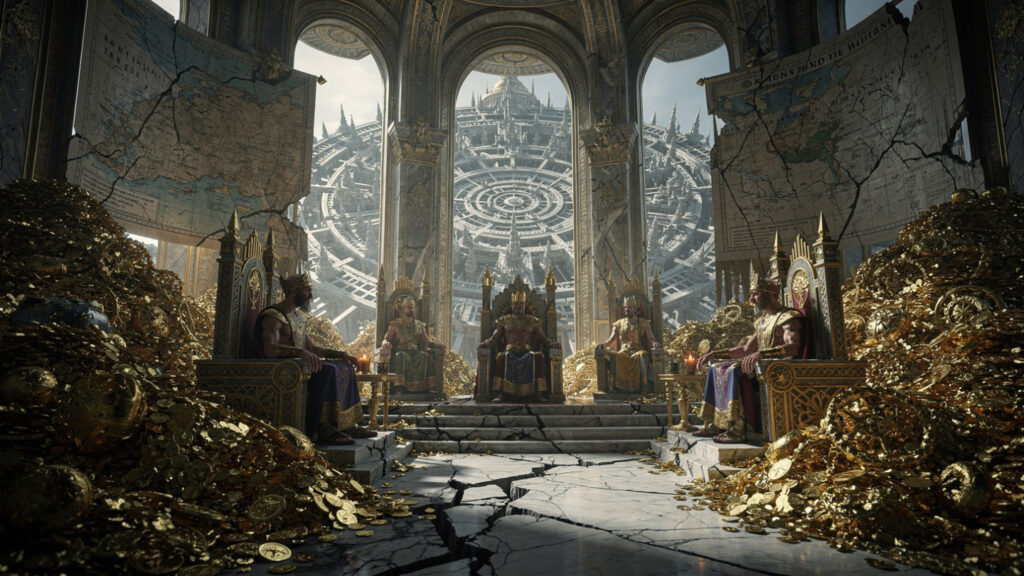
The story of the divine blood thinning in the Atlanteans and the subsequent moral corruption is not a simple allegory about the dangers of wealth and power. It is a myth about what happens when the guardianship of a cosmological structure is entrusted to beings whose nature is not adequate to the indefinite maintenance of the vigilance the structure requires. The containment does not simply require physical barriers. It requires the continuous moral attention of those who inhabit it and maintain it. When that attention fails, the barriers are not immediately compromised, but their integrity is undermined at the level where the human and the structural meet.
The Sinking and What It Was Not
Plato describes the destruction of Atlantis as a single day and night of extraordinary violence: earthquakes and floods simultaneously, the island dragged into the sea, the ocean closed over it, and the location rendered impassable afterward, a shallow muddy expanse that prevented navigation in that direction for generations.
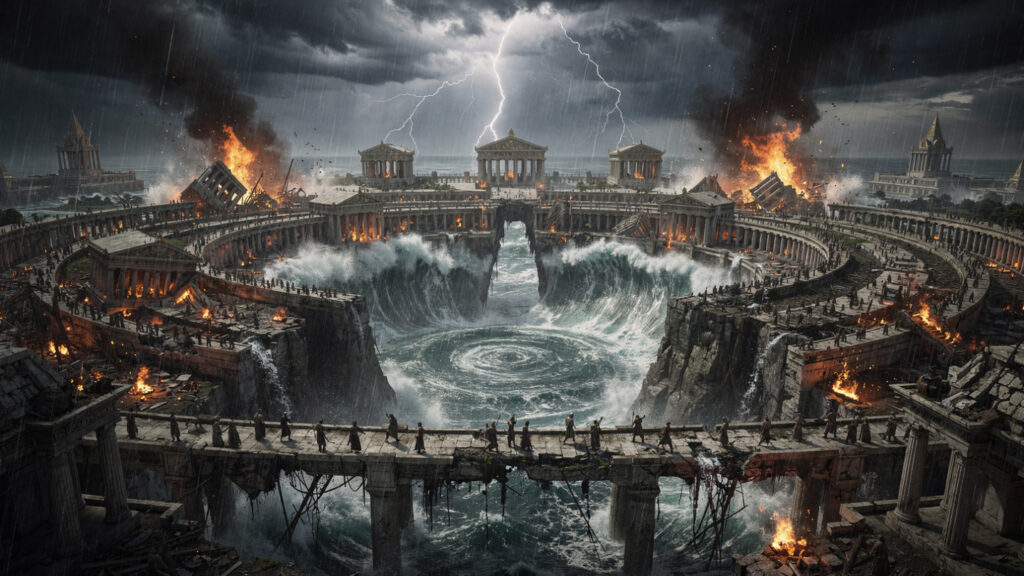
The conventional reading presents this as divine punishment for the Atlanteans’ moral failure: Zeus saw their corruption, called the gods to council, and the destruction followed.
But Plato’s text is more than this reading allows, and the specificity points in a different direction.
The destruction is geological: earthquakes and floods. Not lightning bolts, not divine armies, not the forms of divine punishment that the mythology applies to individual moral failures. The form of the destruction is Poseidon’s domain, not Zeus’s. It is crustal movement and the sea.
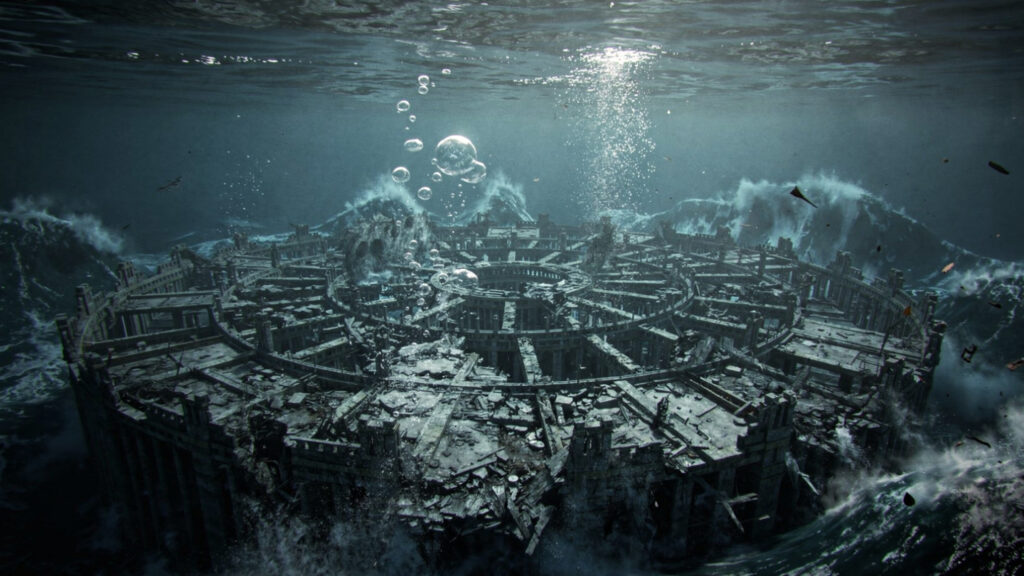
In the cosmological reading, the sinking of Atlantis is not punishment administered from above. It is the structure failing from below: the pressure inside the containment system, increased by the degradation of the human guardianship over generations, eventually exceeding what the rings of water and land and the concentric walls could hold. The response is Poseidon’s, and it is the only response available to the architect of a containment system when the system reaches critical failure: complete closure of the structure, the total submersion of the island, the sea as the final and absolute seal.
The violence that destroys Atlantis comes from the same direction as the force it was built to contain. This is not the form that divine punishment takes in the Greek tradition. It is the form that containment failure takes.
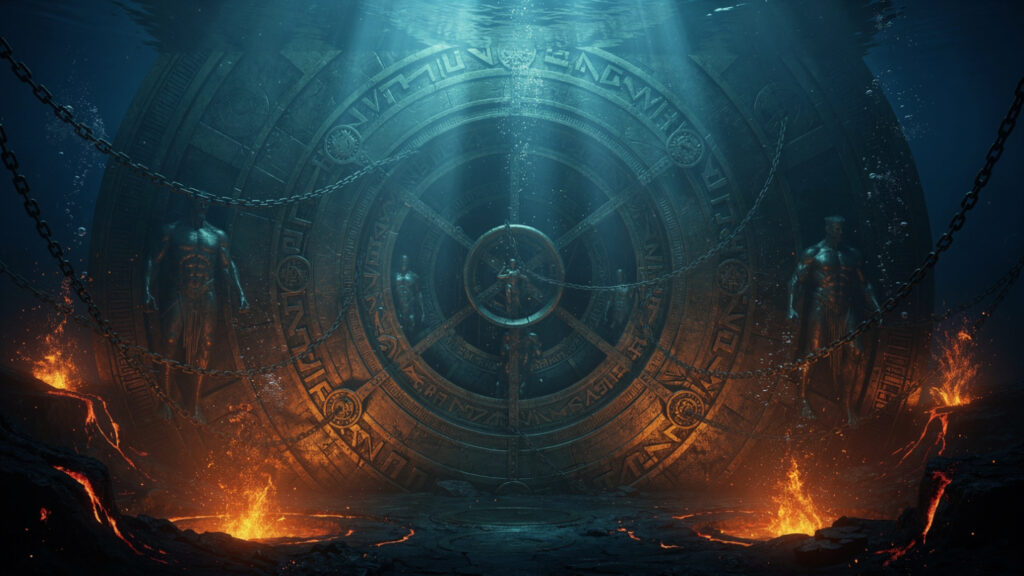
The Titans were not released. The containment was collapsed rather than breached. This is the most important detail in the myth, and it is the one most consistently overlooked: Atlantis sank. It did not explode outward. The forces inside did not escape into the world. The entire structure went down together, taking the guardians and the guards and the rings and the walls and everything built on top of the problem into the abyss that was always waiting at the bottom.
The sea closed over it. Navigation in that direction became impossible.
The vault is sealed. The problem is still there.
What Plato Was Actually Worrying About
The dialogues in which Atlantis appears, the Timaeus and the Critias, are late works written when Plato was old and the political experiments of his life, including his disastrous involvements with the tyranny of Syracuse, had demonstrated repeatedly that the ideal state he had described in the Republic was not available in the actual world of human governance.
The Atlantis myth appears in this context as a meditation on the relationship between the ideal and the actual, between the virtuous constitution and the human nature that inevitably degrades it, between the cosmic order that the Olympians established and the forces that the cosmic order is built on top of and must continuously contain.
Athens, in Plato’s account, was the virtuous city that the Atlanteans attacked and that the Athenians of the legendary time successfully defended. This Athens has been forgotten: the geological catastrophes that destroyed Atlantis also destroyed the records of the Athenian virtue that defeated it, leaving only the Egyptian records that the priest recites to Solon.
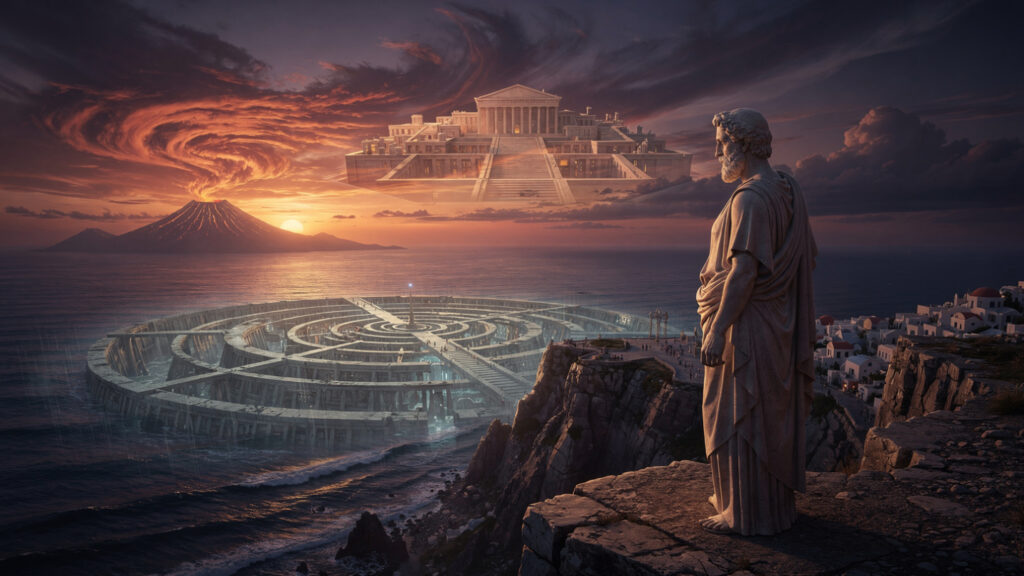
This is a myth about forgetting as much as it is a myth about catastrophe. The virtuous past is inaccessible not because it did not exist but because the catastrophes of the natural world, the same geological violence that expressed the pressure of the contained forces, have erased the human records that carried it. Philosophy, in Plato’s understanding, is the attempt to recover what has been forgotten: the original form of justice and virtue that the human world once expressed and that has been buried under the accumulated degradation of the generations since.
Atlantis is the myth he builds to explain why the recovery is difficult. The forces that made the virtuous past possible are the same forces that also produced the catastrophes that destroyed its record. The volcanic violence that built the Aegean world and made it habitable is the same volcanic violence that expresses the pressure of what the Olympian order contains beneath the surface. The world is beautiful and the world is dangerous for the same reason.
The Volcanic Landscape Beneath the Myth
The Greek world that Plato inhabited was a volcanic world. The Hellenic Arc, the chain of volcanic islands from Methana to Nisyros, sat above the subduction zone where the African plate descends beneath the Aegean. The landscape was shaped by forces that operated at a depth and scale entirely beyond human control or comprehension. The earthquakes that Poseidon caused were real. The caldera that formed when the Thera eruption collapsed was real. The tsunamis were real.
The Greek mythological tradition’s insistence that these forces were not simply geological, that they expressed the activity of divine and primordial beings operating beneath the surface of the ordinary world, was not naive superstition. It was the recognition that the beautiful and habitable surface of the Mediterranean world rested on processes of extraordinary violence, and that the relationship between the ordered surface and the violent depth was not stable but maintained, and maintained by something, and that the something had a character and could be addressed and needed to be acknowledged.
The myth of contained Titans, of divine war and cosmic imprisonment and the structures built to hold what cannot be destroyed, is the Greek tradition’s most complete philosophical account of what it means to live in a landscape shaped by forces that preceded human presence and will outlast it. Plato’s Atlantis is not an allegory about a historical catastrophe. It is a meditation on the permanent condition of a civilisation built on top of what it has not resolved.
The vault is sealed. The sea is calm. The problem is still there, at the depth where Poseidon’s authority reaches, where the bronze walls of Tartarus hold, where the defeated forces of the old world press against their containment in the darkness beneath the roots of the earth and the salt sea.
This is what Plato saw when he looked at the Aegean.
He built a city around it so that others could see it too.
At Olympus Estate, Tales from Olympus reads Greek myth as argument rather than decoration. This article treats Atlantis not as a lost geography but as Plato’s cosmological case for why order is always provisional, a civilisation built on forces the gods defeated but could not destroy, returned to the sea as the necessary consequence of its own excess. The question Plato poses has no island and no treasure map. It has a warning about what every founded city rests on.