
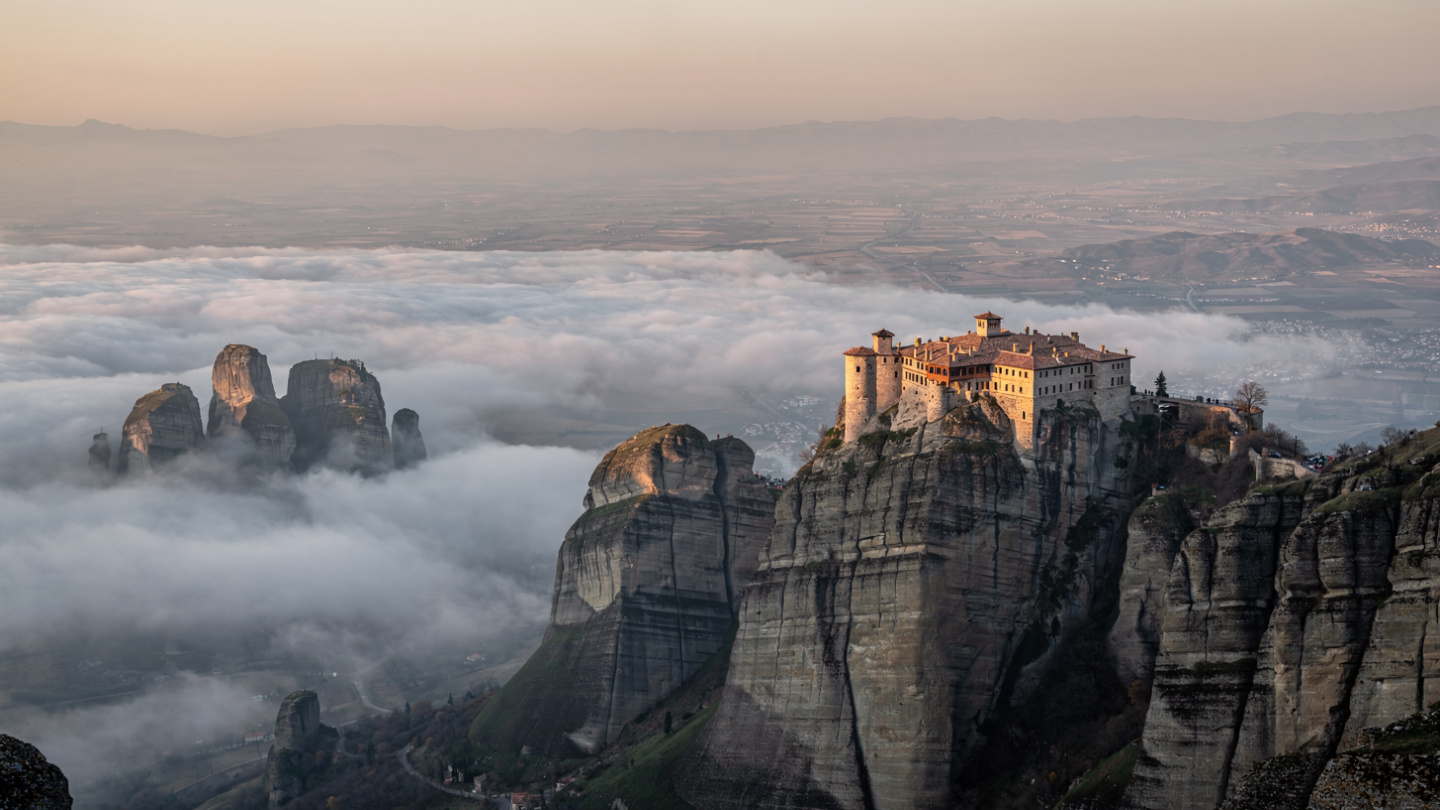
The rock came first, and it took sixty million years.
The sandstone pillars of Meteora were formed when a prehistoric inland sea began its long withdrawal from the Thessalian basin, leaving behind the sedimentary deposits that tectonic pressure and sixty million years of erosion shaped into the formations visible today: monolithic columns and massifs of grey sandstone rising to 400 meters above the plain of Thessaly, their surfaces worn into the texture of very old, very hard stone that has been worked by water and wind across a timescale that makes human history appear as a single afternoon.
The hermits who arrived in the ninth century CE and began carving caves into the lower cliff faces were not the first to understand that something was happening in this landscape. The geological forces that produced the pillars also produced a quality of elevation and separation from the plain that the ascetic tradition had been seeking since its earliest development in the Egyptian and Syrian deserts: a place where the ordinary world could be left behind not only spiritually but physically, where the body’s ascent through difficult terrain was the material expression of the spiritual ascent that the ascetic life sought to enact.
They climbed, found the wind and the view and the silence that very high places produce, and stayed.
The Word and What It Describes
The word Meteora comes from the Greek meteoros, meaning suspended in the air or lifted on high, the same root that gives the natural world its meteors and meteorology and the observation that things high above the earth behave according to principles different from those that govern things on the ground.
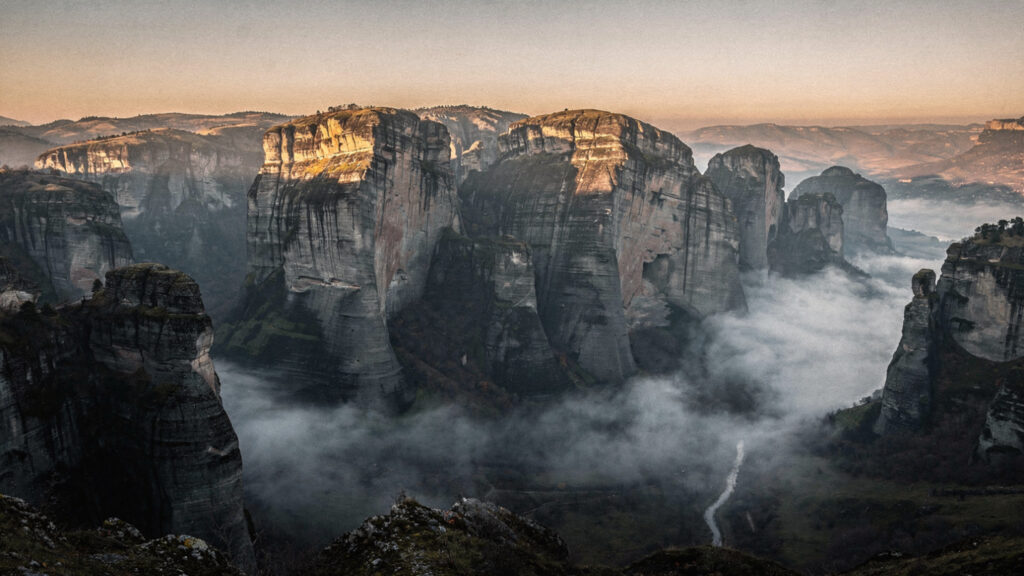
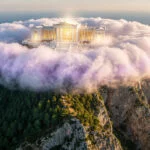
The word is exactly right for what the formations are. Standing in the plain below and looking up at the Great Meteoron on its mesa of stone, the monastery does not appear to be resting on the rock. It appears to float above it, the grey stone of the building continuous with the grey stone of the cliff face but somehow weightless in the quality of the Thessalian light, particularly in the early morning when the mist that the plain generates in the cooler months collects in the ravines between the pillars and leaves the monasteries visible above it as though the plain below did not exist.
The geological origin of this visual effect is the profile of the sandstone pillars: their bases are narrower than their tops, the erosion having removed more material from the lower portions where the wind and water worked most consistently across the longest time, so that the cliff faces overhang their bases and the buildings on their summits are set back from the edge in a way that makes them invisible from the plain until the viewer has moved far enough out to see over the overhang. The monastery that seems to appear from nothing as the viewer walks the plain road is the monastery that has always been there, above the overhang, now revealed.
The First Communities
The history of the Meteora monasteries does not begin with the monasteries. It begins with the individual hermits who inhabited the cave formations in the cliff faces from approximately the ninth century onward, living in the severe simplicity that the ascetic tradition of the Orthodox east had developed in the desert communities of Egypt and the Syrian wilderness and transmitted northward through the Athonite monastic communities of Mount Athos.
What the Meteora offered the ascetic tradition that the flat terrain of most of Greece could not provide was the quality of physical inaccessibility that the most committed ascetics sought: the separation from the world that the desert hermit achieved through distance, the Meteora hermit achieved through height. The climb to the cave required effort and skill. The maintenance of life at the height required constant attention to provisions that had to be raised from below. The isolation was not the isolation of the desert, which is the isolation of horizontal distance, but the isolation of vertical distance, which is more immediately and more continuously felt in the body.

The transition from individual hermitage to communal monastery, which occurred at Meteora in the late fourteenth century, was the same transition that the Athonite tradition had made several centuries earlier: the recognition that the monastic community could sustain the forms of spiritual life that the individual hermit could only maintain intermittently, because the community provided the liturgical structure, the mutual support, and the practical division of labor that allowed the spiritual work to continue through the vicissitudes of weather, illness, and age that the solitary hermit faced without assistance.
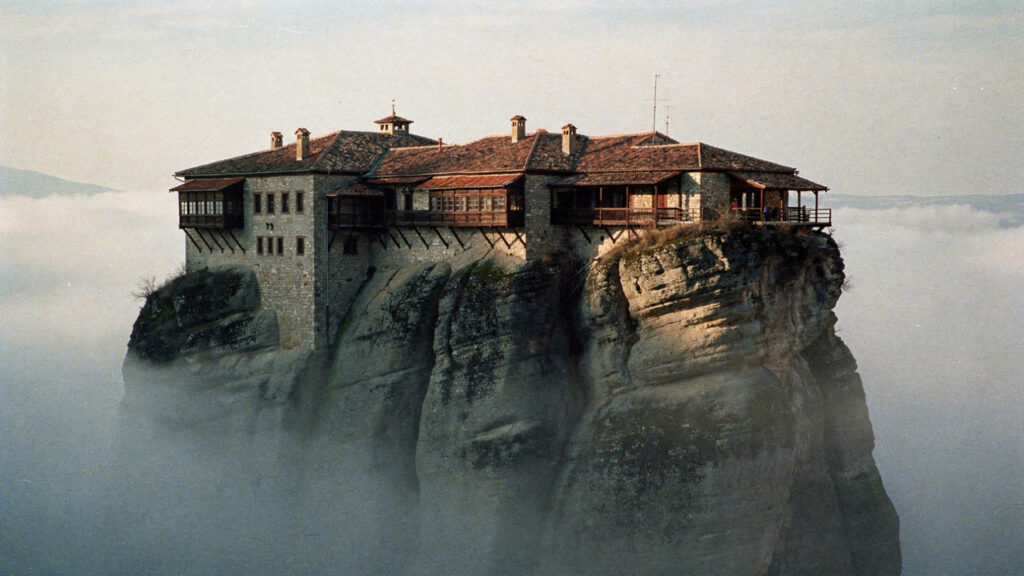
The monks who arrived from Mount Athos to establish the first true monasteries at Meteora brought with them the practice of Hesychasm. This contemplative form of interior prayer, articulated and defended by Gregory Palamas during the theological controversies of the fourteenth century, centered on the Prayer of the Heart. It was a method of inner attention that the Orthodox monastic community viewed as the path toward directly experiencing the divine light revealed during the Transfiguration on Mount Tabor. The dedication of the Great Meteoron to the Transfiguration was not a random choice. It encoded the entire theological mission of the community that built it.
Construction on the Impossible
The practical question of how the monasteries were built is among the most immediately arresting aspects of Meteora, and the answer is one that the builders themselves would have understood as a continuous act of faith rather than a logistical achievement.
Every stone, every timber, every vessel of water, every tool, every icon, every candle, every gram of food for the workers: all of it was raised by hand from the plain using rope nets suspended from hand-turned winches anchored at the summit. The winch systems that survive in the monasteries are not the originals, which were made of materials that did not outlast the medieval period, but they are the same functional design: a hand-operated drum around which the rope wound as the load was raised, with no mechanical advantage beyond what the diameter of the drum provided.

The rope nets that carried loads and, when necessary, people, were made from plant fibers and had the lifespan of plant fiber under the conditions of rope work: they frayed, they weakened, and occasionally they broke. The tradition that ropes were replaced only when they broke rather than on a scheduled basis is recorded in the accounts of visitors to the monasteries in earlier centuries, and the spiritual interpretation that the monks gave to this policy, that the timing of replacement was God’s decision rather than theirs, reflects the theological framework within which the practical decisions of monastic life were understood.
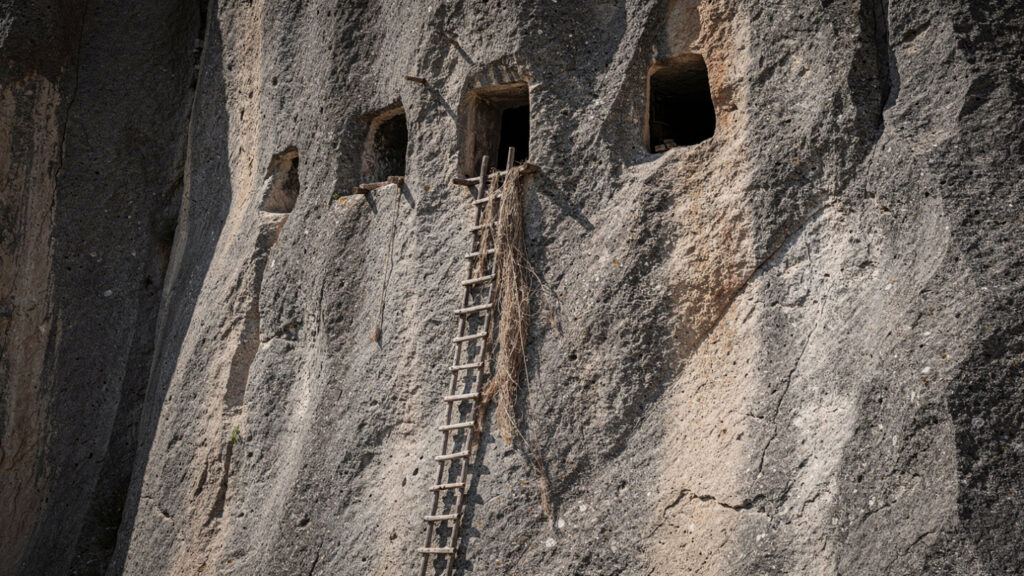
The construction that these conditions produced is the construction visible in the monasteries today: buildings that used the topography of their summit sites with complete economy, adapting to the available flat surface and the configuration of the rock rather than imposing a regular plan on an irregular site, producing the compact, multi-level, organically organized structures that the summits permitted and that photographs consistently fail to convey in their actual scale.
The Sixteen Centuries and the Six That Remain
At their peak in the sixteenth century, twenty-four monasteries were operating at Meteora, and the population of monastics was larger than it has ever been since. The prosperity that this period represented was the prosperity of the late Byzantine and immediately post-Byzantine world: the donations of Byzantine nobles and the patronage of the Orthodox rulers of the Balkans, who saw in the Meteora monasteries both a spiritual investment and a cultural institution whose manuscript libraries and artistic workshops produced objects of lasting value.
The decline that followed the Ottoman consolidation of control over Thessaly was a decline in resources and population rather than in commitment: the monasteries that could no longer maintain the minimum community required for full liturgical life were abandoned to gradual decay, and by the twentieth century the number of active monasteries had contracted to a small fraction of the sixteenth-century peak.

The restoration that the twentieth century undertook was the restoration of the physical fabric and the resettlement of the communities: monks and nuns returned to monasteries whose walls required substantial repair, whose frescoes had deteriorated in the absence of the maintenance that continuous habitation provides, and whose practical connection to the plain below required the infrastructure, roads and steps cut into the rock faces, that the previous centuries had not supplied.
Today six monasteries are active: the Great Meteoron on the largest and highest mesa, Varlaam immediately adjacent to it, Holy Trinity on its slender pinnacle requiring 140 steps of cut stone to reach, Roussanou now a women’s convent whose three-tiered structure is reached by suspension bridge, St. Nicholas Anapausas at the lowest elevation with its frescoes by the Cretan painter Theophanes the Monk, and St. Stephen’s, the most accessible, connected to the cliff road by bridge and without the climbing that the other monasteries require.

Each of the six is a functioning monastery rather than a museum: the communities that inhabit them maintain the daily cycle of prayer that defines monastic life, the Orthros at dawn, the Divine Liturgy in the morning, the Vespers in the evening, and the Compline before the night’s rest. The tourist who enters during the visiting hours is entering a community’s home and place of worship rather than a historical exhibit, and the quality of the experience that this produces, the encounter with a living tradition rather than a preserved one, is what distinguishes Meteora from the purely archaeological sites that most of Greece’s significant cultural destinations provide.
The Frescoes and What They Contain
The painted interiors of the Meteora churches are among the finest surviving collections of post-Byzantine fresco painting in Greece, and their importance is partly due to the conditions of their preservation: the enclosed, high-altitude, low-humidity environment of the monastery interiors has protected the paint layers from the deterioration that frescoes in the valley churches of the Thessalian plain have suffered from moisture and temperature variation.
The frescoes of St. Nicholas Anapausas, painted in 1527 by Theophanes the Monk, who also worked at the Vatopedi and Lavra monasteries on Mount Athos as well as at other monasteries of Meteora, hold immense artistic significance. Theophanes ranked among the foremost painters of the Cretan School, a style of icon and fresco production that emerged in the post-Byzantine period under Venetian rule in Crete. This school offered the most technically sophisticated continuation of the Byzantine aesthetics available following the events of 1453. The quality of Theophanes’ work at St. Nicholas, evidenced by the clarity of his drawing, his palette of warm ochres and cool blues, and his mastery of Byzantine compositional conventions, makes the narrative programs of the church interior remarkably legible. He achieved this without sacrificing the iconic quality that theological doctrine required, offering an experience within the small, compressed space of St. Nicholas that larger and more frequently visited monasteries cannot replicate.
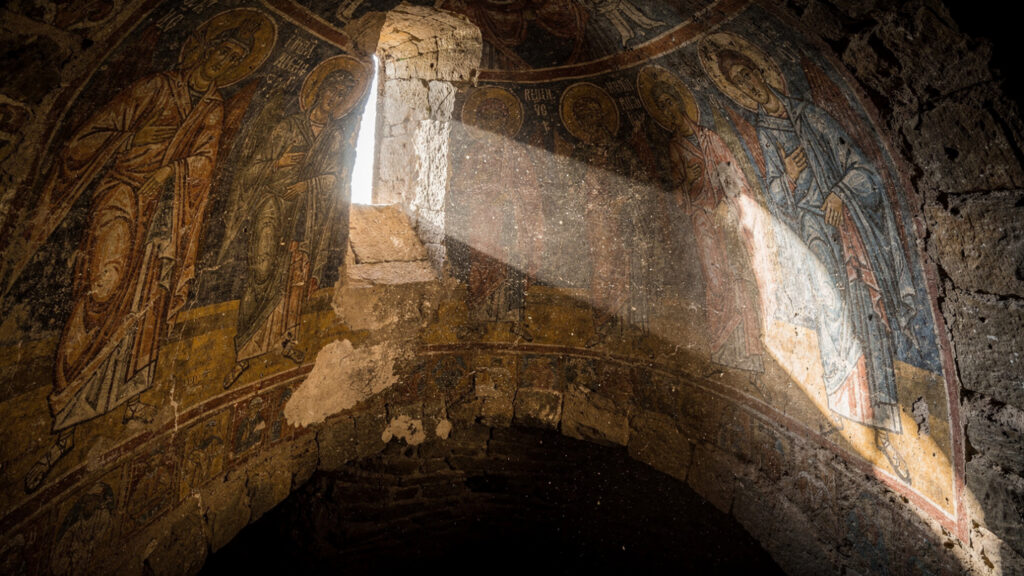
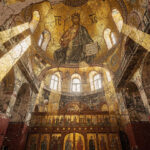
The Great Meteoron’s frescoes, painted in the sixteenth century and substantially restored in the twentieth, are the most extensive decorative program surviving in the Meteora monasteries and include the martyrdom cycles, the images of saints in the sequence of the liturgical calendar, and the Last Judgment in the narthex that the Byzantine church painting tradition consistently placed at the entrance to the nave: the image of divine judgment greeting the worshiper as they enter the church, preceding the liturgical celebration of divine salvation within it.
Kalambaka and Kastraki | The Towns Below
The town of Kalambaka at the foot of the Meteora formations is the largest settlement in the area and the primary logistical base for visitors: hotels, restaurants, and the transportation connections to Thessaloniki, Athens, and the rest of mainland Greece that the train and road networks provide. The cathedral of Kalambaka, the Dormition of the Virgin, is a Byzantine church of the twelfth century CE that contains frescoes of the same period and a marble templon, the precursor of the iconostasis, that is among the finest surviving examples of Byzantine marble carving in Thessaly.

Kastraki, the smaller village immediately below the rock formations, provides the more direct visual relationship with the monasteries: from the village streets the cliff faces are immediately present, the monastery walls visible above the overhangs, and the quality of proximity to the geology that produces the formations is available in a way that the more distant view from Kalambaka does not provide. The village maintains the character of a traditional Thessalian mountain settlement more completely than the larger and more tourist-oriented Kalambaka, and the morning walk from Kastraki to the base of the cliff road before the first tourist coaches arrive is the most direct available encounter with what the landscape is without the human infrastructure organized around its visitation.
When to Come and What to Allow
The morning is essential. The quality of the Meteoran light at dawn, when the mist from the plain collects in the ravines and the monastery walls catch the first direct sunlight above the cloud layer, is the quality that photographs of Meteora consistently attempt and consistently fail to capture: the three-dimensionality of the pillar-and-mist landscape, the color temperature of the first light on sandstone, and the stillness of the early morning before the vehicle traffic on the road between the monasteries begins are qualities that exist in the place rather than in the image.
Spring, from late April through early June, and autumn, from September through October, provide the conditions that most favor the Meteoran experience: the wildflowers of the Thessalian spring visible in the vegetation that colonizes the cliff faces, the quality of the autumn light on the sandstone that photographers consistently identify as the most favorable for capturing the color of the rock, and the absence of the summer visitor density that the July and August peak produces.

Two days is the minimum for a visit that includes all six active monasteries with sufficient time at each to move past the entrance and into the quality of the space. The Great Meteoron and Varlaam are typically grouped together on the same circuit, as they occupy adjacent mesas and share a parking area. Holy Trinity requires the most effort and provides the most extreme version of the Meteoran experience: the slender pinnacle, the 140 steps, and the complete encirclement by the air that the pillar’s isolation provides. St. Nicholas requires the least crowd management and provides the direct encounter with the Theophanes frescoes that the more visited monasteries cannot offer with the same quality of attention.
Dress requirements apply at all six monasteries: covered shoulders and knees for both men and women, with wraps available at the entrance for those who arrive unprepared. The requirement is not a formality. The monasteries are active religious communities, and the dress code is the minimum acknowledgment of this that the visiting tradition has established.
At Olympus Estate, Wanderlust Greece guides you across the sacred and storied terrain of the Hellenic world. Meteora is where the geological time of sixty million years and the human time of eleven centuries of monastic life occupy the same space simultaneously. Come in the morning. Allow two days. The mist will lift and the stone will be gold.