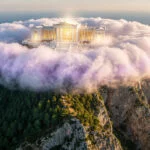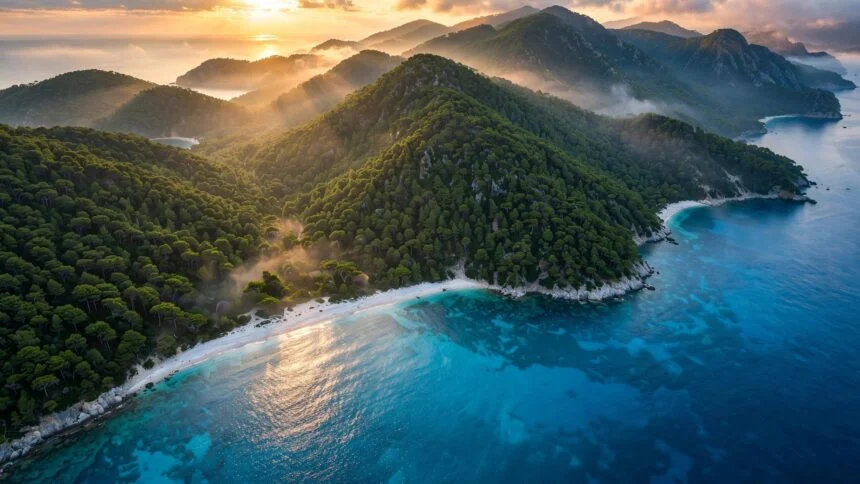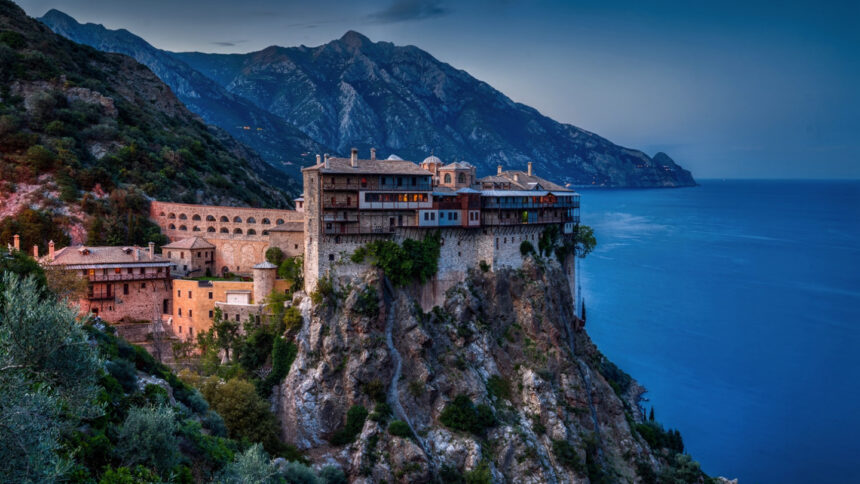
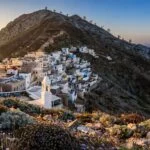


The three peninsulas of Halkidiki extend into the northern Aegean at intervals that make the region identifiable from the air as something ordered and deliberate: Kassandra to the west, Sithonia in the center, and the Athos peninsula to the east, the last of the three carrying on its southern tip the monastery republic that has been in continuous operation for more than a thousand years.
The shape is the first thing to understand about Halkidiki, because the three peninsulas are not interchangeable. Each has its own character, its own relationship with the tourist economy, and its own version of what the northern Aegean landscape produces when it is left largely intact. Kassandra is the most developed and the most accessible, with the resort infrastructure that the majority of Halkidiki’s visitors use. Sithonia is the middle finger in the more literal geography of the region and in the figurative one: less developed than Kassandra, with more forested interior and more hidden coastline that the absence of road access has preserved. The Athos peninsula is inaccessible to most visitors by land and to all women by the administrative arrangement that has governed the monastery republic since the Byzantine period, but its coastline is visible from the sea and its buildings, which the twenty monasteries and their dependencies have built on cliff faces and headlands across the centuries of the republic’s operation, are among the most extraordinary architectural concentrations in the northern Aegean.
Tree felling in the forested areas of Kassandra and Sithonia is prohibited by regulation that has been in place long enough to have produced the quality of forest that the visitor encounters: pine and oak and chestnut grown to a density and a scale that the managed commercial forests of northern Europe do not achieve, the canopy continuous enough in the higher interior to produce the quality of light and air that a mature forest produces, the resin smell of the pines present at a concentration that the occasional hot afternoon wind carries down to the coastal road. This is the smell that people who have spent childhood summers in Halkidiki associate with the place: pine resin and sea salt, the combination of the forest meeting the Aegean.
The Landscape and What It Contains
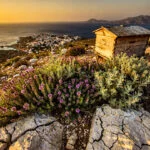
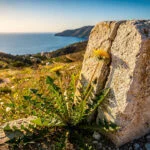
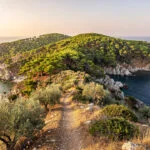
Halkidiki’s terrain is the terrain of a landscape that the last ice age left in a condition and that the intervening millennia have not substantially altered: rolling limestone hills covered in mixed Mediterranean forest, descending to a coastline that the peninsula’s multiple aspects make varied in character from beach to beach and cove to cove.
The 104 Blue Flag beaches that the region holds in 2024 represent the most concentrated density of internationally certified beach quality in Greece, which already ranks second globally in Blue Flag beach numbers. The Blue Flag certification is awarded against criteria for water quality, environmental management, safety facilities, and public information, and its maintenance requires annual re-certification that rewards consistent performance rather than simply initial qualification. The beaches that hold the certification across multiple consecutive years are the beaches whose management has demonstrated the consistency that the award requires.

The water quality that the Blue Flag criteria assess in Halkidiki reflects the oceanographic character of the northern Aegean at this latitude: the Thermaikos and Singitikos gulfs that flank the Kassandra and Sithonia peninsulas respectively are semi-enclosed bodies of water that warm faster in spring than the open Aegean and retain their heat later into autumn, extending the comfortable swimming season from approximately Easter through late October in favorable years. This extended season is not a marketing claim: it is the measurable consequence of the enclosed gulf’s thermal behavior, which the sea temperature data from the monitoring stations confirms.
The coastline’s variety, from the organized resort beaches of southern Kassandra with their full infrastructure to the pebble coves of Sithonia’s eastern coast accessible only by boat or on foot, accommodates the full range of what beach visitors require: the families who need shallow water and lifeguard coverage and proximity to facilities, and the visitors who want the beach that requires effort to reach and rewards the effort with the quality of a place that most people have not found yet.
Kassandra | The Accessible Peninsula
Kassandra, the westernmost of the three peninsulas, is connected to the mainland by the narrow isthmus at Nea Potidaea, where a canal cut in the 1930s separated the peninsula from the coastal road and necessitated the bridge that now crosses it. The bridge is the entry point, and the road that follows the peninsula’s coast is the organizational spine of its tourist geography: the resort settlements, the beaches with their Blue Flag designations, and the services that support the summer visitor population are all distributed along or near this coastal circuit.
The peninsula’s interior, accessed by roads that climb from the coast into the forested hills, provides the contrast that Kassandra’s coastal development makes necessary: the villages of the higher ground, the pine forest that covers the interior ridges, and the views from the elevated terrain across the Thermaikos Gulf to the west and the Toroneos Gulf to the east that the coastal road cannot provide. The mountain biking routes that Break Free and similar operators run through the interior trails are the most direct way to experience the Kassandra landscape beyond its beaches, and the camel’s hump ridge that the interior topography produces is the terrain that the routes are built around.
The thermal baths at Agia Paraskevi on the southwest coast of Kassandra are developed in the dedicated article on Halkidiki alternatives in the Olympus Estate collection. Their position on the coast makes them simultaneously accessible by the coastal road and in their offering: the warm, sulphurous spring water that the peninsula’s geology produces at this location is a resource that the organized bathing facility makes available to visitors who would not otherwise know to look for it.
Sithonia | The Quieter Middle
Sithonia’s character is the character of a landscape that development has modified less thoroughly than Kassandra, and the difference is perceptible in the quality of what the visitor finds when they move through it: longer distances between settlements, more forest between the coastal road and the interior, beaches that are harder to reach and therefore less populated when reached.
The Sithonia coastline holds the coves and inlets that the dedicated Halkidiki alternatives article describes in detail: the Porto Elea camping site on the northern coast at the end of an unpaved road that filters the casual visitor, the Vourvourou bay with its cluster of small islands that provides the protected water that the Sea Kayak Halkidiki excursions use, the seafood tavernas of Kalamitsi and Sarti where the combination of fresh-caught fish and the coastal setting justifies the claim that the best eating in Halkidiki is in Sithonia rather than in the more developed resort areas.

The diving off the Sithonian coast, centered on the Atlantis Diving Center at Nikiti at the peninsula’s northern entrance, accesses a sea floor that the limited coastal development has left in the condition that the Mediterranean’s clearest water at its most protected from boat traffic produces: the scorpion fish and sea bass and the anemone-covered rock formations that the dedicated article describes are the underwater expression of the same landscape quality that the forested hills express above the waterline.
The sailing and camping excursions to the small islands between Kassandra and Sithonia, in the Toroneos Gulf, are the most complete version of what Sithonia specifically offers: the access to water and islands and the quality of the northern Aegean sea that the enclosed gulf produces, without the infrastructure that transforms the experience into something managed rather than genuine.
Mount Athos | The Monastery Republic
The Athos peninsula is the third finger of the Halkidiki hand and the one that extends furthest into the Aegean, its southern tip at Mount Athos itself reaching close to the latitude of Thessaloniki’s harbor. The peninsula is approximately 50 kilometers long and between 8 and 12 kilometers wide, densely forested in its middle and upper sections, and carrying on its various aspects the twenty monasteries that constitute the Holy Community of Mount Athos, the monastic republic whose administrative autonomy within the Greek state has been continuous since the Byzantine imperial charters that established it.
The practical consequence of this autonomy for the visitor is the entry requirements: male visitors who wish to enter the peninsula by land must obtain the diamonitirion, the monastic visa, from the Pilgrims Bureau in Thessaloniki in advance, and the number of such permits issued daily is limited. Women may not enter the peninsula by land under any circumstances, a prohibition that has been in force since the tenth century and that the current administrative arrangements maintain.

The alternative for those who wish to see the Athos coastline and its monastery buildings without entering the peninsula is the sea cruise from Ouranoupoli, the town at the base of the isthmus that connects the Athos peninsula to the mainland. The cruise boats that run from Ouranoupoli along the western coast of the peninsula and around its southern tip provide views of the monastery buildings from the sea, which is the perspective from which their architectural character, built on cliff faces and headlands to defend against the sea attacks that the medieval period made constant, is most completely visible.
The monasteries of Athos, which include the Great Lavra, founded in 963 CE and the oldest of the twenty, and Vatopedi, whose library holds one of the most significant collections of Byzantine manuscripts in the world, are communities in which the daily rhythm of life has been organized around the liturgical hours for more than a thousand years without substantial interruption. The quality of continuity that this represents is difficult to convey to someone who has not encountered it: not simply an old institution but an institution whose daily practice, the prayers at the hours, the fasting on the days, the cycle of the liturgical year, has been continuous in the same place since the tenth century.
The Siesta and the Table
The cultural practices that distinguish a visit to Halkidiki from a visit to a more internationally homogenized beach destination are the practices that the northern Greek tradition maintains with the seriousness of a community that has not been fully reshaped by the demands of the tourist economy.
Mesimeri, the siesta period from approximately 2 PM to 5 PM in the summer months, is not simply a local custom to be noted and accommodated. It is the consequence of a climate and a daily rhythm that the human body in a Mediterranean summer genuinely requires: the hours of the afternoon when the sun is at its highest and the heat is at its most intense are the hours when rest is not laziness but biological intelligence, and the Greek tradition of organized quiet during these hours reflects the accumulated understanding of a population that has been living in this climate for millennia.

The kafeneion that the villages of the Halkidiki interior maintain, the tables under the plane tree in the square, the game of tavli being played in the midday shade and the conversation that continues through it, represents a social form that the resort town does not produce but that the visitor who moves inland from the coastal strip will encounter with the quality of an institution that has not been arranged for their benefit but that they are welcome to observe and participate in.
The evening table, the long meal that begins when the heat of the day has retreated and continues past the time that the restaurants of northern Europe would have closed, is the form of Greek hospitality that most directly expresses the cultural priority the region maintains: the meal is the occasion for gathering, and the gathering is the purpose rather than the eating being the purpose and the gathering being incidental. The grilled octopus, the fresh fish, the local wine from the Gerakini vineyard that the Halkidiki alternatives article describes, and the tsipouro that follows the meal as the signal that the eating is concluded and the conversation can continue: these are the components of an evening that the clock does not govern.
Thessaloniki | The City Behind the Peninsula
Halkidiki’s proximity to Thessaloniki, 70 kilometers from the peninsula’s entry at Nea Potidaea, gives it an urban anchor that the Aegean islands do not have: a city of 800,000 people with an international airport, Byzantine architecture of international significance, a food tradition that the Greeks themselves consistently rank among the country’s most sophisticated, and the energy of a city that is the second largest in Greece and that has been at the intersection of the Balkans, the Aegean, and the eastern Mediterranean since the Roman period.
Thessaloniki’s Byzantine heritage, the Rotunda, the White Tower, the chain of UNESCO-listed churches that the Byzantine Empire built across the centuries of its governance, is covered in the dedicated northern Greece section of the Olympus Estate Greece travel guide. For the visitor to Halkidiki, Thessaloniki serves as both the point of arrival and the cultural excursion that the peninsula’s natural and beach-oriented character does not provide. A day in Thessaloniki from a Kassandra or Sithonia base is a day in one of the most historically layered cities in Europe, from which the return to the pine forest and the sea in the late afternoon is the contrast that the combination of the two places provides.
The road north from Halkidiki to Thessaloniki also passes near Dion, the Macedonian sacred city at the foot of Olympus, which is covered in the Mount Olympus travel guide in this collection. The circuit of Halkidiki, Dion, and the lower slopes of Olympus is a single day’s drive from any base on the peninsulas, providing access to the most significant Macedonian archaeological site and the mountain that the entire region takes its cultural identity from.
When to Come
The peninsula’s extended swimming season, from Easter through late October in favorable years, reflects the enclosed gulf’s thermal advantage over the open Aegean, and the practical implication for the visitor is that the seasons adjacent to the July-August peak provide the same water temperature and swimming conditions with considerably lower visitor density.

June is the month when the combination of warm enough water, full resort and taverna operation, and visitor numbers below peak creates the conditions that most visitors would choose if they could choose freely rather than within the constraints of the school holiday calendar. The sea temperature in June in the enclosed Toroneos and Singitikos gulfs reaches levels that make extended swimming comfortable. The Blue Flag beaches are operational. The tavernas and the seafood are at their freshest. The afternoon heat is present but not at the August intensity that makes the midday hours uncomfortable for anyone not in or near the water.
September provides the same combination of conditions with the additional dimension of the light: the quality of the northern Aegean autumn, the longer shadows and the slightly cooler air and the sea that has been warmed by three months of summer and retains the warmth into October, is the quality that the visitors who return to Halkidiki year after year often identify as the reason they return.
At Olympus Estate, Wanderlust Greece guides you across the sacred and storied terrain of the Hellenic world, from the Blue Flag beaches of Sithonia to the monastery coastline of Athos visible from the sea. Halkidiki is not one place. It is three peninsulas with three distinct characters, a city behind them, and a monastery republic at the far end that has been operating since the tenth century. The relaxation that the region is famous for is real. So is everything else.