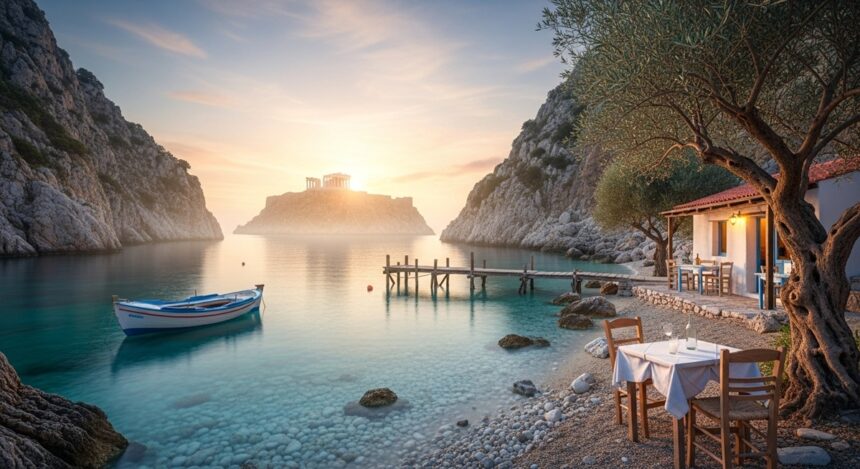



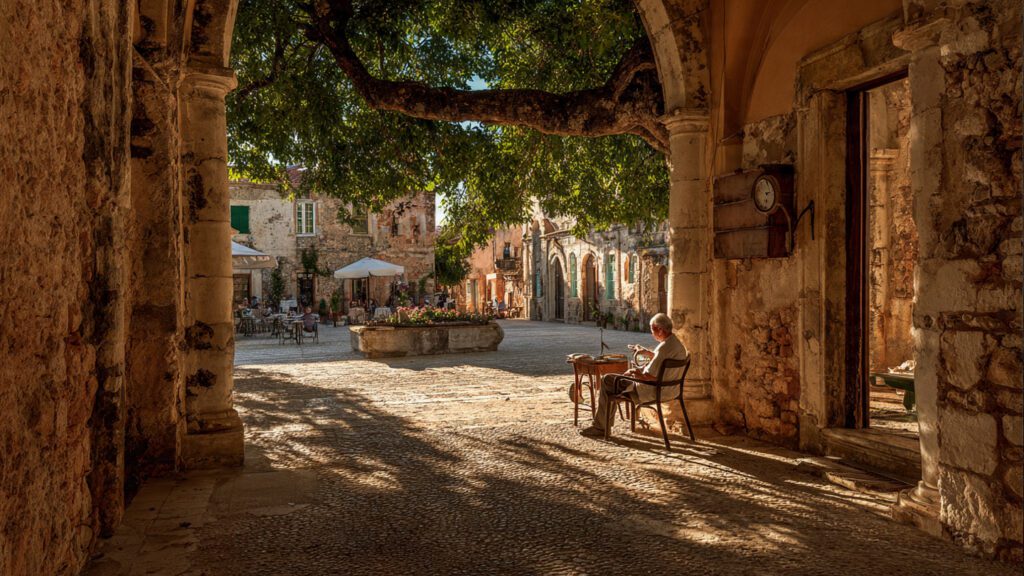
The sun over a stone threshold in the Peloponnese does not just move across the sky. It carves shadows into the limestone that feel like heavy, deliberate brushstrokes. On a Tuesday afternoon in a village square where the only sound is the click of worry beads and the dry rustle of plane tree leaves, the clock on the church tower might tell you it is three o’clock. However, the old man sitting with his coffee knows that the hour is not defined by the position of the hands. It is defined by the quality of the heat, the depth of the silence, and the sudden, unscripted arrival of a friend.
This is the living tension between two ways of being that the people of Ancient Greece understood better than perhaps any civilization before or since. They knew that to live only by the counting of seconds was to be a slave to a hunger that could never be satisfied. They looked at the horizon and saw not just a calendar, but a divine choreography.
To walk the path of Greek Living is to acknowledge that we exist in two worlds simultaneously. One world is sequential, measurable, and often exhausting. The other is spontaneous, sacred, and potentially transformative. In our contemporary struggle to optimize every minute of our existence, we have largely abandoned the latter, yet the landscape of Greece remains a persistent reminder of its power. This is the story of how a culture learned to navigate the difference between the time that passes and the time that arrives, a distinction that remains the most vital secret for anyone seeking a life of true substance and Wisdom.
The Relentless Hunger of the Titan Chronos
When we speak of Chronos, we are speaking of the weight of the universe. In the earliest layers of Greek mythology, this figure emerged as a representation of the quantitative, the linear, and the inevitable. He is the father of hours and years, the one who ensures that the sun rises and sets with mechanical reliability. There is a reason that the name Chronos is so often entangled with Cronus, the Titan who famously devoured his own children to prevent his own overthrow. Both figures represent a force that consumes everything it produces. Every second that Chronos creates, he immediately takes back. Every year he grants to a mortal, he eventually demands in return through the slow erosion of aging and decay.
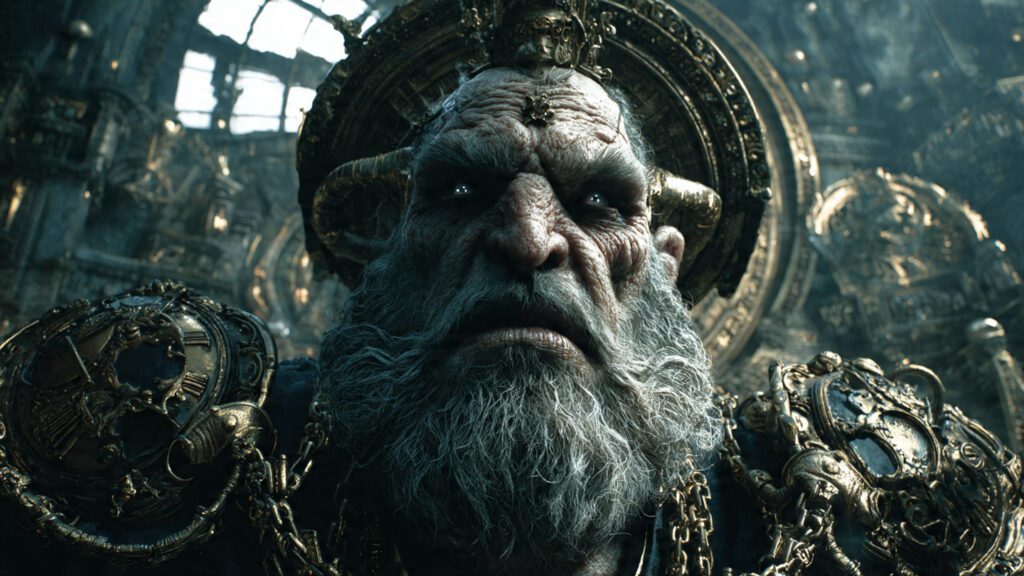
In Ancient Greece, this was understood as the necessary structure of the world. Without Chronos, there would be no seasons, no harvests, and no history. He is the master of the metron, the measure. He governs the rhythm of the tides and the cycles of the moon. He is the time that we spend waiting for the bus or the time we spend working at a desk. It is a time that can be sold, traded, or wasted. In the modern world, we have made Chronos our absolute king. We have built our cities and our lives around the frantic maintenance of his schedules. We believe that if we can just manage Chronos more effectively, we will finally find peace. But the Greeks knew that Chronos has no interest in peace. He only has interest in the next second, and the next, and the next.
However, the Greek relationship with Chronos was never purely one of resentment. They saw a certain dignity in his relentless march. They built temples to last for centuries under his gaze and developed a Philosophy that taught how to endure his passing with grace. But they also knew that if a life consisted only of Chronos, it would be a tragedy of empty repetition. They needed an escape hatch, a way to puncture the linear and touch the eternal. This is where the second god of time enters the narrative, a figure who does not march, but flies.
Kairos and the Forelock of Divine Opportunity
If Chronos is the quantity of time, Kairos is the quality of the Moment. He was often depicted in ancient art as a youthful, athletic figure with wings on his heels and a curious hairstyle, a long lock of hair hanging over his forehead while the back of his head was completely bald. This was a visual metaphor for the nature of Opportunity. As he approaches you, you can grab him by the forelock. Once he has passed, there is nothing to hold onto. He is gone into the slipstream of history. Kairos is the time that cannot be measured by a clock. It is the sudden opening in the clouds, the moment a poet finds the perfect word, or the instant a traveler realizes they are exactly where they are supposed to be.
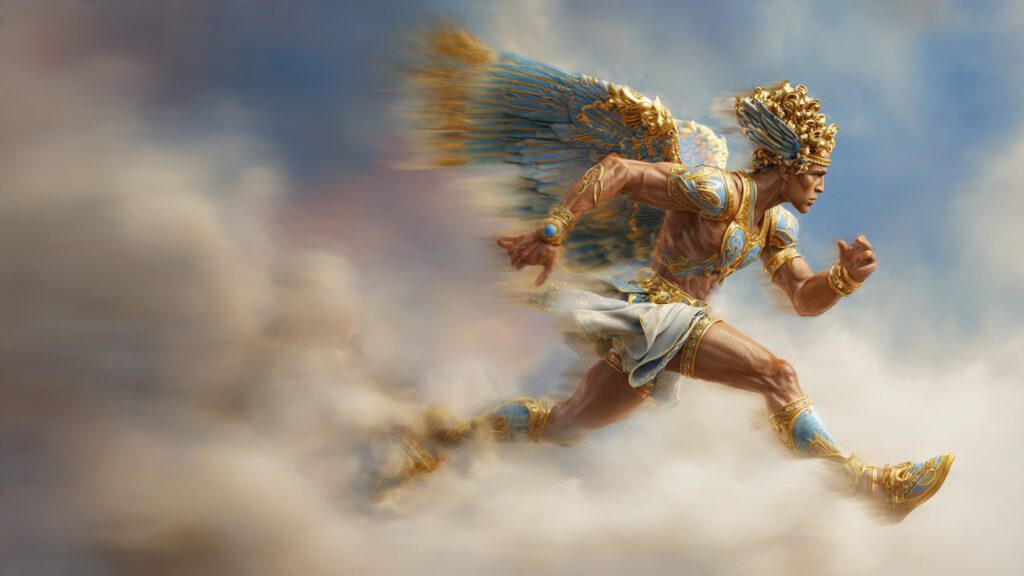
The concept of Kairos is perhaps the most revolutionary contribution of Greek philosophy to the way we understand our lives. It suggests that there is a “right time” for every action, a window of divine Opportunity that requires awareness rather than effort. You do not schedule Kairos. You prepare for him. You sharpen your senses so that when he flies past, you are ready to seize the moment. This is why the Greeks placed such a high value on the virtue of phronesis, or practical Wisdom. It was the ability to recognize the Kairos in any situation, whether in the heat of a political debate or the tension of a battlefield.

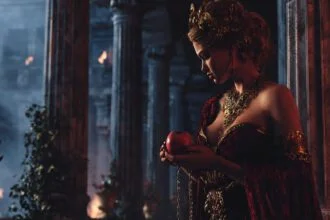

In the context of Greek Living, this manifests as a refusal to be hurried when the moment is not yet ripe. It is the reason a conversation over a glass of wine in a village tavern can last for four hours. The participants are not “wasting” Chronos. They are waiting for Kairos. They are waiting for that sudden deepening of the connection, that unexpected insight, that flash of laughter that justifies the entire day. They know that the clock is ticking, but they choose to ignore it in favor of a deeper, more resonant Rhythm. To live according to Kairos is to live awake, sensitive to the subtle shifts in the atmosphere that signal a change in Destiny.
The Heroic Timing of the Odyssey and the Iliad
The foundational stories of Greek mythology are essentially studies in the management of time. The heroes who survive and thrive are those who understand the difference between a headlong rush and a Kairotic strike. Take the example of Odysseus, the most cunning of all the Greeks. His entire ten year journey home to Ithaca is a masterclass in waiting for the right moment. He does not attack the Cyclops immediately; he waits until the giant is blinded by sleep and wine. He does not reveal himself to his wife Penelope the moment he steps onto his island; he waits, disguised as a beggar, testing the loyalty of his household and observing the arrogance of the suitors.

For Odysseus, Time is a tool. He uses Chronos to endure the long years of exile, but he lives for the moments of Kairos that allow him to reclaim his throne. His patience is not passive. It is a state of high alert. This reflects the ancient Greek belief that Destiny is not something that happens to us, but something we meet at the crossroads of opportunity and action. If Odysseus had acted too early, he would have been killed. If he had acted too late, his kingdom would have been lost. His greatness lies in his ability to sense the “winged moment” and act with total conviction.
Contrast this with the heroes who fail, those who are consumed by the hunger of Chronos or blinded by their own impulses. The tragedy of many Greek myths arises from a failure of timing. It is the son who flies too close to the sun because he cannot wait to test his wings, or the king who makes a vow he cannot keep because he spoke in a moment of unexamined passion. The legends of Olympus are filled with warnings about the dangers of ignoring the sacred Rhythm of the world. They teach us that even the most powerful human being is subject to the delicate balance of the opportune moment.
The Philosophical Pursuit of the Metron
The great thinkers of Ancient Greece took these mythic patterns and refined them into a system of ethics. For Aristotle, the concept of Virtue was inseparable from the concept of timing. He taught that every virtue is a “golden mean” between two extremes, and finding that mean requires an exquisite sense of Kairos. Courage, for example, is not just about being brave. it is about knowing exactly when to stand your ground and when to retreat. To be brave at the wrong time is not courage, but recklessness. To be generous at the wrong time is not charity, but waste.

This emphasis on the Moment created a culture that valued presence over productivity. The goal of a citizen in a Greek polis was not to accumulate the most hours of labor, but to achieve the highest quality of action. This required a constant engagement with the present. It required a Philosophy that was not tucked away in books, but practiced in the marketplace and the gymnasium. The Stoics later expanded on this by suggesting that while we cannot control the Chronos of the world, we have absolute control over our internal Kairos. We can choose how we respond to the present, regardless of what the external clock is doing.
This ancient wisdom offers a profound critique of our Modern Life. We have become experts at measuring time, but we are amateurs at inhabiting it. we have lost the ability to find the metron, the proper measure. We swing between the extremes of burnout and boredom, never quite hitting the resonant frequency of the opportune moment. The Greek philosophers would have looked at our world of constant notifications and infinite scrolling and seen it as a form of madness, a total surrender to the most superficial layer of Chronos.
Geography as a Gateway to Sacred Time
There are places in Greece where the boundary between these two types of time seems to thin. If you stand in the theater at Epidaurus as the sun begins to set, the silence is not just the absence of noise. It is a presence. It is a Kairotic silence that seems to hold the echoes of every performance ever given there. The architecture itself seems designed to slow the heart rate and open the senses. In places like this, the pressure of the modern world simply falls away. You are no longer concerned with the next hour or the next day. You are simply there, in the center of a moment that feels eternal.

The sanctuary at Delphi functions in a similar way. The ancient pilgrims did not just go there for information; they went for an encounter with the divine. They had to wait for the Pythia to be ready, and they had to be ready themselves. The entire journey was a preparation for a single, transformative moment of insight. This is the essence of Wanderlust Greece. It is not about checking destinations off a list. It is about traveling to locations that demand a different way of being. Whether it is the rugged peaks of Olympus or the sun bleached ruins of Delos, these sites are anchors for a type of Time that the modern world has forgotten how to navigate.

At Olympus Estate, we believe that the landscape is the most powerful teacher of this ancient rhythm. The land does not rush. The olive trees take decades to reach their full glory, and the mountains have seen empires come and go without blinking. To live in proximity to this history is to be constantly reminded of the long shadow of Chronos and the sudden brilliance of Kairos. It is an invitation to slow down, to breathe the scent of the wild thyme, and to wait for the moment that truly matters.
The Resistance of the Greek Afternoon
Perhaps the most visible survival of Kairos in the modern world is the ritual of the Greek afternoon. Between the hours of two and five, much of the country still enters a state of deliberate suspension. The shops close, the streets empty, and the world retreats into the shade. To the outsider, this might look like laziness or an inefficient use of Time. To the Greek, it is a sacred necessity. It is the mesimeri, the middle of the day, a time when the heat of the sun is too great for work and the soul requires a pause.

This is not a nap in the modern sense of a quick recharge for more production. It is a descent into a different state of Existence. It is a way of honoring the cycle of the day. When the world wakes up again in the early evening, it does so with a renewed sense of energy and a focus on social connection. The evening volta, the slow walk through the town square, is the ultimate expression of Kairos. No one is walking to get somewhere. They are walking to be somewhere, with each other, in the present. It is a rejection of the linear march of progress in favor of the cyclical dance of community.

This resistance to the total dominance of Chronos is what makes life in Greece so intoxicating for those accustomed to the frantic pace of northern cities. It is a reminder that there is another way to live. It is a demonstration that Wisdom consists not in getting more done, but in being more present. It is the realization that a life is measured not by its length, but by the number of moments that were truly lived.
The Return to a Kairotic Life
Recovering a sense of Kairos does not mean abandoning the responsibilities of the modern world. We still have to pay our bills, keep our appointments, and navigate the demands of our careers. But it does mean refusing to let those demands define our entire reality. It means creating spaces in our lives for the spontaneous and the sacred. It means learning to recognize the winged god when he approaches and having the courage to grab him by the forelock.
In the end, the ancient Greek distinction between these two types of time is a call to a more human way of being. It is an invitation to join the child playing draughts on the floor of the universe, to find the joy in the game regardless of the outcome. Whether we are standing on the slopes of Olympus or sitting in a crowded office, we have the capacity to punctuate the mundane with the divine. We have the capacity to choose Kairos.
As the shadows lengthen over the Aegean and the first stars begin to appear, the clock continues to tick. Chronos will have his due. But for those who have learned the secret of the Greek moment, the night is not just the end of a day. It is the beginning of a new opportunity to be awake. The path carved long ago by the gods and the philosophers is still there, waiting for anyone who is ready to step off the treadmill of the seconds and into the light of the eternal present.