




He never ran from Marathon to Athens.
This is where the record and the legend part ways, and the record is where the story actually starts. Herodotus, writing within living memory of the battle, describes no exhausted runner staggering into Athens, gasping the word for victory, and dropping dead. He describes something else. A run so much longer, so much harder, and so much better attested that the popular version starts to look less like history and more like a consolation prize.
The real story is not smaller than the legend. It is larger, and it belongs to a different man doing a different job, at a different point in the same campaign entirely.
The Run That Actually Happened
In the late summer of 490 BCE, before a single Persian soldier had fought a single Athenian on the plain of Marathon, the Athenian generals sent a professional long-distance runner named Pheidippides on a mission with nothing to do with announcing a victory. They sent him to Sparta to beg for help.
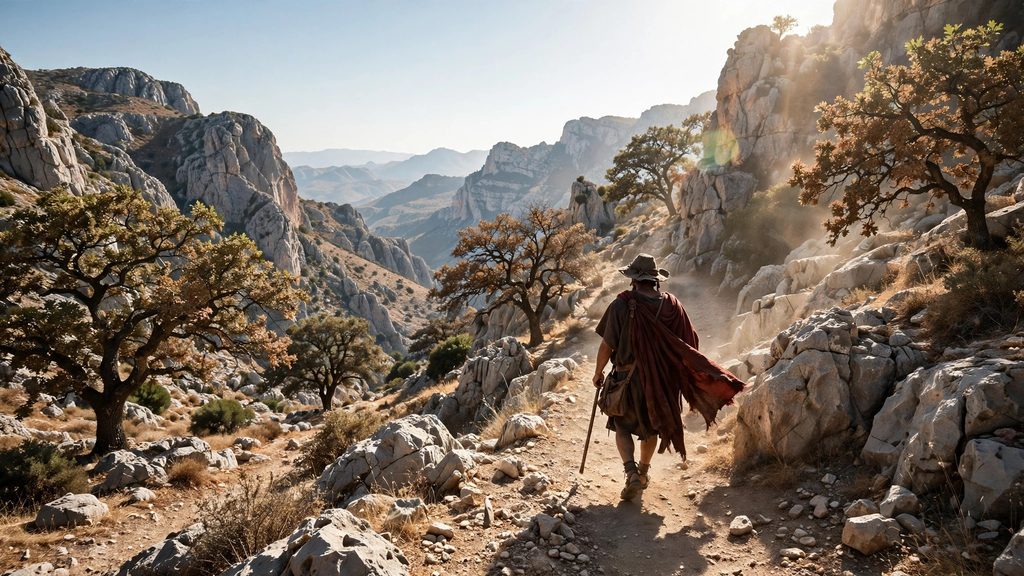
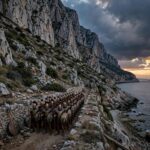
Herodotus records the distance and the outcome with the flat precision of a man reporting something he considers simply true rather than remarkable: Pheidippides covered roughly one hundred and forty miles of rough, mountainous road, through Corinth, Nemea, and the highlands of Arcadia, and arrived in Sparta the day after he set out. Modern attempts to reconstruct the route put the one-way distance at roughly two hundred and twenty five kilometers, covered, on Herodotus’s own account, within two days. What the return journey cost him in time or distance, Herodotus does not say. The Spartans received him, expressed real willingness to help, and then explained that Spartan religious law forbade them from marching to war before the full moon, a delay tied to a festival most likely the Carneia.
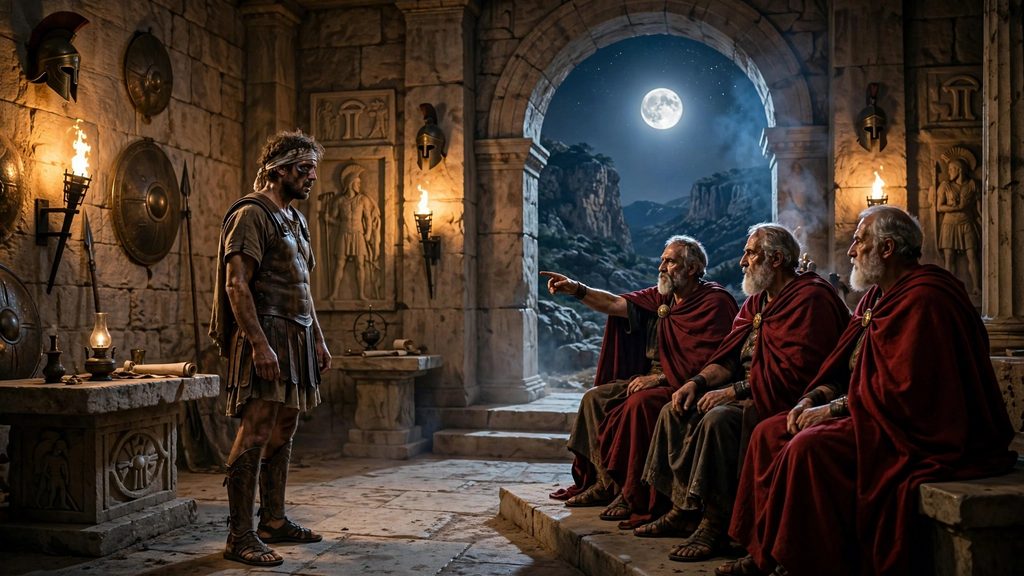
Whether this was genuine piety or a convenient excuse for a city with its own reasons to let Athens face the danger alone remains, appropriately, disputed. The Spartans did eventually march. They arrived after the battle was already won.
On the road through Arcadia, Herodotus records something else: Pheidippides encountered the god Pan, who asked why the Athenians paid him so little honor given his continued goodwill toward the city, and promised to help against the Persians when the moment came.
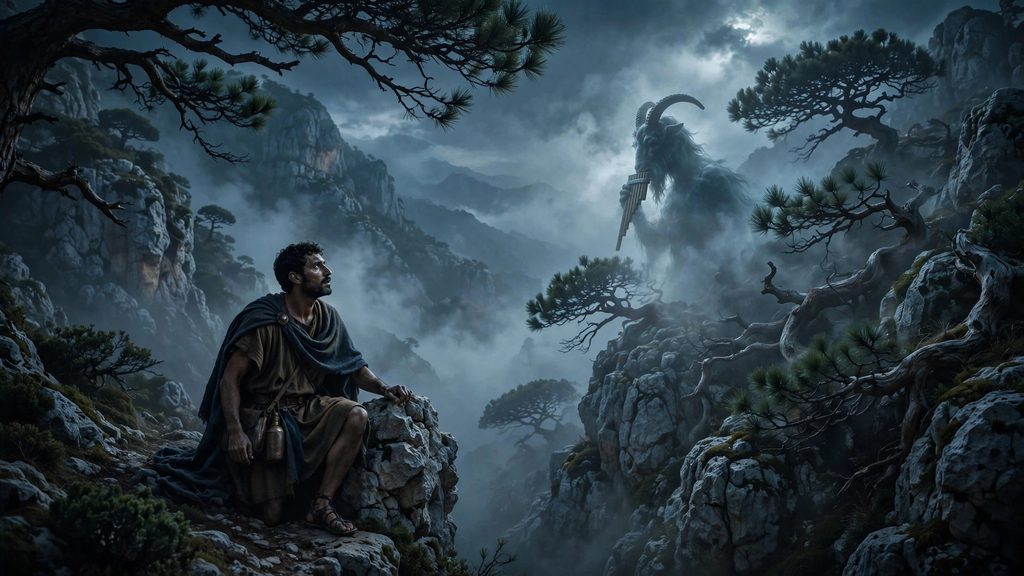
Athens took the god seriously enough to build him a shrine on the north slope of the Acropolis after the battle and establish an annual torch race in his honor, a debt paid to a god who had, according to the story the Athenians themselves told, kept his word on a lonely mountain road at exactly the moment the city needed every kind of help it could get.
Where the Death Run Really Comes From
The story everyone knows, the twenty six mile sprint from the battlefield to Athens ending in a single triumphant word and a collapse, does not appear anywhere in Herodotus. It appears roughly five hundred years later, in the writing of Plutarch, who attributes the run not to Pheidippides at all but to a herald he names as either Eucles or Thersippus, accounts differ. A century after Plutarch, the satirist Lucian tells a similar story and attaches the name Philippides to it, a name close enough to Pheidippides that the two were eventually merged into a single figure in the popular imagination, doing a job that belonged, in the earliest and most reliable source available, to nobody at all.
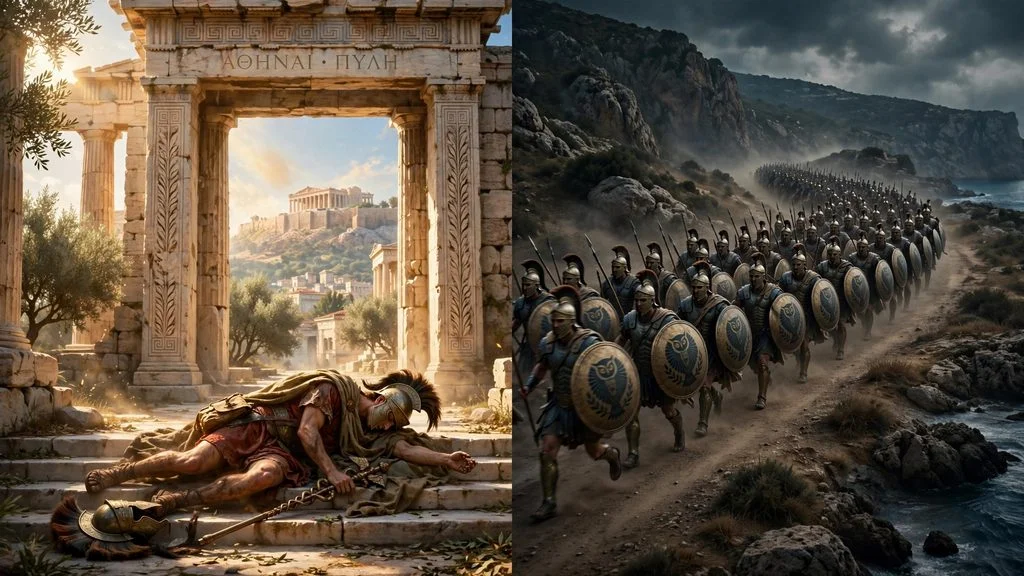
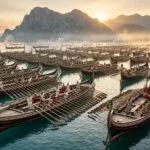
What the later tradition most likely did, whether deliberately or simply through five centuries of retelling, was compress two separate events into one dramatic image: the genuine, exhausting mission to Sparta before the battle, and the genuine, urgent march of the entire Athenian army back to the city after the battle, racing a Persian fleet that was attempting to reach an undefended Athens before the hoplites could get home. Both events were real. Neither involved a lone runner dying after announcing victory. The Athenian army that made the second journey arrived intact, in fighting order, and stood in visible formation at the harbor of Phaleron when the Persian fleet sailed into view, which was precisely enough to convince Datis that a second landing was no longer worth the risk. The fleet turned for home.
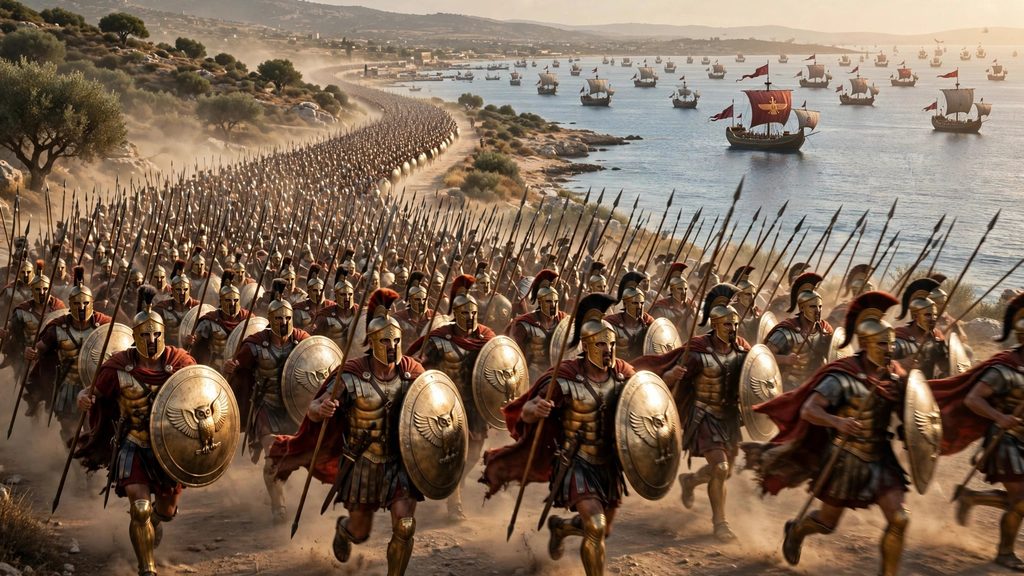
The best-attested feat, the Sparta run, is the more remarkable one by any honest measure. Two hundred and twenty five kilometers of mountain road in under two days, one way, is an extraordinary athletic accomplishment by modern standards, attempted with modern shoes, modern nutrition science, and modern road surfaces. Pheidippides did it in sandals, on foot paths, carrying a message whose failure would have meant Athens faced the Persian army entirely alone. The twenty six mile version is the one that became famous. The one hundred and forty mile version is the one that happened.
Why Miltiades Chose to Fight
The Persian force that landed at Marathon, under the joint command of Datis and Artaphernes, was sent by Darius I specifically to punish Athens and Eretria for supporting the Ionian Revolt against Persian rule a few years earlier. Herodotus records that Darius, on learning of Athenian involvement in the burning of Sardis, had an attendant repeat three words to him before every meal: remember the Athenians. The detail is specific enough to suggest it circulated widely, and it was almost certainly a story Athens told about itself, about how personally its defiance had registered with the largest empire in the world.
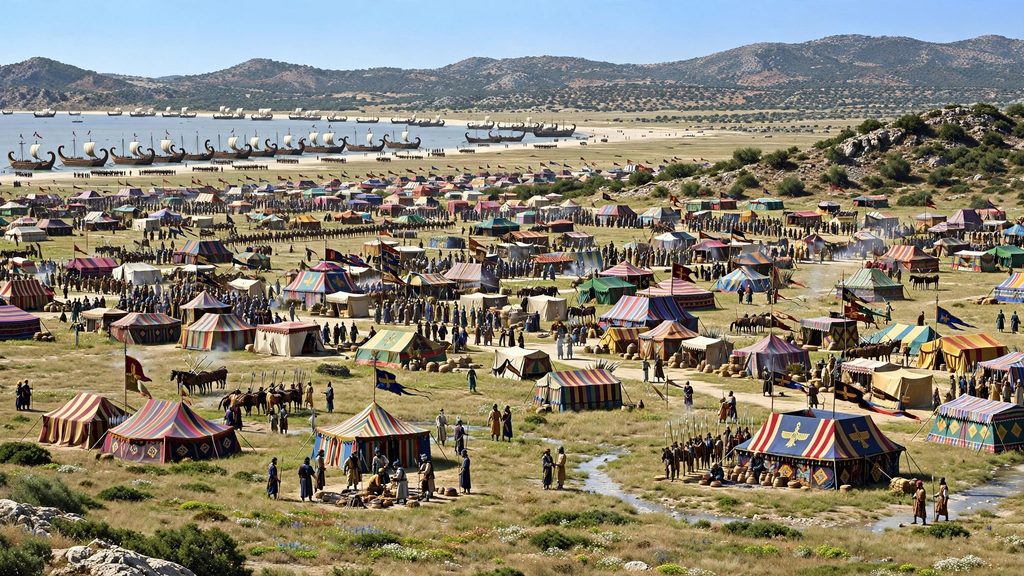
Guiding them was the exiled former Athenian tyrant Hippias, who hoped to be restored to power in the city’s ruins. Modern historians generally estimate the Persian infantry at somewhere between fifteen and twenty five thousand, with cavalry support, against an Athenian force of roughly ten thousand hoplites. Only one other city sent help: a thousand men from Plataea, the single ally willing to stand with Athens when Sparta could not. The choice of Marathon itself was deliberate on the Persian side: an open plain, ideal terrain for cavalry, the one arm of the Persian military the heavily armored Greek hoplite had no good answer for.
For several days, neither side attacked. Then, according to a tradition preserved not in Herodotus but in the later Byzantine encyclopedia known as the Suda, Ionian Greeks serving unwillingly in the Persian ranks signaled to the Athenians that the cavalry had been withdrawn and loaded back onto the ships. Why remains disputed.
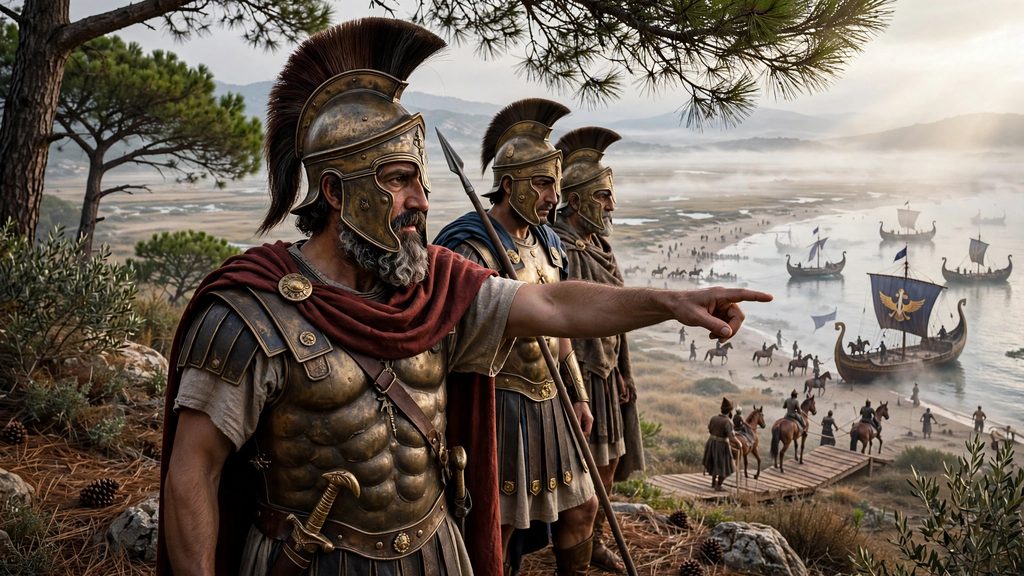
Repositioning for a second attack on Athens, ordinary logistics, something no surviving source explains: any of these is possible. Herodotus himself is silent on this specific mechanism, which means the detail should be treated with real caution rather than presented as settled fact. What is certain is that Miltiades, one of the ten generals holding command on a daily rotation, persuaded the war archon Callimachus, whose vote would decide the matter, to commit to battle before the moment passed.
The Charge the Persians Called Madness
Miltiades arranged his line with a calculated weakness: he thinned his center to reinforce both wings, matching the width of the much larger Persian formation at the cost of depth exactly where the fighting would be hardest. Then, at a distance Herodotus records as roughly a mile from the Persian line, he ordered his hoplites to run.
Herodotus presents the charge itself as something close to unprecedented. A fully armored hoplite carrying spear and shield did not ordinarily sprint into battle. The armor made sustained running exhausting, and breaking formation at speed risked the discipline the phalanx depended on. The Persians, watching it happen anyway, are said to have considered it something close to suicidal madness, an army without cavalry or archer support closing the distance at a dead run into what should have been a killing field for Persian arrows. The tactic worked precisely because it was unexpected: it minimized the time the Athenian line spent exposed to Persian missile fire, and it hit the Persian formation with a physical shock the slower, more conventional approach would not have delivered.
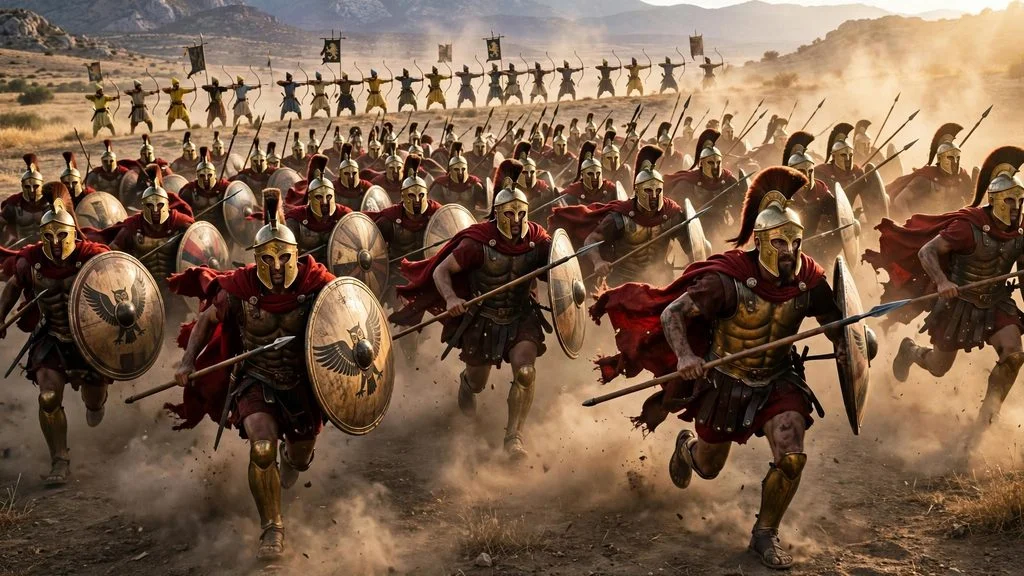
The weakened Athenian center did exactly what its thinness predicted: it buckled, and for a real, dangerous interval, nearly broke entirely under the pressure of the strongest Persian troops, who had been massed there deliberately. But the reinforced Athenian wings, facing the weaker flanking contingents of the Persian force, broke first, and instead of pursuing the fleeing Persians outward, away from the battle, the Athenian wings wheeled inward, attacking the exposed flanks of the Persian center from both sides at once.
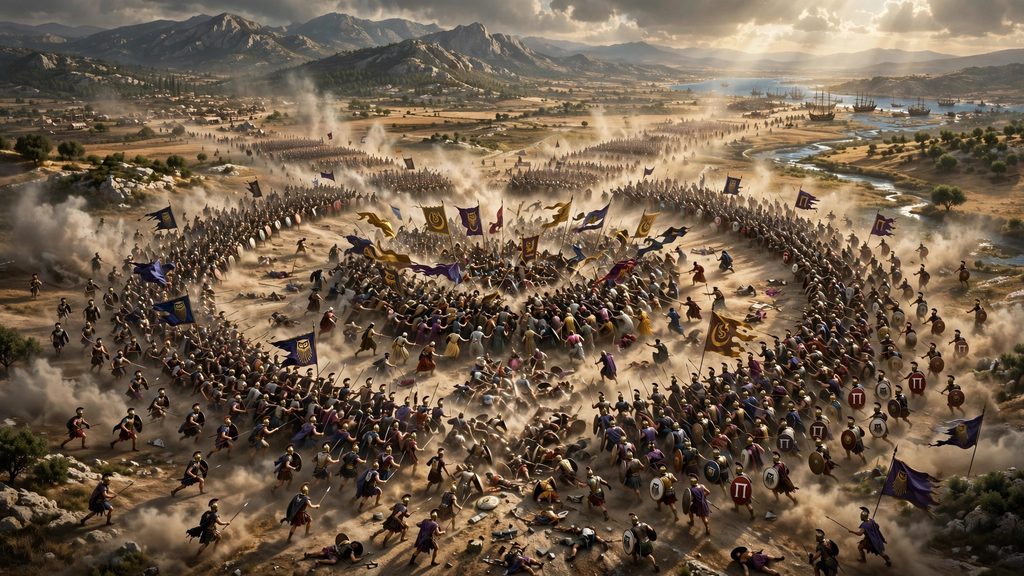
Whether this envelopment was Miltiades’s deliberate design from the outset or an improvised response to how the battle unfolded is a question the ancient sources do not fully resolve, and modern historians remain divided on the answer. What is not disputed is the result: the Persian center, caught between three directions of attack at once, broke and ran for the ships.
The Numbers, and Why One of Them Is Suspicious
Herodotus gives precise figures for the dead on both sides: one hundred and ninety two Athenians and eleven Plataeans, against six thousand four hundred Persians.
The Athenian figure is probably close to exact. The names of the one hundred and ninety two dead were inscribed in stone, tribe by tribe, a memorial practice that made an accurate count both possible and expected. The Persian figure deserves more caution than it usually receives. Unlike the Athenian dead, whose names were carved and counted, the Persian total came with no comparable mechanism for verification, and one detail is worth noting rather than resting an argument on: six thousand four hundred is exactly thirty three and one third times one hundred and ninety two, a suspiciously tidy ratio for a battlefield count. It does not prove the figure was rounded or invented. It is reason enough to treat it as an estimate rather than a census.
Among the Athenian dead was Callimachus, the war archon whose vote had committed the city to battle. Among them too, in one of the battle’s most vivid and specifically remembered moments, was Kynegeiros, who pursued a retreating Persian ship into the surf and seized its stern with his hand, trying to prevent its escape, until a Persian sailor severed the hand with an axe and Kynegeiros fell.
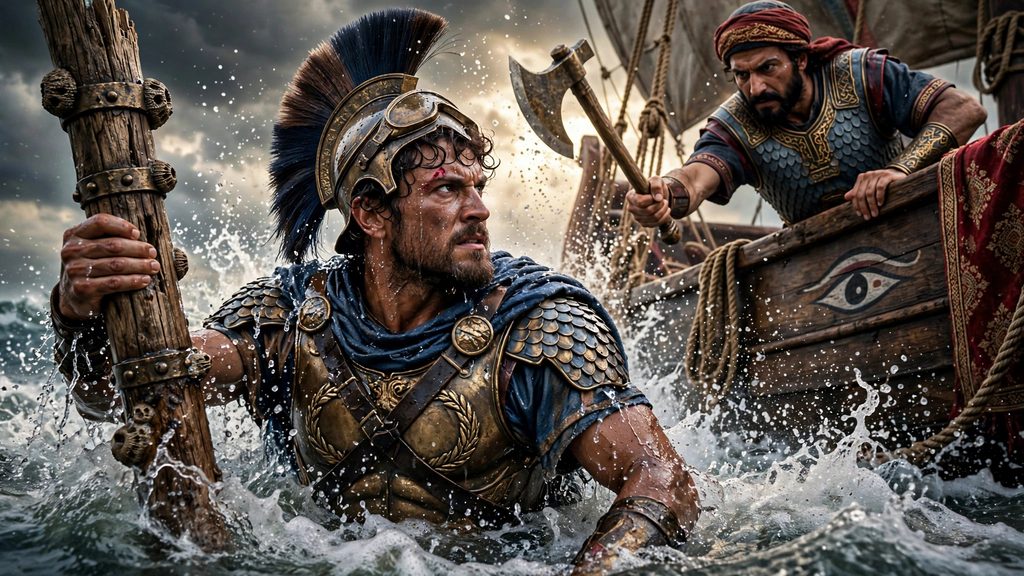
His brother was the playwright Aeschylus, who had fought in the same battle and would spend the rest of his life, by his own later account, considering his service at Marathon the accomplishment he wished most to be remembered for, ahead of every play he ever wrote.
What Still Stands on the Plain
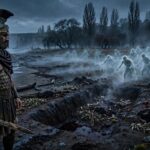
Unlike the pass at Thermopylae, buried under centuries of river silt, or the harbor at Pella, lost to the same slow geological erasure, the battlefield at Marathon has kept something real and visible on its own surface.
The Soros, the burial mound the Athenians raised over their one hundred and ninety two dead, still stands roughly ten meters high on the plain, a few kilometers from the modern town. Nineteenth century excavation confirmed what the ancient sources claimed it contained: a layer of charcoal from the cremation, human bones, and Ethiopian obsidian arrowheads consistent with the composition of the Persian force Herodotus describes. One skeleton within the mound received distinctly more careful treatment than the others, buried in its own pottery container rather than simply among the general remains, and while no inscription confirms it, the educated guess offered by more than one historian is that these are the bones of Callimachus himself, the polemarch whose vote made the battle happen and who did not survive to see how it ended.

A separate mound nearby holds the Plataean dead, a smaller monument for the one city that answered when Sparta would not. The Marathon Archaeological Museum, close to both mounds, holds finds from the site and the surrounding necropolis, including material considerably older than the battle itself, since the plain had been inhabited and buried in for millennia before 490 BCE gave it its permanent place in the story Athens told about itself.
The Race That Remembers the Wrong Run
When the modern Olympic Games were revived in Athens in 1896, the French philologist Michel Bréal proposed a long-distance running event specifically to commemorate the legend of the messenger’s run from Marathon to Athens, the story drawn from Plutarch and Lucian rather than Herodotus, already the more famous version by nearly two thousand years of retelling. The distance was not yet standardized at that first modern Olympics. It would not be fixed at the now familiar twenty six miles and three hundred and eighty five yards until the 1908 London Olympics, chosen for reasons involving the British royal family’s viewing preferences at Windsor Castle rather than anything to do with ancient Greek geography at all.
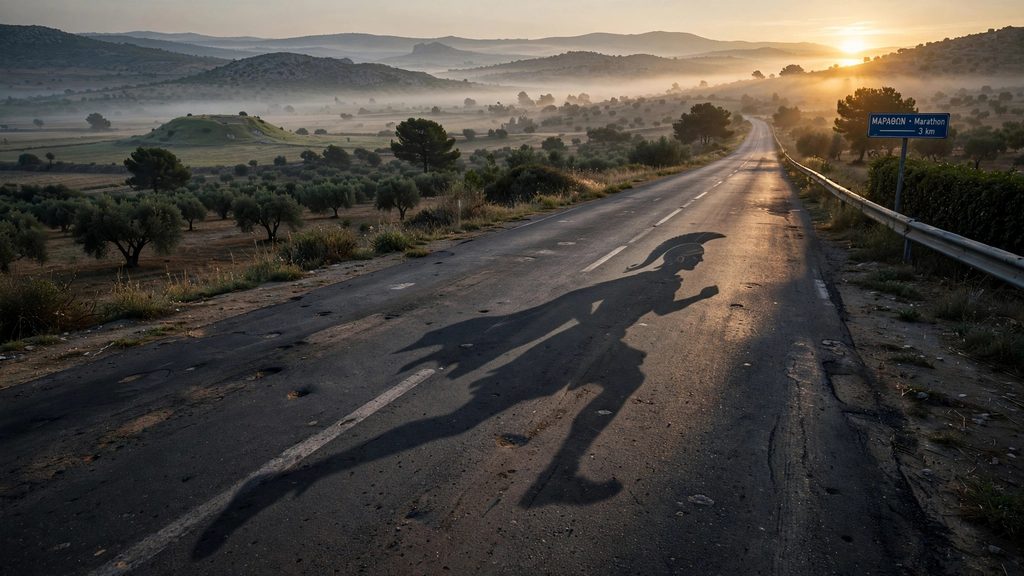
The modern marathon, in other words, commemorates a run that did not happen, at a distance fixed for reasons that have nothing to do with the battle, in honor of a man whose best-attested achievement was a completely different and considerably harder journey in the opposite direction, made before the battle rather than after it, for a reason that had nothing to do with announcing anything at all. Pheidippides ran to save Athens, not to celebrate it. The distinction has been quietly running the wrong direction in the popular imagination for roughly two thousand years.
What Actually Happened at Marathon
Strip away the death run, and what remains is not a diminished story. It is a more coherent one. A city that had been threatened with destruction sent its fastest runner on a remarkable two day journey to beg for help that arrived too late to matter. A vastly outnumbered army, reinforced only by the single city willing to stand with it, chose an unconventional and considerably risky tactic, ran directly into what should have been a killing field, and won through a combination of calculated formation, exploited timing, and an envelopment that historians still cannot fully agree was planned or improvised. The dead were buried where they fell, honestly counted on one side and probably rounded on the other, and the mound raised over them has stood on the same plain for twenty five centuries, outlasting the empire that tried to erase the city that built it.
Ten years later, Persia came back, and the war that Marathon only delayed was decided at Salamis and Plataea instead, in a city, examined at length in its own right on this site, that had marched home from this plain intact rather than burned. But the plain northeast of Athens kept its name, its mound, and eventually a race that remembers, with real affection and almost no accuracy, the wrong half of what actually happened there.
At Olympus Estate, Tales from Olympus keeps testing the stories Greece told about itself against the evidence that actually survives. Pheidippides never ran from Marathon to Athens. Herodotus records only his earlier mission, roughly 140 miles to Sparta and back in under two days, seeking help that arrived after the battle was already won. The famous death run first appears five centuries later in Plutarch, attached to a different name entirely, and only becomes Pheidippides a century after that in Lucian. Miltiades won the actual battle by weakening his center, reinforcing his wings, and ordering an unprecedented charge the Persians reportedly considered suicidal. The burial mound raised over the 192 Athenian dead still stands on the plain today, one of the few sites from this era that geology never buried. The modern marathon, fixed at its familiar distance for reasons involving 1908 London rather than 490 BCE Greece, still commemorates the wrong half of the story.