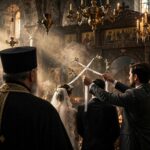
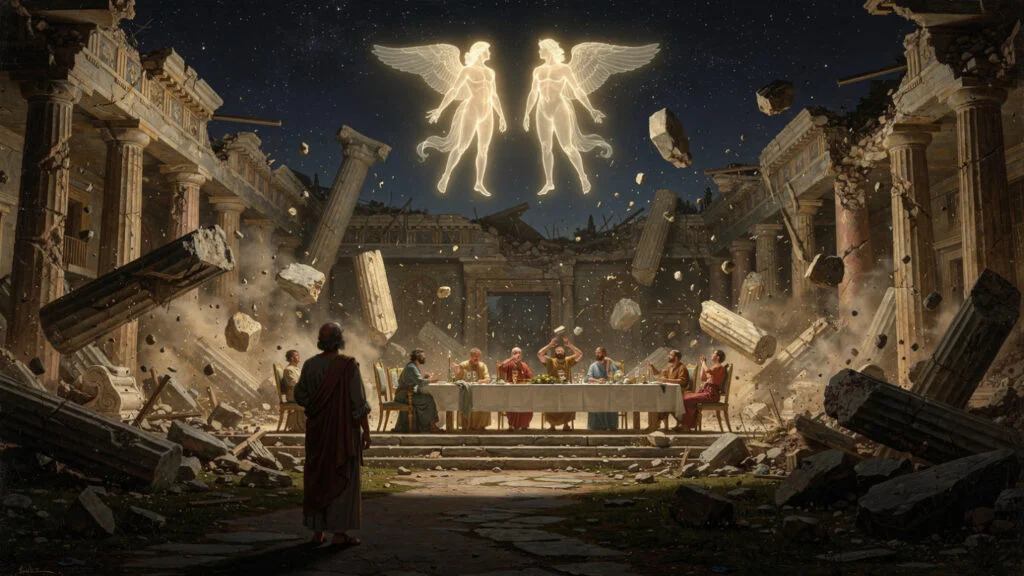
When the roof fell in at Scopas’s banquet, Simonides the poet was the only person standing outside.
He had been called out moments before by two young men who wanted a word with him. He went. The ceiling collapsed. Everyone inside, the host, the guests, the servants, died in the rubble. The two young men were nowhere to be found.
Simonides understood what had happened. He had written an ode for Scopas celebrating a chariot victory and had devoted, by the patron’s measurement, too much of its praise to Castor and Pollux rather than to the man who commissioned it. Scopas had refused to pay the full fee, suggesting that the twins whose honour Simonides had excessively celebrated might like to cover their share. The poet had said nothing in return. He had not needed to.
The story survives in Cicero, who uses it to illustrate the art of memory: Simonides, forced to identify the crushed bodies by their positions in the room, apparently invented the technique of spatial memorisation in the process. But the story’s older function was different. It was told across the ancient world as evidence that Castor and Pollux were present, attending, responsive, and capable of intervention in the affairs of people who had honoured them and people who had not.
This is not the mythology of distant gods. It is the mythology of twins who were genuinely, practically present in the world, whose protection was available to those at sea, at war, in danger. And it is mythology that a second civilisation, centuries after the Greeks first told it, found so practically compelling that they built it directly into the architecture and the annual civic calendar of their capital city.
The Problem of the Two Fathers
The parentage of the Dioscuri is the mythology’s most precise structural decision, and it requires a moment of attention before the rest of the story can be fully read.
Leda, queen of Sparta, was visited by Zeus in the form of a swan and lay with him. She also lay with her husband Tyndareus that same night. From both unions came children: four in the fullest account, Castor and Polydeuces, and their sisters Helen and Clytemnestra. The early tradition, preserved in Homer’s Odyssey and in Hesiod, described both twins as sons of Tyndareus alone. The later convention, established by Pindar in the Nemean Odes and becoming the standard account, resolved the ambiguity by splitting the parentage: Polydeuces was the son of Zeus, Castor the son of Tyndareus.
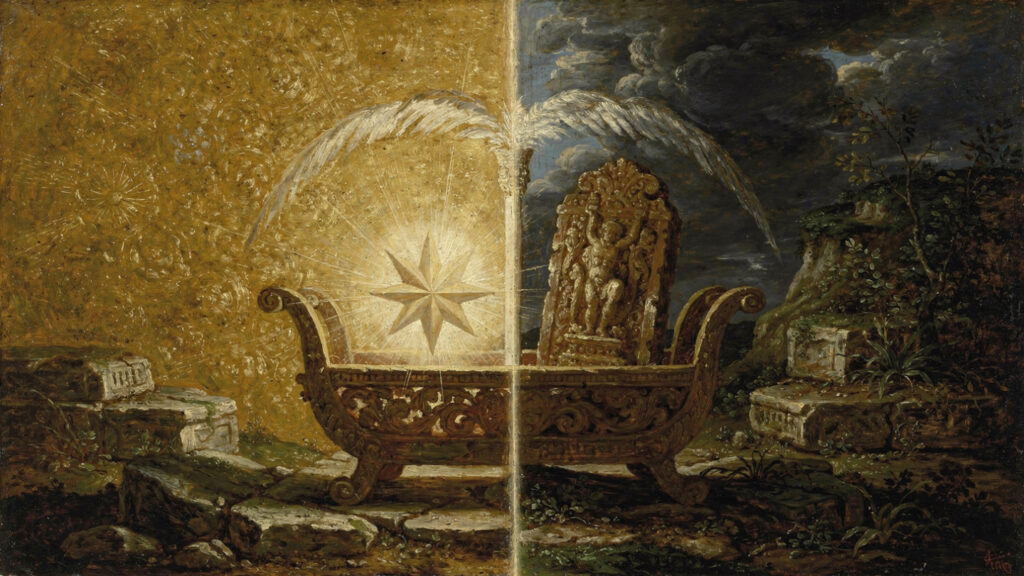
This split matters more than it might initially appear. It means the twins were born of the same mother on the same night from different fathers, one divine and one mortal, producing children of opposite natures in the same womb at the same moment. Polydeuces carried the divine inheritance of Zeus and was therefore immortal by nature. Castor carried the mortal inheritance of a human king and was therefore subject to death by nature.
They were identical in appearance, inseparable in action, devoted to each other beyond any competing loyalty. And they were constitutionally different in the most fundamental way that the Greek world could articulate: one was the kind of being that does not die and the other was the kind of being that does.
The Greek tradition built this asymmetry deliberately into the myth and then watched what happened to it.
What They Did Before the Crisis
The Dioscuri were among the most active heroes of the generation before the Trojan War, present in nearly every significant collective undertaking of their era.
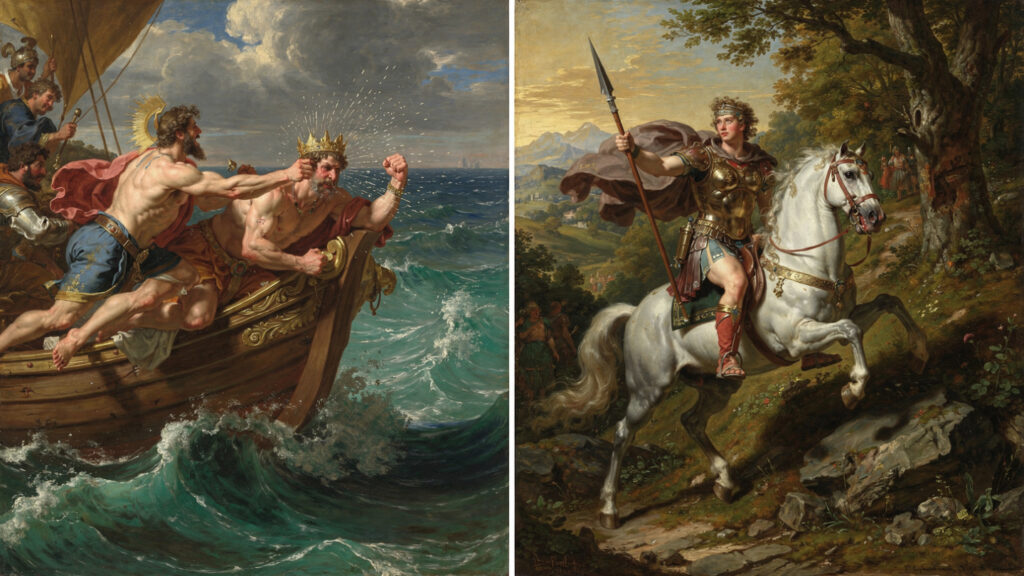
They sailed with Jason on the Argo. During that voyage, at the court of King Amycus of the Bebryces, a kingdom whose custom required every stranger to box the king before being allowed to pass, Polydeuces stepped forward and fought him and won with a blow to the temple that the sources describe with the precision of a detail worth preserving. The Argonauts continued.
They participated in the Calydonian Boar Hunt, the great pan‑Hellenic heroic gathering that brought together the generation’s significant figures to pursue the monstrous boar that Artemis had sent to devastate Calydon. Castor’s domain was horses. His riding was the best in the generation, and the tradition preserved his mount’s name, Cyllarus, with the precision reserved for animals whose quality was worth recording.
When their sister Helen was abducted by Theseus before the Trojan War, before Paris, before any of the events that the Iliad chronicles, Castor and Polydeuces were the ones who went to Athens and took her back. They invaded Attica, recovered Helen, and returned her to Sparta. The protection of their household was not theoretical. It was operational.
Homer, writing of the Trojan War, gives the figure of Helen a moment of painful clarity. Standing on the walls of Troy watching the Greek forces arrayed below, searching the ranks for her brothers, she cannot find them. Homer supplies the explanation she cannot have: they were already dead, buried in the earth of Sparta, their share of the war over before it began. The audience knew what Helen did not. The twins had died, and the world had moved on without telling her.
The Death and What Followed
The quarrel with Idas and Lynceus over cattle that led to the death of Castor is one of those myths that the ancient tradition recounts with the vivid detail of an event that left a mark.
The exact nature of the original dispute varies between sources. Cattle theft, or the contested outcome of a cattle raid, or a broken agreement over the division of spoils: the exact cause matters less than the dynamic it produced. The conflict between the Dioscuri and their cousins escalated to open violence. In the most widely accepted account, Lynceus killed Castor. Polydeuces killed Lynceus. Idas, retaliating for his brother, was struck down by Zeus before he could kill Polydeuces.
Castor was dead.
Polydeuces, the immortal son of Zeus, stood over his dead brother and faced a fact that his nature had not prepared him for. He was the kind of being that does not die. His brother was not. The distance between them, which had been invisible while both were alive and active, was now the distance between existence and its absence, and it was permanent.
He refused heaven.
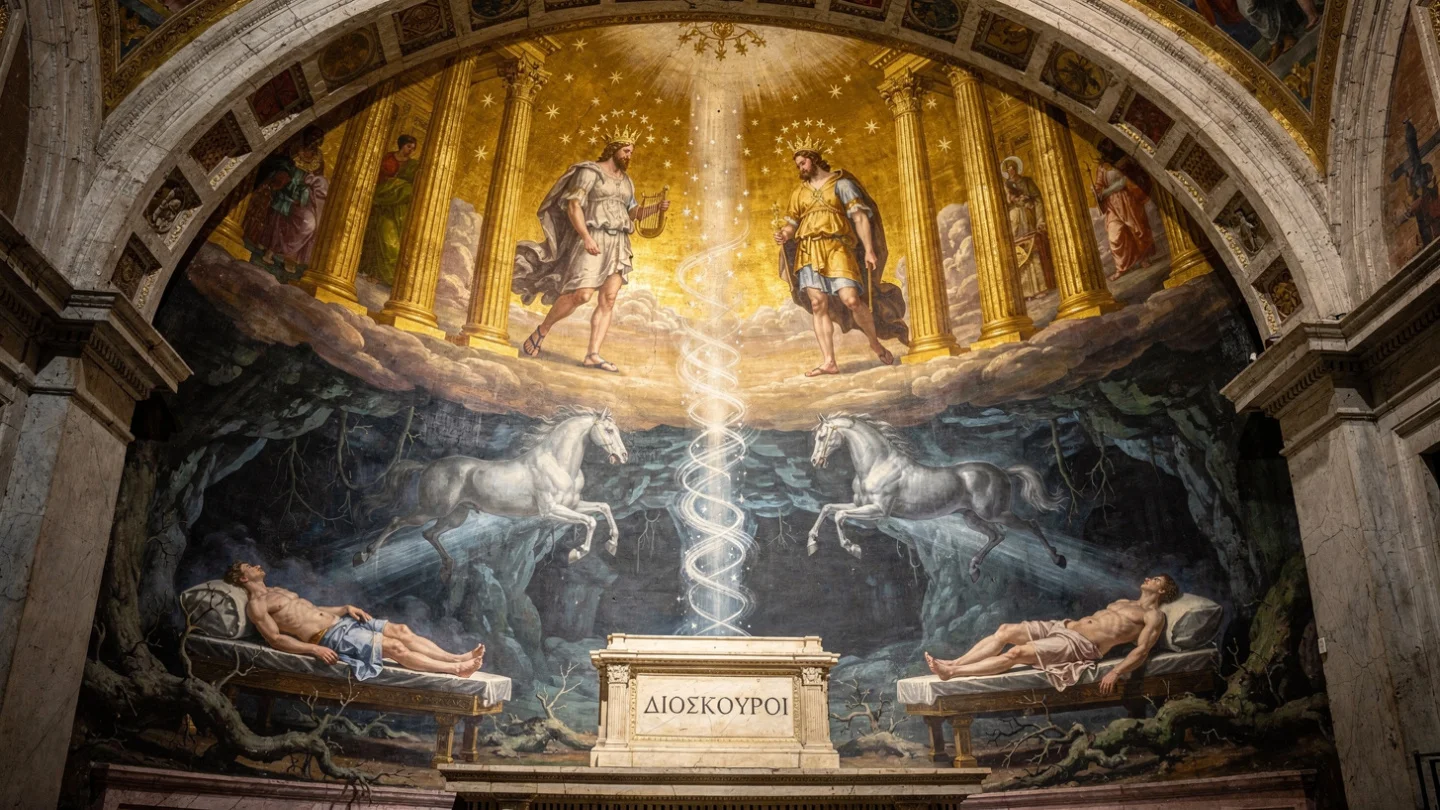
Pindar’s version is the most complete account and the one the tradition treated as authoritative. Polydeuces, unable to bear the immortality his nature entitled him to while his brother lay in Hades, asked Zeus to let him share his immortality with Castor. He was offering to give up half of what made him what he was. Half his days in Olympus, the world of the living divine. Half his days in Hades, the world of the dead, where Castor was.
Zeus granted it.
They would live on alternating days. Today Castor in Hades while Polydeuces walks in Olympus. Tomorrow Polydeuces in Hades while Castor walks in the light. Pindar’s Pythian Ode gives the arrangement its most precise poetic form: they live today within Therapnae’s dwellings, tomorrow in the halls of high Olympus.
Therapnae was the sanctuary near Sparta where both twins were believed to be buried and simultaneously venerated as living divine presences. The paradox of a tomb that is also a sanctuary was not a contradiction in the cult’s understanding. It was the physical expression of the alternating immortality: at any given moment, one twin is here, in the earth, accessible through the sanctuary’s ritual, and one twin is there, in Olympus, beyond the reach of prayer. Which is which depends on the day.
What the Greeks Were Saying
The alternating immortality of the Dioscuri is the most emotionally precise mythological response to grief in the ancient tradition.
Polydeuces’s refusal of heaven alone encodes something that the philosophical tradition struggles to articulate and that the mythology delivers with the directness of one choice, made by one person, in one moment. The self that is inseparable from a particular relationship cannot remain itself when that relationship is severed by death. The immortality that Polydeuces would carry into eternity without Castor would not be the immortality he had lived. It would be an eternal condition that had lost the relationship that made the condition worth inhabiting.
His prayer was not the prayer of a person who feared death. It was the prayer of a person who understood that the self they had been was constituted by a single bond, and that the continuation of the self beyond that bond was not continuation but substitution.
The arrangement Zeus granted did not resolve this. It maintained the asymmetry permanently. Polydeuces never got his brother back. He got every other day with him, which is not the same thing as getting him back, but which is considerably different from eternal separation. The grief does not end. It alternates.
This is the mythological structure that the Greeks built around the most common human experience of loss: not the promise of reunion, not the dissolution of the bond in eternal forgetting, but the acknowledgement that the loss is permanent and the relationship continues anyway, in whatever form the conditions of existence allow it to continue.
Rome Believed Them and Built a Temple on the Spot
The Greek myth of the alternating twins did not stay confined to Sparta and the sanctuary at Therapnae. It crossed the Adriatic, took root in central Italy, and produced one of the most enduring civic cults in the entire Roman Republic, founded on the claim that the Dioscuri could move between two places faster than any messenger Rome itself could send.
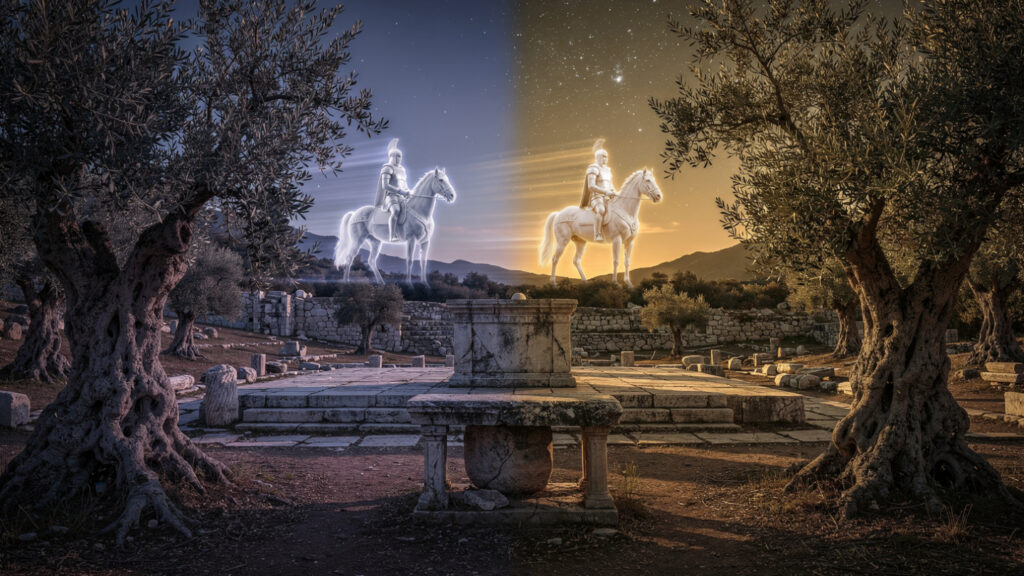
In 499 or 496 BCE, the young Roman Republic faced the army of the Latin League at the Battle of Lake Regillus, fighting to prevent the restored Tarquin monarchy from returning to power. According to the tradition recorded by Livy and by Dionysius of Halicarnassus, the Roman dictator Aulus Postumius vowed a temple to Castor and Pollux during the fighting, when the battle hung in the balance. Two young horsemen in white armour, mounted on white horses, appeared on the battlefield and fought alongside the Roman line. The tide turned. The Latins were broken.
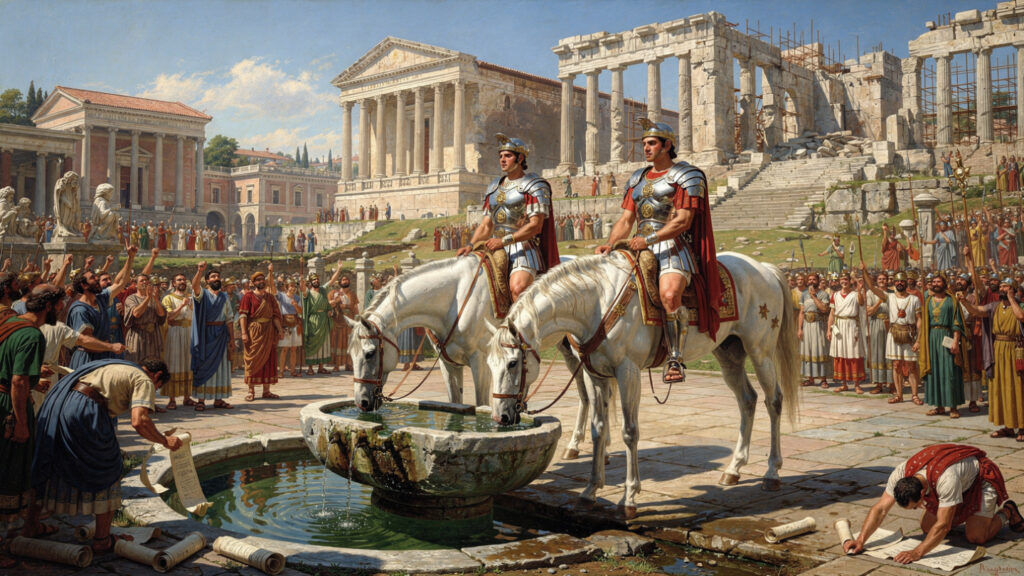
Then, before the Roman army’s own messengers could reach the city, the same two horsemen appeared in the Forum at Rome. They were seen watering their horses at the Spring of Juturna, and they announced the victory in person, having somehow crossed the distance between the battlefield and the capital faster than any human rider possibly could. The Romans understood immediately who had been on the battlefield with them.
They built the temple on the exact spot where the twins had watered their horses. The Temple of Castor and Pollux, dedicated in 484 BCE, stood in the Roman Forum for the remainder of the Republic and through the Empire, rebuilt and expanded across the centuries, its three surviving Corinthian columns still visible above the Forum today, among the most recognisable ruins in Rome.
Every fifteenth of July, the anniversary of the battle, the Romans staged the transvectio equitum. It was a cavalry parade of five thousand knights, the equites, riding in formation through the city and led by two young men chosen each year to impersonate Castor and Pollux. For centuries, the Roman cavalry class reenacted, every single year, the moment when two riders had supposedly out‑travelled every courier the army possessed. The temple’s podium was used as a speaker’s platform during the political life of the Republic, its steps functioning as a second rostra. The standard weights and measures of the Roman state were kept inside it. The strongroom in its foundations served as a treasury for private citizens who trusted divine twins more than they trusted a bank.
This is what the Greek myth of alternating presence became when a second civilisation took it seriously enough to build policy and architecture around it: not simply a story about grief and the limits of immortality, but a practical claim about speed, presence, and divine intervention at the precise moment a republic needed it most. The Romans did not receive a metaphor from the Greeks. They received two riders who could apparently be in two places at once, and they built their financial system, their cavalry tradition, and their civic religion around the conviction that this was literally true.
St Elmo’s Fire and the Sailors Who Recognised Them
The practical cult of the Dioscuri was one of the widest in the ancient world, crossing Greek and Roman and eventually early Christian traditions without losing its essential character.
They were the patrons of sailors, and their physical manifestation at sea was the electrical phenomenon now called St Elmo’s fire: the luminous plasma that appears on the tips of ships’ masts during electrical storms, visible as a pale blue or violet flame that burns without consuming the wood, most common precisely at the moments of greatest danger when the storm is at its intensity.
The ancient sailors who saw this fire knew what they were seeing. Two flames appearing simultaneously on a ship’s mast meant both twins were present and the ship would survive the storm. One flame meant one twin was absent, in Hades on his alternating day, and the situation was dangerous. The mythology was not a metaphor for the sailors who watched the mast. It was a meteorological reading system, a way of interpreting a real physical phenomenon in terms of divine presence or absence.
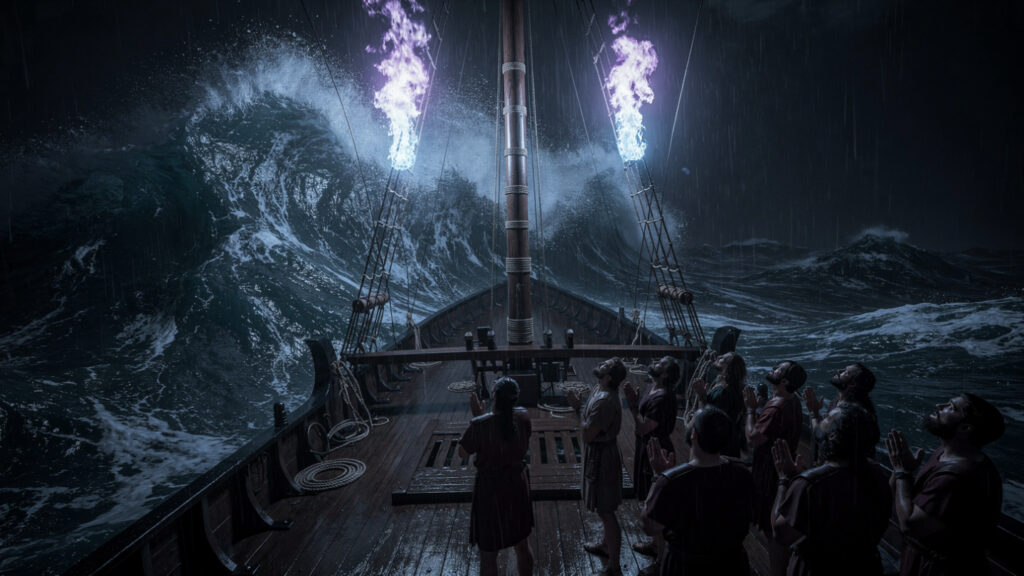
The alternating immortality that Polydeuces had negotiated at such personal cost had a direct practical consequence in the physical world: on any given night at sea in a storm, one of the twins might be in Hades rather than available to help. The sailor who saw only one flame had the mythology to explain why and the mythology to tell them that the situation was therefore more precarious than if both were present.
The Gemini and What the Sky Remembers
Zeus placed them as the constellation Gemini, the twins, the two bright stars Castor and Pollux visible on winter evenings in the northern hemisphere.
The constellation preserves the myth’s essential structure. Two stars of similar brightness, positioned close together, belonging to the same named figure in the sky, individually distinguishable but inseparable in their meaning. The star named Castor is actually a sextuple star system, six stars gravitationally bound together and appearing as one from earth. The star named Pollux is a single giant star orbited by a confirmed planet. Different in nature, similar in appearance, adjacent in the sky.
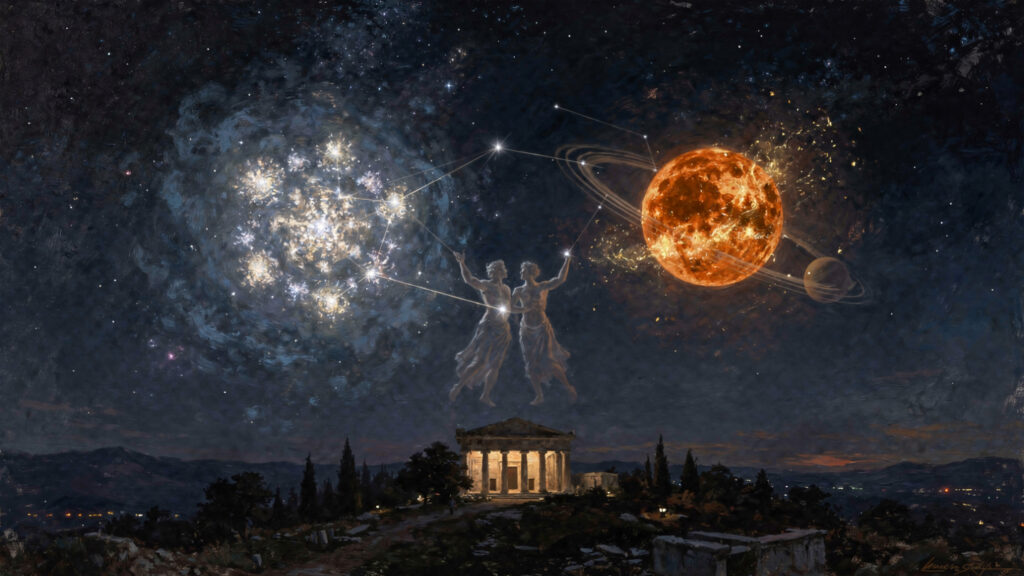
The ancient Greeks would not have known the physical details that modern astronomy reveals. They would have known that the two stars were always together in the sky, rising together, setting together, visible on the same nights in the same region of the heavens, and that this permanence of proximity was exactly what the myth required. Wherever Castor was, Pollux was nearby. Whatever separated them in the world below was not visible from the perspective of the sky.
The Alternation That Holds the World Together
The roof fell on Scopas and his guests. Simonides was already outside, summoned by two young men who were nowhere to be found when he looked for them.
He spent the rest of his life understanding what had happened in that moment and teaching others how to use space and position to hold what the mind needs to keep. The art of memory, which the Western rhetorical tradition preserved from Simonides through Cicero through the medieval mnemonic systems, began in the debt of a patron who underpaid a poet for praising the twins too generously.
Four centuries earlier, in a battle the Greeks had nothing to do with, two riders in white armour had already appeared on a foreign battlefield, helped the side that would build the most enduring civilisation the Western world produced, and then ridden ahead of every messenger that civilisation could send. Rome built a temple where their horses drank. Rome paraded five thousand cavalry past that temple every July for as long as the Republic and then the Empire stood.
They were always present in the world, on alternating days, taking turns at being available to those who needed them. The alternation was the cost of the arrangement. The arrangement was the cost of refusing to leave a brother alone in Hades forever.
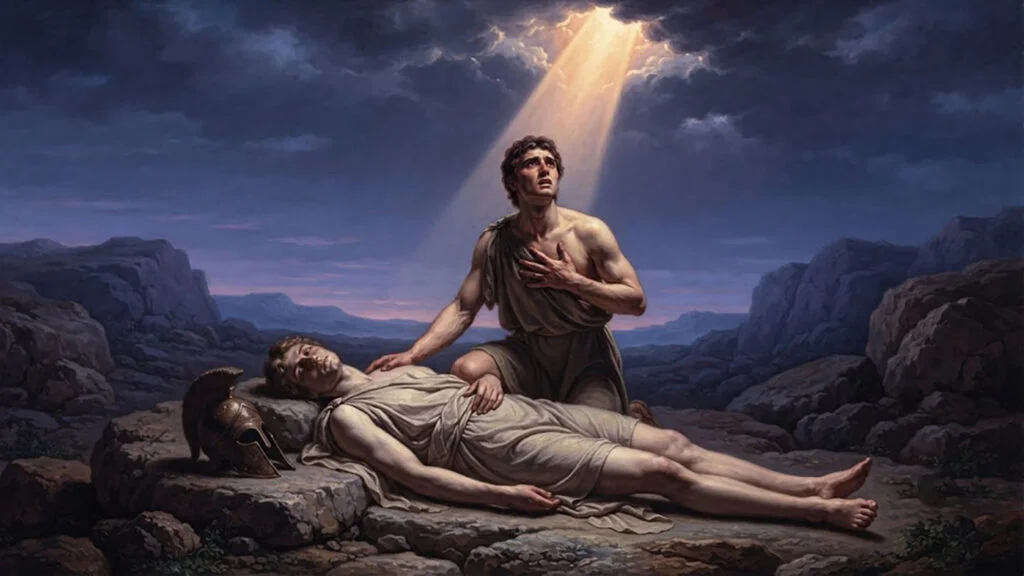
Polydeuces did not get what he wanted. He got what was possible within the structure of what death and immortality allow.
The Greeks considered this sufficient. The Romans considered it sufficient enough to build their treasury inside it. Both civilisations watched for two flames on the mast in the storm. Both told stories of riders who arrived before anyone should have been able to.
They understood that love which survives the conditions that should end it is not a lesser form of love. It is love that has found out what it is made of.
At Olympus Estate, Tales from Olympus explores the full architecture of Greek myth, including the figures whose stories carry the most precise emotional intelligence, and what subsequent civilisations did when they found those stories practically useful. The Dioscuri are not a myth about immortality. They are a myth about what a person does when immortality is offered and the terms are not acceptable, and about what happens when an entire republic decides to believe the answer.