



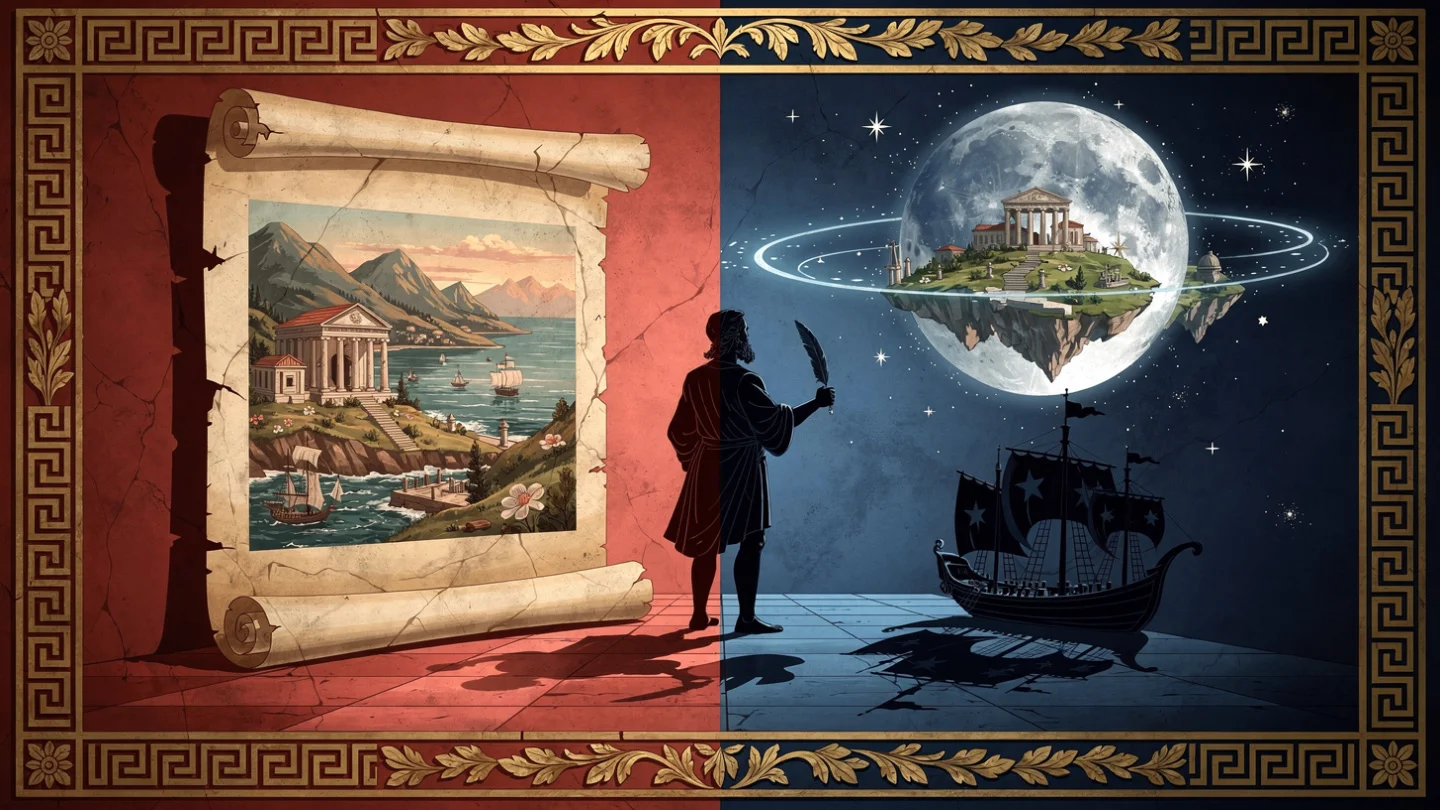
The first science fiction novel was written in the second century CE by a Syrian.
Not by Jules Verne, not by H.G. Wells, not by Mary Shelley, whose Frankenstein is conventionally cited as the genre’s founding text in the English-language critical tradition: the literary form of the narrative that imagines journeys beyond the known world through imagined technology and encounters with alien peoples and civilizations, and that uses these imaginings as the vehicle for satirical commentary on the human world left behind, was first fully realized by Lucian of Samosata in a novella written in Greek in approximately 160 CE and called Alethes Historia: A True Story, or as it is usually translated into English, A True History.
Lucian announced the satire in the opening paragraph. He told his readers directly that everything that follows is a lie, that he had no experience of any of the things he was about to describe, that he had never traveled beyond the Pillars of Hercules into the Atlantic Ocean, and that the sole truth his story contains is the statement that it contains no truth. This is the satirical move that the text was built on: the claim of the false history that exposes the false histories of the historians and travel writers who claimed to be telling the truth. Herodotus, whose Histories contained accounts of the dog-headed Cynocephali and the giant ants of India, was Lucian’s primary target. Homer, whose Odyssey Lucian read as an embellished travelogue in which the hero conveniently lost all his companions before returning to Ithaca without witnesses to contradict him, was the secondary target. A True History was the reductio ad absurdum of the tradition that confused imaginative elaboration with factual reportage: if you are going to invent things, Lucian’s text was arguing, at least be honest about the invention.
The satire that resulted from this intention is the satire that accidentally produced the genre: the text that was designed to expose the absurdity of false travel narratives by producing the most elaborately false travel narrative ever written produced, in the process of its elaboration, a set of imaginative inventions so elaborate and so vividly realized that they constitute something more than satire. They constitute the first systematic imaginative engagement in Western literature with the questions that define science fiction as a genre: what would it look like to travel beyond the earth? What kind of world might exist above the clouds? What civilizations might inhabit the Moon? What would warfare look like between the inhabitants of the Sun and the inhabitants of the Moon?
Lucian of Samosata | The Man Behind the Text
Lucian was born in approximately 120 CE in Samosata, the capital of the province of Commagene on the upper Euphrates, in the territory that is now southeastern Turkey near the Syrian border. He was not ethnically Greek: his native language was the Aramaic dialect of the Syrian region, and he learned Greek as an educated person learned the language of the civilization that the education of the Roman Empire transmitted. By the time he was writing, in the reign of Marcus Aurelius, Greek had been the language of educated culture across the eastern Mediterranean for approximately five centuries, the inheritance of Alexander’s conquests and the Hellenistic civilization that followed them, and Lucian wrote in Greek with the self-consciousness of someone who had mastered a tradition he was also positioned slightly outside.
This position outside the tradition while inside its language gave Lucian the satirical perspective that his work consistently demonstrates. He could see the Greek philosophical and literary world with the clarity of the person who has chosen it rather than inherited it, who has learned what it values rather than absorbed those values unreflectively, and who is therefore capable of observing what the world takes for granted in a way that the person born into it cannot easily achieve.
The body of Lucian’s surviving work is large. Approximately eighty texts survive under his name, though the authenticity of some is disputed, covering a range of forms including the philosophical dialogues that mockingly imitate the Platonic world, the gods’ own dialogues in which the Olympian deities are shown arguing and scheming with the pettiness of people rather than the dignity of gods, the satirical philosophical biographies of Lives for Sale and The Fisherman, and the travel‑narrative satire of A True History and the shorter Icaromenippus. He was among the most widely read ancient authors throughout the Byzantine period and in the Renaissance, when the humanist world’s recovery of his texts produced a significant influence on Thomas More’s Utopia and on Erasmus’s Praise of Folly, both works that carry the combination of the imaginative and the satirical that Lucian had developed.
The Text and Its Inventions
A True History opens with Lucian and fifty companions sailing west through the Pillars of Hercules into the Atlantic. After eighty days of sailing they encounter a violent storm that drives the ship upward through the atmosphere, and after seven days of aerial travel they arrive on the Moon: described as a bright island floating in the air, visible as the earth appears from space, which is itself an imaginative achievement for the second century CE.
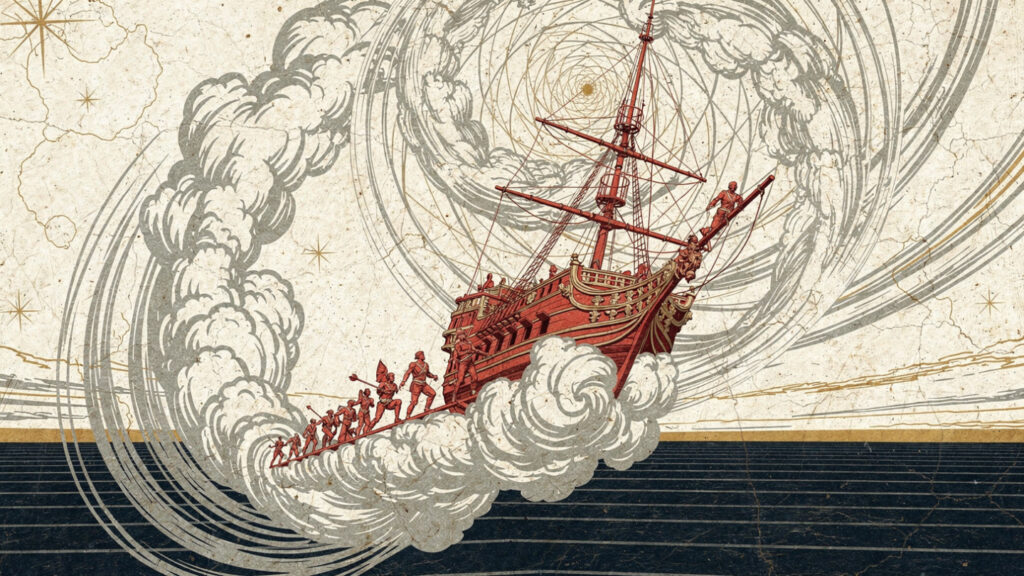
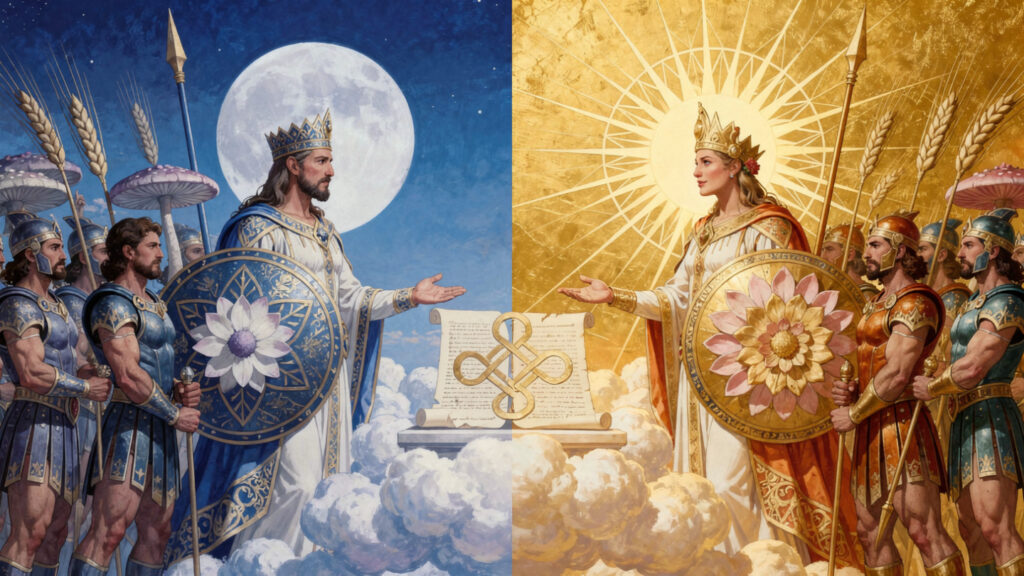
The Moon is inhabited. Its king is Endymion, the mortal who in the Greek mythological tradition was beloved by the Moon goddess Selene and granted eternal sleep rather than death, here translated into the king of the lunar civilization rather than a sleeping figure on a hillside. He is at war with Phaethon, the king of the Sun, over control of the planet Venus, and Lucian’s crew is conscripted into the Moon’s army.
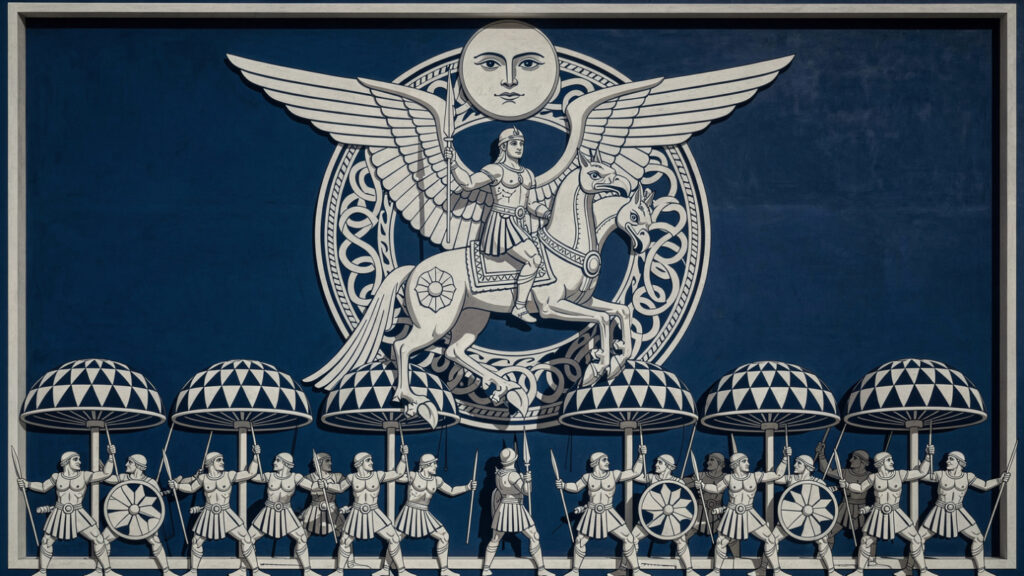
The inventions in the military sequences are the inventions that have attracted the most attention from readers interested in the text’s relationship to science fiction. The Moon’s warriors ride giant three-headed vulture-horses, which Lucian describes in enough mechanical detail to suggest a flying transport capable of carrying armored soldiers. The Moon’s army includes units of soldiers who use giant mushrooms as shields and asparagus stalks as spears, which is clearly satirical, and units of vegetable-birds whose wings are made of giant lettuce leaves, which is equally clearly satirical, and the mixture of the clearly absurd and the specifically detailed is the technique of the text throughout: the satirical invention and the serious speculation are woven together so that the reader cannot always tell which is which, and the inability to distinguish them is the text’s satirical point.
The battlefield is constructed by giant spiders whose webs, stretched between the Moon and the nearest stars, form a platform large enough to support the armies. The Sun’s forces include Cloud-Centaurs, hybrid beings of the kind that the Greek mythological tradition had always associated with the boundary between the human and the divine, and giant gnats used as aerial cavalry.
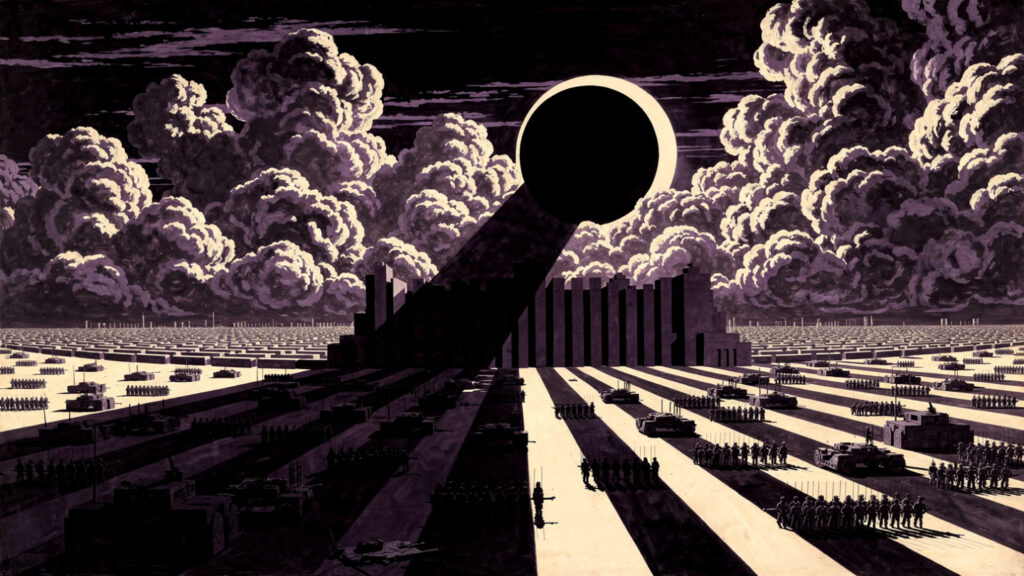
The war ends by treaty when the Sun’s king darkens the Moon by building a wall of clouds, producing the first military application of solar eclipse in literary history. The peace terms are negotiated, a treaty is signed, and Lucian’s crew departs.
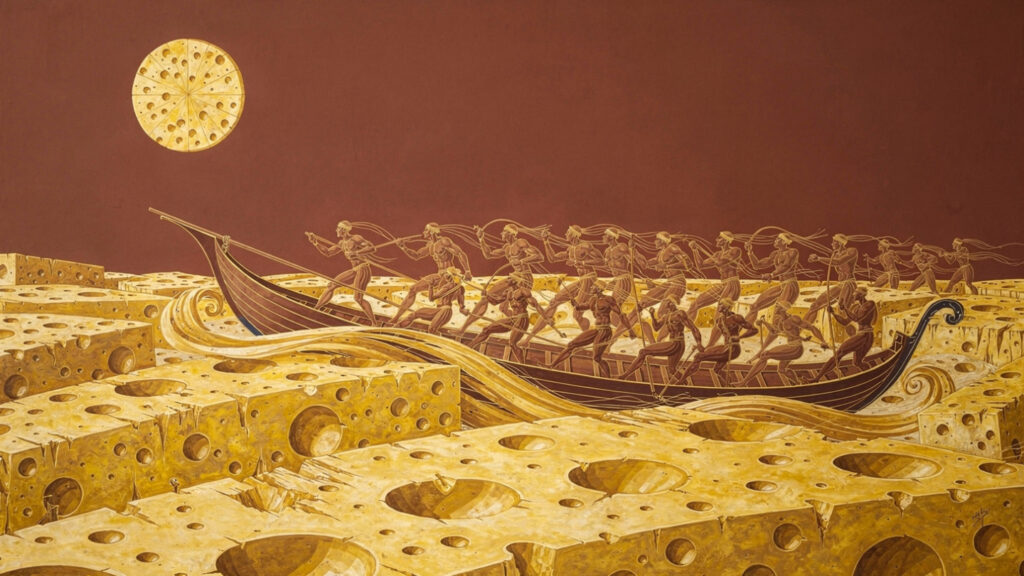
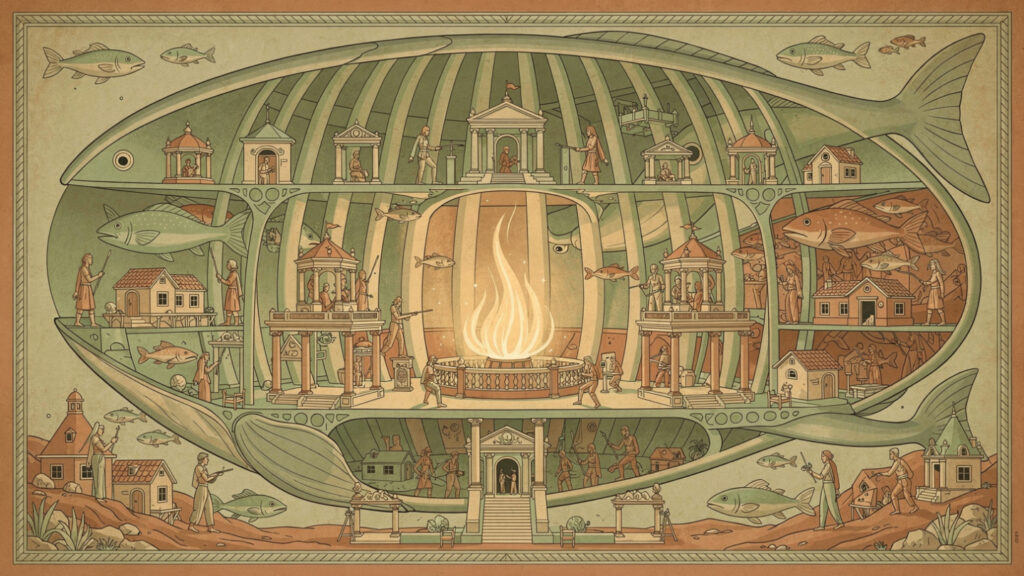
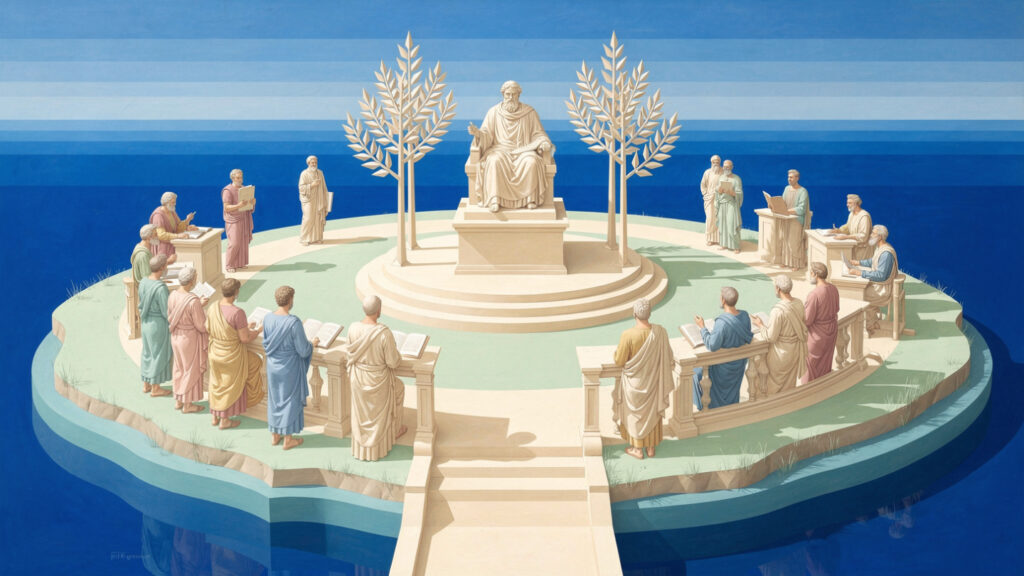
The subsequent adventures take the crew into the interior of a 200-mile whale that contains within it an entire society of fish-people, an inland sea, and various political factions living in permanent conflict. After escaping by fire, they sail through seas of milk and cheese, visit an island made entirely of cheese, and arrive at the Island of the Blessed, the Greek afterlife’s most favorable precinct, where they find Homer in residence and discover that Herodotus has been condemned to punishment for his false histories.
The text ends without resolution: Lucian simply announces that more adventures followed and that he will narrate them in subsequent books, books that were either never written or have not survived. The open ending is itself part of the satirical structure: the travel narrative whose conclusion is perpetually deferred is the travel narrative that the epic tradition had established, and Lucian’s refusal to bring his story to a proper conclusion is the refusal to provide the formal satisfaction that the genre demands.
The Intellectual Context
A True History was produced in the intellectual environment of the Antonine period of the Roman Empire, the period between Hadrian’s accession in 117 CE and the death of Commodus in 192 CE, which the historian Edward Gibbon identified as the period in which the Roman world was governed most wisely and the quality of human life within its borders was at its historical peak.
In this environment, the intellectual interests that gave A True History its content were more developed than the text’s satirical framing might suggest. The question of what the Moon was made of and whether it was inhabited had been a serious subject of ancient philosophical and scientific inquiry for several centuries before Lucian wrote. Plutarch, the essayist and biographer whose Table Talk the dining article in this collection discusses, wrote a treatise called On the Face in the Moon that is a genuinely sophisticated philosophical and physical inquiry into the Moon’s nature: Plutarch argued that the Moon was a physical body similar to the Earth, with mountains and valleys and possibly an atmosphere and possibly inhabitants, and he engaged with the scientific arguments for and against this position with the attention that the Platonic tradition brought to natural philosophical questions.
Aristarchus of Samos had proposed in the third century BCE that the Earth orbited the Sun rather than the reverse, the heliocentric hypothesis that Copernicus would independently develop eighteen centuries later. Eratosthenes had calculated the circumference of the Earth to within approximately two percent of its actual value using shadow measurements at different latitudes. Hipparchus had produced the most accurate ancient star catalogue and had calculated the Moon’s distance from the Earth using parallax measurements. The ancient Greek scientific tradition had, by Lucian’s time, developed a sophisticated observational and theoretical astronomy that provided genuine reasons to take seriously the questions that A True History imagines.
The Antikythera mechanism, the bronze computational device for tracking astronomical cycles that was recovered from a first-century BCE shipwreck and that modern analysis has revealed to be of extraordinary mechanical sophistication, is the material evidence for the practical engineering capacity that the ancient astronomical tradition was able to deploy. The culture that produced the Antikythera mechanism was the culture in whose intellectual atmosphere Lucian wrote.
The Satirical Targets
The targets of Lucian’s satire in A True History are the targets that his other works also engage: the historians and travel writers who claimed to report truth while embellishing it, the philosophers who claimed to have knowledge of the divine and the cosmic that no human being could possess, and the poets who claimed their fictions were reports of actual events.
Herodotus is the primary historian target: his Histories contain extended accounts of the Cynocephali and the Sciapods and the giant gold-digging ants of India and the phoenix of Arabia, all presented in the same factual register as the accounts of the Persian Wars that the modern reader accepts as historical. Lucian’s satirical move was to out-Herodotus Herodotus: to produce an account of travels and wonders so obviously false, so specifically announced as fictional, that the reader could not miss the contrast with the Herodotean tradition of presenting fictions as facts.
The philosophers who speculated about the Moon were the secondary targets: Plutarch’s serious philosophical inquiry into lunar habitation was the background against which Lucian’s comic habitation of the Moon appeared. The contrast between Plutarch’s careful philosophical hedging about what the Moon might contain and Lucian’s detailed comic specification of exactly what it contains and exactly who lives there and exactly what they are fighting about was the contrast that the satirical text exploited.
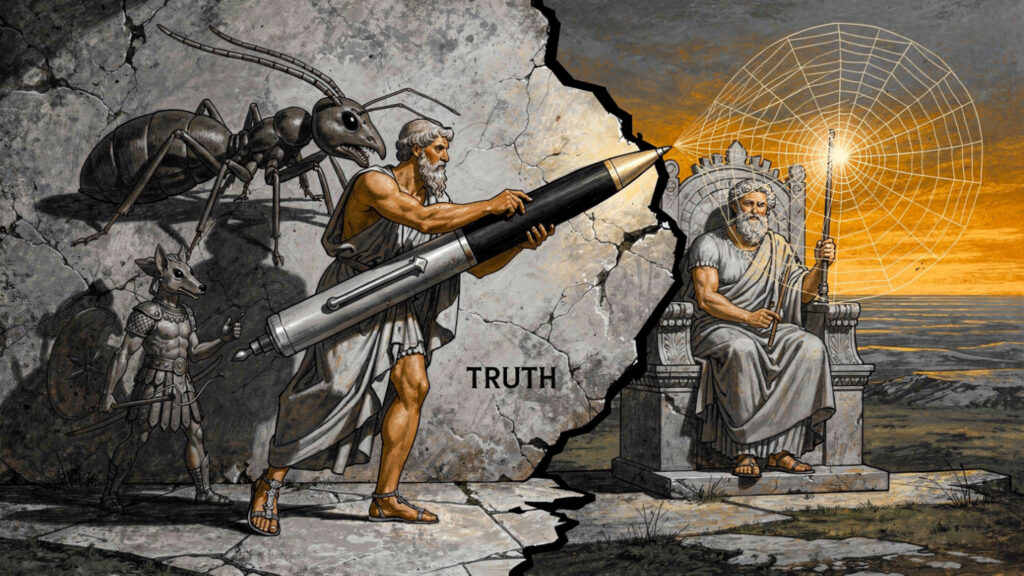
Homer was the literary target: the Odyssey as the travel narrative whose hero conveniently encountered wonders that no one else witnessed and survived dangers that killed all his companions was the model that A True History was specifically parodying by escalating every element of the Odyssean travel narrative to the point of obvious absurdity. Lucian’s whale is the Cyclops’s cave taken to its logical extreme: an enclosed space large enough to contain not just Odysseus and his men but an entire society.
The Genre Lucian Founded
The literary tradition that A True History initiated was not recognized as such until the critical world caught up with it in the twentieth century, when the science‑fiction genre had developed sufficiently to allow readers to recognize in Lucian’s work the formal features that the genre had institutionalized.
H. G. Wells acknowledged A True History as a direct precedent for The First Men in the Moon, his 1901 novel about lunar travel and the discovery of an insectoid lunar civilization. The parallel between Lucian’s organized lunar society with its king and its army and its conflict with the Sun’s forces and Wells’s Selenites with their organized society and their conflict with the human visitors is close enough that the acknowledgment was honest recognition of a source rather than simply polite intellectual generosity.
Cyrano de Bergerac’s Histoire comique des États et Empires de la Lune, published in 1657, is the intermediate work between Lucian and Wells that most directly transmitted the Lucianic world into the modern European literary consciousness. Cyrano’s narrator travels to the Moon by a variety of increasingly absurd mechanical means, encounters a lunar civilization, and engages in philosophical and satirical dialogues that are clearly modeled on Lucian’s combination of the fantastic and the critical.
Jonathan Swift’s Gulliver’s Travels, published in 1726, is the work in the English‑language literary world that most completely realizes the Lucianic program without specifically acknowledging it. The narrator who travels to impossible destinations that serve as the settings for satirical commentary on the human world left behind is the Lucianic structure, and the targets of Gulliver’s Travels, the English political culture and the philosophical pretensions of the Royal Society, are targets in the Lucianic mode of the satirist who uses the fantastic as the vehicle for pointed observation about the actual.
Thomas More’s Utopia, Erasmus’s Praise of Folly, Voltaire’s Candide, Samuel Butler’s Erewhon: the literary world of the satirical fantastic narrative that uses impossible destinations or impossible circumstances as the occasion for social criticism is the world that A True History founded, and its influence on the subsequent Western literary imagination is among the most underacknowledged of the significant ancient works.
Reading Lucian Today
A True History is a short text: approximately twenty thousand words in the original Greek, readable in a single long sitting in any of the several modern English translations. The most widely available English translation is the nineteenth-century version by Francis Hickes, revised by A.M. Harmon for the Loeb Classical Library edition, and the more recent translation by Paul Turner for Penguin Classics is the translation that most successfully renders Lucian’s comic timing in contemporary English.
The pleasure of the text for the contemporary reader is the pleasure of encountering a voice from the second century CE that is more recognizably contemporary in its satirical mode than almost any other ancient text: the dry announcement that everything that follows is a lie, the escalation of each absurd element past the point of straight-faced acceptance, the sudden deflation of the grandiose, and the consistent observation that the human impulses toward greed and conquest and self-deception do not change regardless of whether the battlefield is in Argos or on the Moon.
The text that Lucian announced was false is the text that turned out to be the foundation of one of literature’s most productive traditions. The genre he accidentally invented while mocking the genres of his time is the genre that has produced more readers in the twentieth and twenty-first centuries than any other. He would have found this outcome completely appropriate and moderately funny.
At Olympus Estate, Mythic Essays moves through the deeper currents of the Greek tradition. Lucian of Samosata told his readers in the opening paragraph that everything that follows is a lie and that the sole truth his story contains is the statement that it contains no truth. Then he invented science fiction. The Moon in his text is inhabited by warring civilizations led by Endymion and Phaethon. The Sun builds a wall of clouds to darken the Moon and force a treaty. Herodotus in the afterlife is being punished for his false histories. The satirist whose target was the false history produced the truest account of what the human imagination can do when it stops pretending to report facts and simply admits that it is making things up.