

The olive tree that Athena planted on the Acropolis was still there when the Persians burned it.
This is not a detail that belongs only to the mythological dimension of the story. Herodotus, writing in the fifth century BCE, records that on the day after the burning of the Acropolis in 480 BCE, the Athenians who returned to the ruined sanctuary found that the charred trunk had produced a new shoot approximately two cubits in height overnight. Pausanias, who visited Athens in the second century CE, described an olive tree growing on the Acropolis in the Erechtheion’s precinct that the Athenians identified as the tree Athena had planted, or as its direct descendant, the living continuity of the mythological event in the form of a living tree.
The relationship between the myth of Athena’s gift and the physical olive tree on the Acropolis was not, for the Athenians, a relationship between a story and a symbol. It was a relationship between an event and its evidence. The tree was there. It had been there since the contest. It had survived, or at least its descendant had survived, the burning that the Persians inflicted on everything else. The shoot that appeared the morning after the fire was read not as the resilience of a common plant but as the confirmation of divine intention: the goddess had not abandoned the city along with the Acropolis.
The Contest and Its Setting
The myth places the contest between Athena and Poseidon on the Acropolis, which in the mythological account of Athenian origins was not yet the site of the city’s defining monuments but a bare limestone rock, a high point of terrain overlooking the plain of Attica that the first settlers had recognized as defensible and sacred before the city that would surround it had been built.
King Cecrops presided. The accounts describe Cecrops as the first king of Athens and as a being of dual nature, man above the waist and serpent below, a form that associated him with the chthonic powers of the earth and with the oldest religious practices of the Attic landscape. His role as witness and judge in the contest placed the decision about the city’s divine patronage in the hands of the oldest human presence in the region, the being whose nature connected the human political order to the earth itself.
Poseidon went first. He struck the Acropolis rock with his trident and a spring of saltwater burst from the rock, producing what the ancient sources called the Erechtheion sea, a small body of saltwater on the summit of the Acropolis that remained there throughout the classical period and was shown to visitors as evidence of the contest. The saltwater spring was Poseidon’s gift: a demonstration of his power over the sea and its connection to the land beneath the city, an offer of naval capability and maritime dominance.
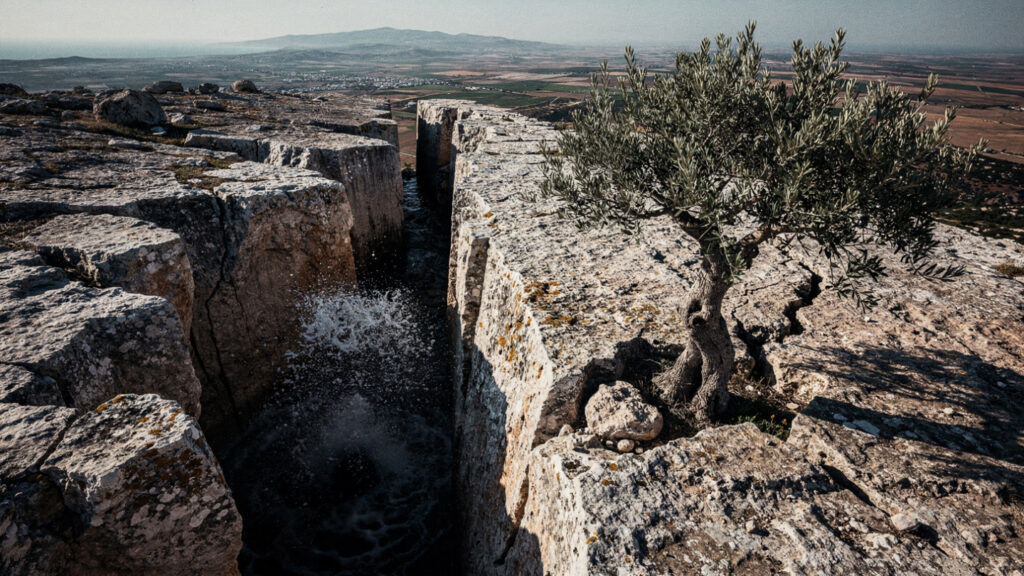
Athena struck the same rock with her spear. From the point of impact, an olive tree grew.
The comparison between the two gifts was what the myth was built to explore, and the comparison is more complex than the simple contrast between salt water, which cannot be drunk or used to irrigate crops, and an olive tree, which provides food and oil and wood and the basis for trade, might suggest. Poseidon was offering the city a relationship with the sea: access to maritime commerce, naval power, the possibility of empire built on the control of sea routes. These were not trivial gifts. The Athenian maritime empire of the fifth century BCE, which made Athens the wealthiest and most powerful city-state in Greece, was built on exactly the capabilities that Poseidon was offering.
What Athena offered was different in its orientation. The olive tree was not a demonstration of power. It was a demonstration of care for the conditions of ordinary life: the food, the oil, the economic stability that the olive provided in the Mediterranean world. The choice between the two gifts was a choice between two modes of civic life, and the tradition recorded that Cecrops chose the one whose benefits were distributed across the whole of the city’s population rather than concentrated in the military and commercial elite who operated the ships.
What the Olive Provided
The olive tree’s position in the Mediterranean world of antiquity requires some account if the weight of Athena’s gift is to be properly understood.
The olive is not a tree that produces quickly. A newly planted olive requires several years before it produces its first significant crop, and it reaches full productivity only after several decades. An olive grove is an investment across generations, a commitment to a piece of land and a place that the tree itself enforces through its slow maturation. Olive groves in the Mediterranean world were understood as the most direct material expression of a community’s permanent relationship with its land, the agricultural equivalent of the walls and temples that made a settlement into a city.
The products of the olive tree sustained Mediterranean life across every domain. The oil pressed from the fruit provided cooking fat in a cuisine that was otherwise without animal fats in the quantities that northern European cuisines relied on. It provided lighting fuel, in the form of the oil burned in clay lamps that were the primary light source of the ancient world. It provided the base for cosmetics and medicinal preparations. It provided the oil that athletes rubbed on their bodies before competition and that the victors at the great games received in the specially marked amphorae that Athens gave as prizes. The branches of the olive tree provided the crowns worn by Olympic victors in the earliest period of the games.
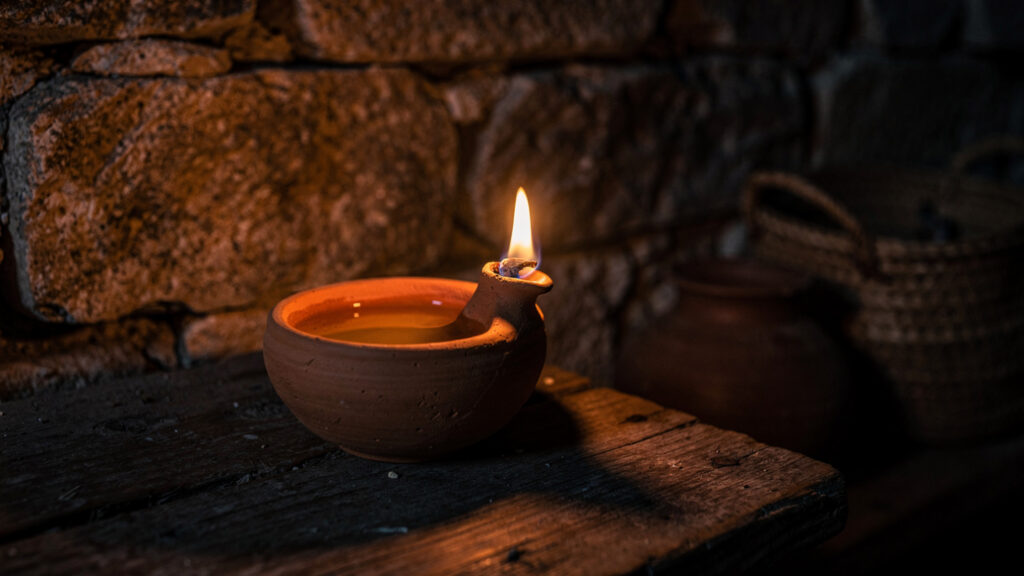
The Athenians who chose Athena’s gift chose not only the immediate utility of a particular tree. They chose the entire system of production, trade, and daily life that the olive sustained, and they chose the orientation toward the cultivation of the land that the olive represented against the orientation toward the mastery of the sea that Poseidon had offered.
The myth did not record that the other choice was wrong. It recorded that Cecrops and the Athenians made a choice, and that the city that resulted from that choice was the city that Athens became: a city of olive groves and the products of olive groves, of craftsmen and merchants and philosophers and dramatists and the particular civic culture that Athens developed in the centuries after the mythological contest on the Acropolis.
Maria Elaia and the Descent of the Groves
The name Maria Elaia, preserved in the accounts as the name of the first olive tree, encodes a claim about the relationship between Athena’s gift and the olive groves of the Mediterranean world.
Elaia is the Greek word for the olive tree, and the narrative that associated the name Maria with the original tree preserved the claim that all subsequent olive cultivation descended from this origin. The Athenians believed, or at least the literature asserted, that the olive groves that covered the hills of Attica and spread across the Mediterranean world from Crete to the coasts of North Africa and the Iberian Peninsula were the biological descendants of the tree that Athena had produced on the Acropolis.
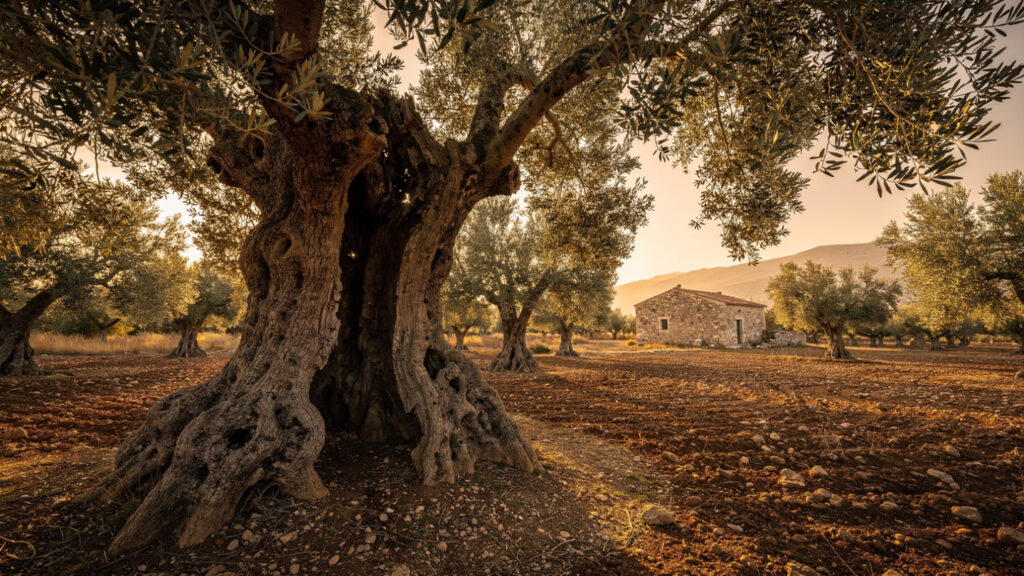
This is not an agricultural claim in the strict sense. The olive had been cultivated in the Mediterranean world before the mythological date of the contest, and Minoan Crete was producing and trading olive oil centuries before the city of Athens existed in any form recognizable to classical history. The claim is a theological one: that the olive’s presence in the world as a cultivated plant, as a source of sustenance and wealth and cultural practice, was the result of divine intention expressed through Athena’s gift.
The descent of all the world’s olives from Maria Elaia is the myth’s way of asserting that wherever the olive was cultivated in the Mediterranean world, the cultivation was an extension of Athens’s relationship with its goddess. Every olive grove in Attica was connected to the Acropolis not merely by agricultural practice but by mythological lineage.
Potnia Athana and the Older Tradition
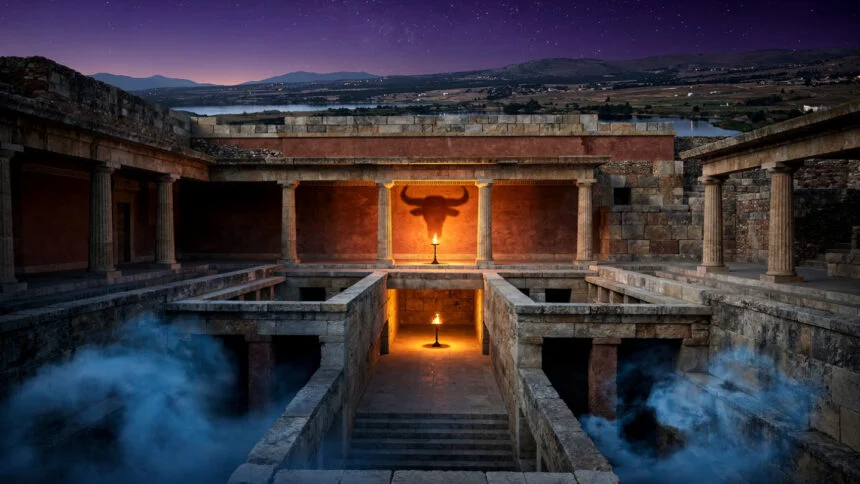
The Linear B tablets recovered from Knossos include, among their administrative records, a reference to Potnia Athana: the Lady Athena, a divine figure receiving offerings within the Minoan palace administrative system.
The Linear B script was the writing system of the Mycenaean Greek world, and its presence at Knossos reflects the Mycenaean occupation of the palace in its final period. The Potnia Athana reference places a recognizable form of the goddess Athena within the religious practice of Crete no later than the fourteenth or thirteenth century BCE, several centuries before the classical Athenian cult of Athena developed into the form that the Parthenon represents.
The Cretan accounts preserved a story of Athena’s birth near the mouth of the Triton River in Crete, distinct from the mainland version of her birth from the head of Zeus. In this regional narrative, Athena’s association with the olive was not a gift made to Athens, but an offering to the oldest European civilization, the Minoan world that preceded the Greek one and was subsequently absorbed and partially inherited by the Mycenaeans.
These two strands of lore do not contradict each other so much as they reflect the multiple origins of a cult that was already ancient when the classical period systematized it. The goddess who was worshipped as Potnia Athana in Minoan era Crete, who produced or gifted the olive in the Cretan account, and who struck the Acropolis rock with her spear in the Athenian contest myth was a figure whose cult had been present in the Aegean world long enough to develop distinct local practices in different regions, long before the political dominance of Athens in the fifth century BCE gave the Athenian version its subsequently canonical status.
The olive trees of Crete predate the classical Athenian myth. The Minoan economy was substantially built on olive oil production and trade centuries before the Acropolis contest was placed in its mythological time frame. The Cretan claim that Athena gave the olive to the Minoans first may be less a competing story than an older layer of the same lore, preserved in Crete because Minoan cultural memory was not overwritten by Athenian political dominance in the way that other regional accounts were.
The Persian Fire and the Morning After
The Persian sack of Athens in 480 BCE, which followed the Athenian evacuation of the city and the burning of the Acropolis by the forces of Xerxes, was the most catastrophic event in the city’s history to that point and the event that the subsequent Athenian recovery and the victories at Salamis and Plataea transformed into the founding myth of Athenian greatness.
When the Athenians returned to the burned Acropolis, the sanctuary was destroyed. The temples were in ruins. The dedications that worshippers had placed at the shrine over generations were gone. The sacred olive tree, the living connection between the city’s present and the mythological event of its founding, had been burned with everything else.
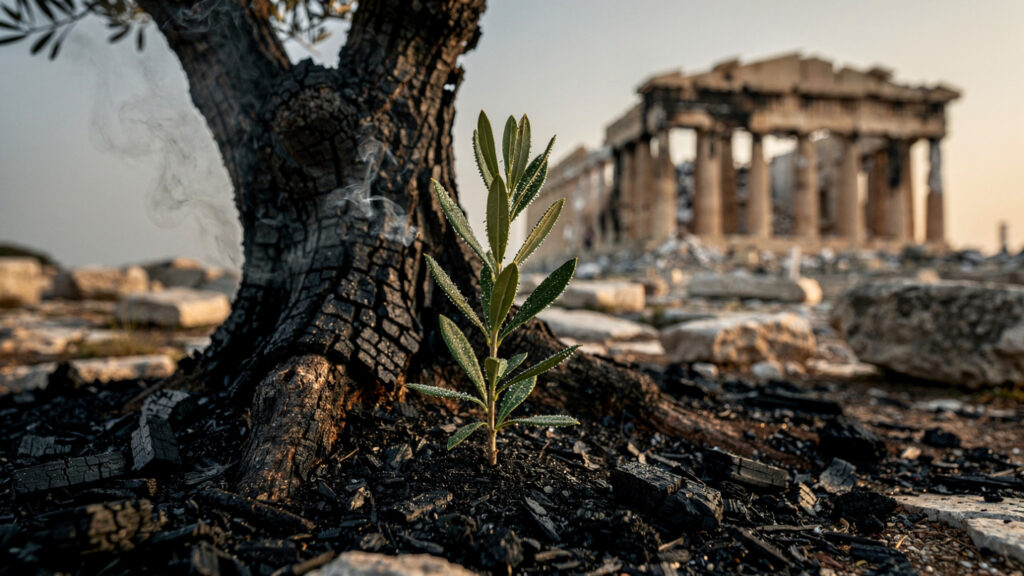
The shoot that appeared the following day was approximately two cubits in height, according to Herodotus. The measurement is and the specificity is significant: this was not a general report of renewed growth but an account precise enough to have come from someone who was present and who measured what they found. Two cubits is approximately ninety centimeters. An olive shoot of that height appearing overnight from a burned trunk was not botanically impossible, since olive trees are known for their capacity to regenerate from the base after fire damage, but it was sufficiently remarkable in the circumstances to be recorded and to be read as divine confirmation.
The Athenians who saw the shoot the morning after the Persian burning were looking for exactly this kind of sign. The city had been evacuated, the sanctuary burned, the religious and cultural continuity of Athens disrupted by the most comprehensive destruction the city had experienced. The olive shoot was confirmation that the goddess had not departed with the Persians’ arrival. The tree whose mythological origin connected the city to Athena’s choice had survived the fire, as the city itself would survive, as the Persian fleet would not survive Salamis.
The symbolism was available to the Athenians who read it, and Herodotus records that they did read it. The shoot that appeared from the burned trunk of the olive was incorporated into the narrative of divine favor that the victories of 480 and 479 BCE generated, the story that Athens told about why it had survived and what the survival meant.
The Acropolis Olive Today
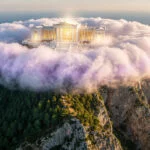
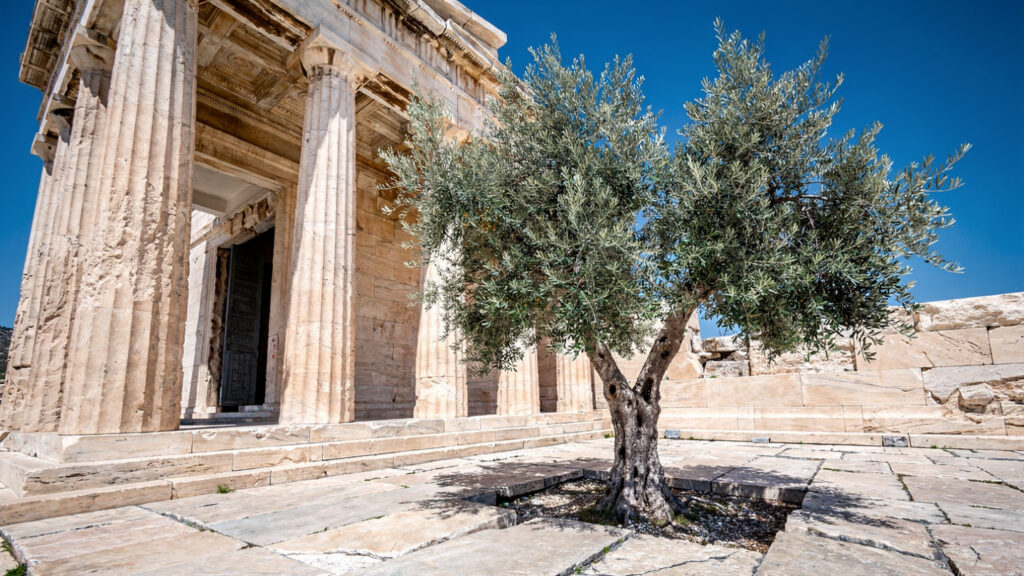
The Erechtheion, the temple built on the Acropolis in the late fifth century BCE to house the most ancient sacred objects of Athenian religion, was built on the spot where the contest between Athena and Poseidon had been mythologically located. Within the Erechtheion’s north porch, an opening in the floor showed visitors the marks left by Poseidon’s trident strike. Adjacent to the Erechtheion, in the precinct that the temple enclosed, grew the olive tree that the Athenians identified as Athena’s.
The tree that Pausanias saw in the second century CE was not the original tree. The original had been burned by the Persians. Its successor had grown from the shoot. The sanctuary had been destroyed and rebuilt. The tree that stood in the classical period and that Pausanias described was the descendant of the shoot that appeared the morning after the Persian fire, itself a descendant, in the mythological account, of the tree that Athena had produced when she struck the Acropolis with her spear.
The Acropolis today carries a descendant of this tree in the same position. The olive that grows in the precinct adjacent to the Erechtheion is a living thread connecting the mythological account of the city’s founding to the present moment, maintained by the continuity of cultivation and of intention: the decision of each generation to keep the tree there, in that place, as the evidence of what Cecrops chose and what Athens became.
The olive groves of Attica are still productive. The hills visible from the Acropolis, which carried groves in the classical period, carry them still. The oil they produce is pressed in mills that operate by the same basic principle as the mills of antiquity, gravity and stone and time.
Maria Elaia’s descendants, if the tradition is taken on its own terms, grow across the Mediterranean from the Iberian coast to the Levantine shore. The gift that Athena made on the Acropolis is the gift that still produces the oil in the bottle on the table, the one that came from a grove on a hillside in Attica or Crete or the Peloponnese, in soil that the olive has been growing in since before the classical city was built.
The myth explains why the olive tree carried this weight for the Greeks. What actually grows on Greek soil today, the specific cultivars descended from that first contested gift, is its own story.
At Olympus Estate, Mythic Symbols and Lineage traces the emblems that form Greece’s symbolic inheritance, from the trident mark beneath the Erechtheion to the olive shoot that appeared the morning after the Persian fire. The oldest symbols grow back from the root.