

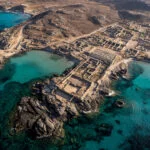
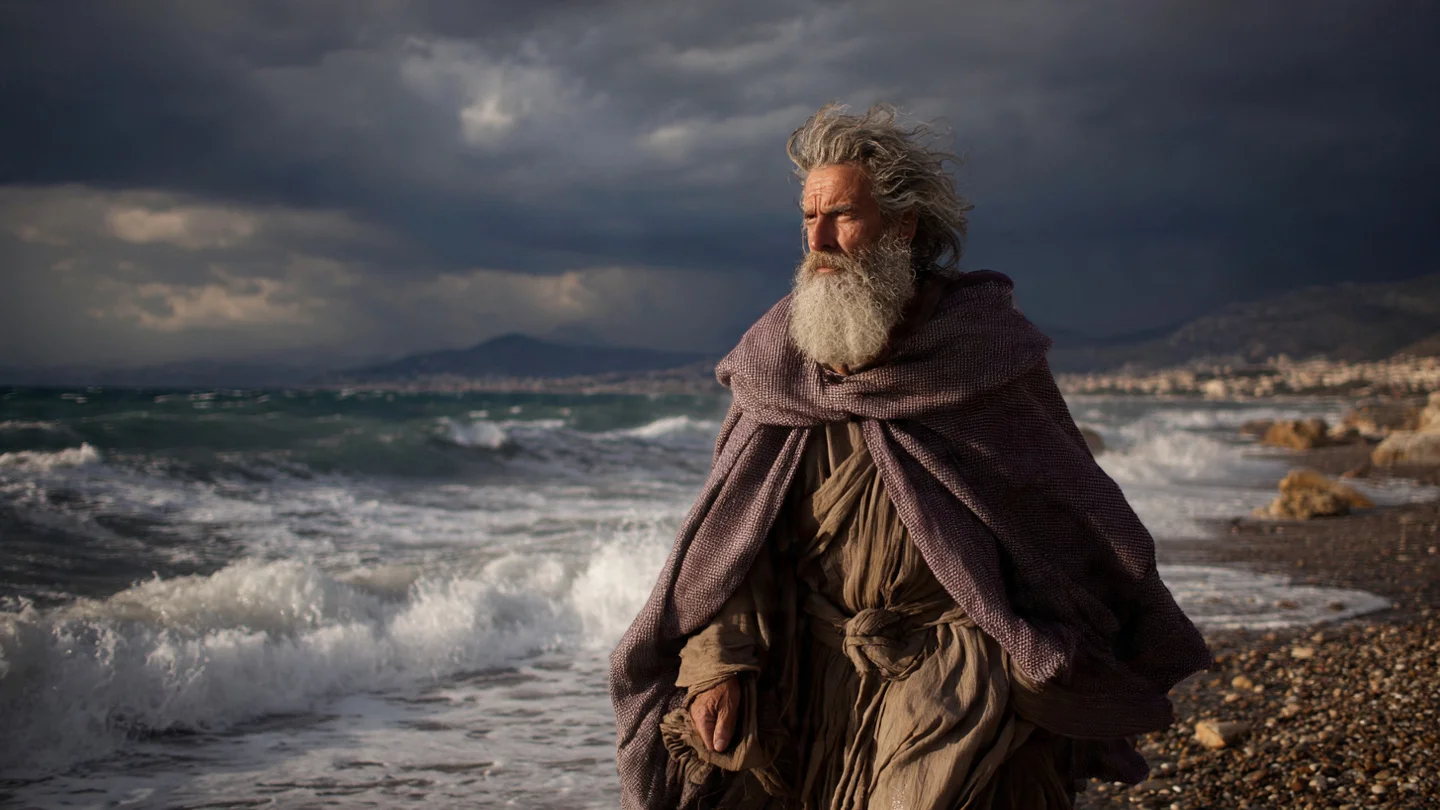
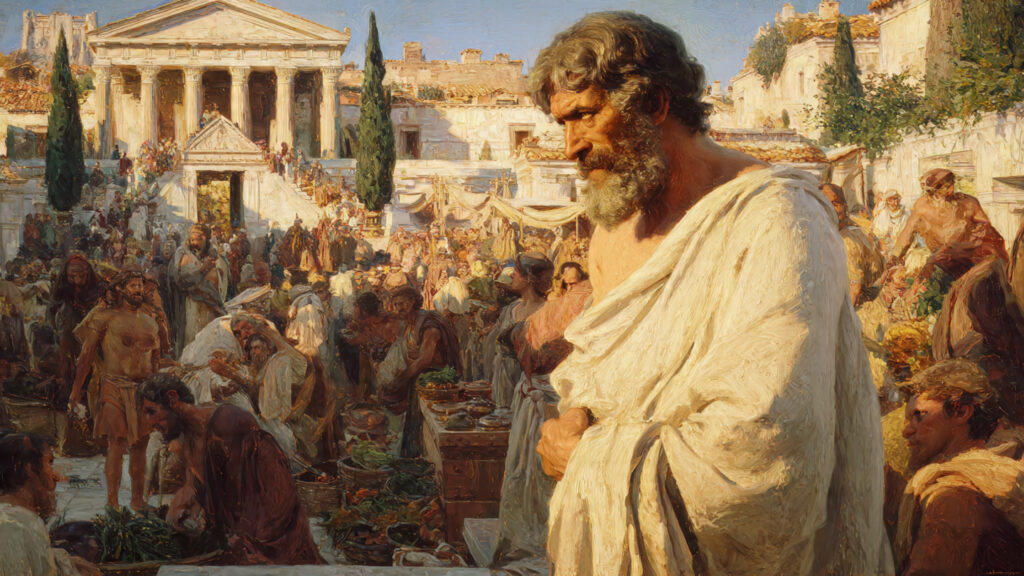
Zeno of Citium arrived in Athens around 300 BC after surviving a shipwreck near Piraeus. The loss of his Phoenician purple cargo forced him into a new life, and he turned to philosophy under Crates the Cynic. In time he founded his school in the Stoa Poikile, the Painted Porch, an open colonnade on the northern edge of the Athenian Agora. Unlike the Academy or the Lyceum, the Stoa was not a private retreat. It was a public artery of the city, decorated with murals of the Battle of Marathon and the Sack of Troy. Stoicism emerged in a place where weather, noise, and human movement refused to cooperate. It was a philosophy shaped by exposure.
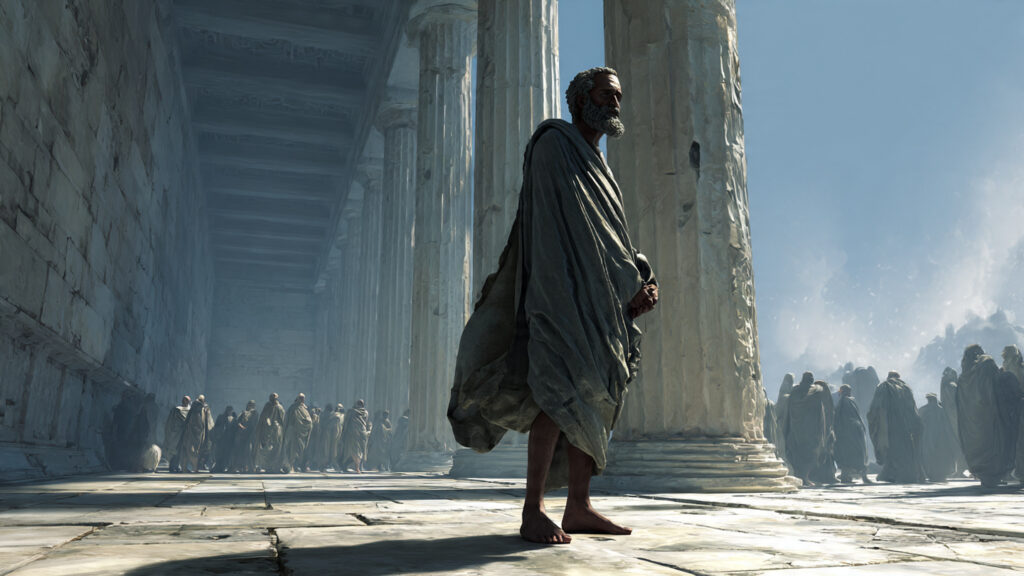
The marble floor of the Stoa Poikile remains cold long after the sun has passed the roofline. Winter in the Athenian Agora carries the smell of wood smoke from clay braziers and the damp weight of unwashed wool. Boreas moves through the columns with a sharp, whistling edge. The limestone foundations are grey. The shadows are long. Men once stood here barefoot on stone, speaking of virtue while the wind cut through their cloaks. The environment was not a backdrop. It was a teacher. The early Stoics used the cold as a calibration device. They stood in the wind to prove that the mind could remain still.
The Painted Porch as Environmental Philosophy
The Stoa Poikile was a technical achievement that merged architecture, art, and civic life. The murals of Polygnotus and Micon were not decoration. They were a visual curriculum of triumph and tragedy. The space was open to the elements, which meant that any student of Zeno had to test their philosophy in real conditions. No walls softened the rain or the dust. The porch demanded that thought survive the market’s noise and the winter’s bite. It was a bridge between private reflection and public struggle, a site of constant environmental feedback.
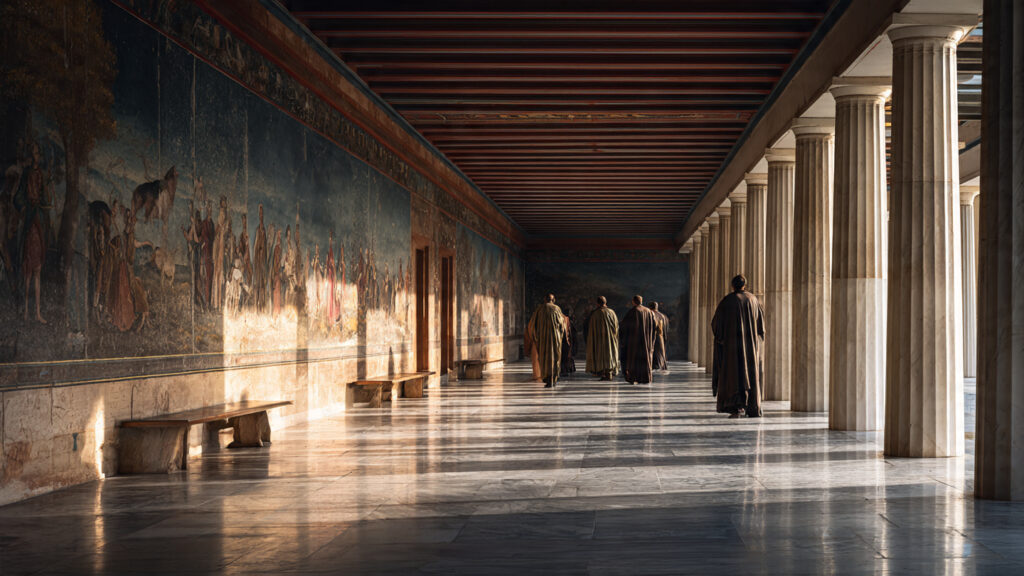
Early Stoics chose this location because it prevented mental isolation. Truth had to be tested in the crowd. Noise sharpened concentration. Cold strengthened endurance. They rejected the idea that wisdom required a quiet garden. They found their silence in the center of the city. The body learned to ignore shivering. The mind learned to ignore distraction. This was the foundation of Stoic discipline, a refusal to be moved by the exterior world.
The Stoa was a crossroads of the Mediterranean. Merchants, sailors, philosophers, and soldiers passed through it daily. This diversity reinforced the Stoic idea of the cosmopolis, the world city. Zeno taught that every individual was a citizen of the universe. The porch embodied this truth. The wind that blew through its columns had crossed seas. The people who gathered there carried stories from distant coasts. Stoicism was built to be universal.
Voluntary Hardship and the Body as Instrument
The thin cloak known as the tribon was a deliberate choice. It provided minimal protection, forcing the practitioner to generate warmth from within. The sensation of cold air on the skin served as a sensory anchor, keeping the mind present and preventing drift into abstraction. The body became a hearth in a cold world. Stability was self generated.
This training shaped the nervous system long before anyone had words for such things. The early Stoics observed that the man who could stand in winter without complaint was less likely to be shaken by anger, fear, or misfortune. Physical hardship prepared the ground for moral clarity. It built a structural calm that could not be disturbed by external events.
Their diet was equally restrained. Dried figs, cheese, barley bread, water, and diluted wine. This simplicity was not asceticism for its own sake. It was energy management. They refused to be ruled by appetite. They sought a clear, responsive mind. Excess creates weakness. Simplicity creates readiness.


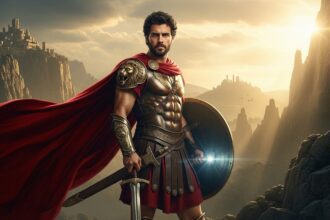
Volition and Fortune
Stoicism rests on a single boundary. What we control and what we do not. Zeno used the image of a dog tied to a moving cart. The cart moves according to forces beyond the dog’s control. The dog may run with it or be dragged by it. The movement of the cart is the movement of the universe. The response is the only domain of freedom.
The weather, the politics of the city, the health of the body. These were external. A winter storm was not a crisis. It was a condition. One could seek shelter or endure the cold. The logic was simple. Conserve energy for what can be shaped. Release everything else. This produced efficiency and peace.
The early Stoics did not seek to change the world. They sought to change their relationship to it. Seasons shift. Bodies age. Empires fall. Resistance to these truths creates suffering. Alignment with them creates freedom. This alignment was active, not passive. It was the decision to work within the present moment. This is structural calm. Stability while the cart moves.
Heraclitus and the Winter Logos
The Stoics inherited much from Heraclitus of Ephesus, who taught that everything flows and that the logos governs all things. They believed the universe was a living organism directed by this rational fire. Nothing was random. Not the cold of winter. Not the loss of a ship. Every event was part of a larger coherence.
The logos was associated with fire, the creative force. A spark of this fire lived within each person. By aligning their inner fire with the fire of the cosmos, they achieved harmony. Winter was a reminder of the cycle of the logos, the cooling phase of the universal flame.
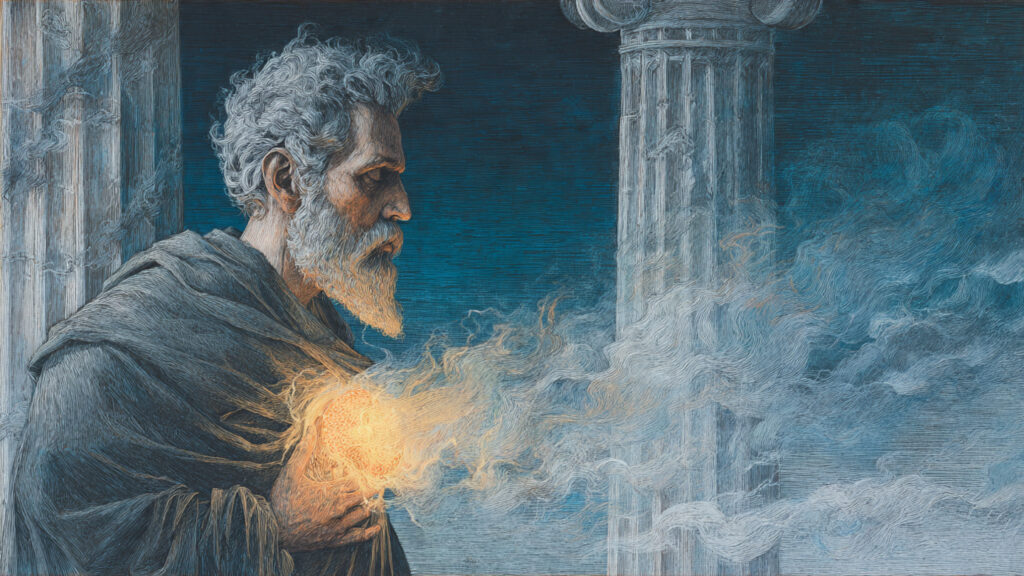
Heraclitus taught the unity of opposites. The path up and the path down are one. Winter and summer are one year. Difficulty and ease are one life. This understanding allowed the early Stoics to remain centered. They were like the mountains of Thessaly. Unmoved by storms. Shaped by them.
Hestia and the Inner Hearth
Hestia presided over the hearth, the unmoving center of the ancient Greek home. The hearth provided warmth, light, and continuity. The early Stoics internalized this architecture. Every individual, they believed, should cultivate an inner hearth, a stable center that remains lit regardless of external cold.
Building this hearth required reducing dependencies. Luxury weakens the flame. Social approval dims it. Voluntary hardship strengthens it. The Stoic’s warmth was self generated. Their security came from character, not circumstance. This was a form of sovereignty.
Winter was the ideal season for this work. The nights were longer. The distractions fewer. The cold drove people inward, physically and mentally. The early Stoics used this time for reflection and correction. They reviewed their actions each evening, tending the inner fire. The mind became a sanctuary.
The Agora as Training Ground
The Athenian Agora was a crucible of noise, commerce, and political tension. For a Stoic, it was the perfect arena. They practiced composure amid distraction, clarity amid gossip, integrity amid ambition. This was not a philosophy for the fragile. It was a discipline for those who wished to live effectively.
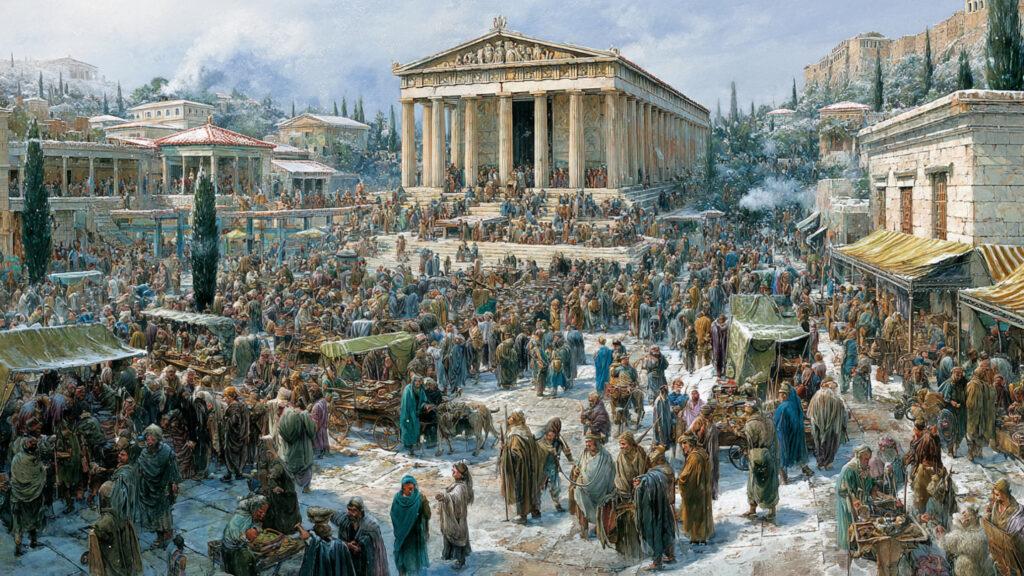
Zeno became known for his calm and frugality. He sought no power, yet he held influence. By relinquishing the desire for control, he gained a form of authority that others could not touch. He was free in a city of people enslaved by appetite and fear.
Athens changed many times during the life of Zeno. Wars. Coups. Economic shifts. The early Stoics remained stable. They participated when appropriate but never lost sight of their larger citizenship. The cosmopolis. This perspective allowed them to navigate turbulence without being consumed by it.
The Greek Landscape and Structural Calm
Greece is a land of mountains and sea, a landscape of limits. Fertile land is scarce. Valleys are isolated. The sea is unpredictable. This environment produced a culture of resilience. Stoicism was the philosophical expression of this terrain. It reflected the hardness of rock and the clarity of winter air.
Walking the winter paths of Attica or the slopes of Mount Olympus reveals the same elements the early Stoics faced. Silence. Wind. Stone. These conditions strip life to essentials. They force presence. This is the core of the Stoic path. Reduction to what is necessary and powerful. The result is a calm as enduring as the landscape itself.
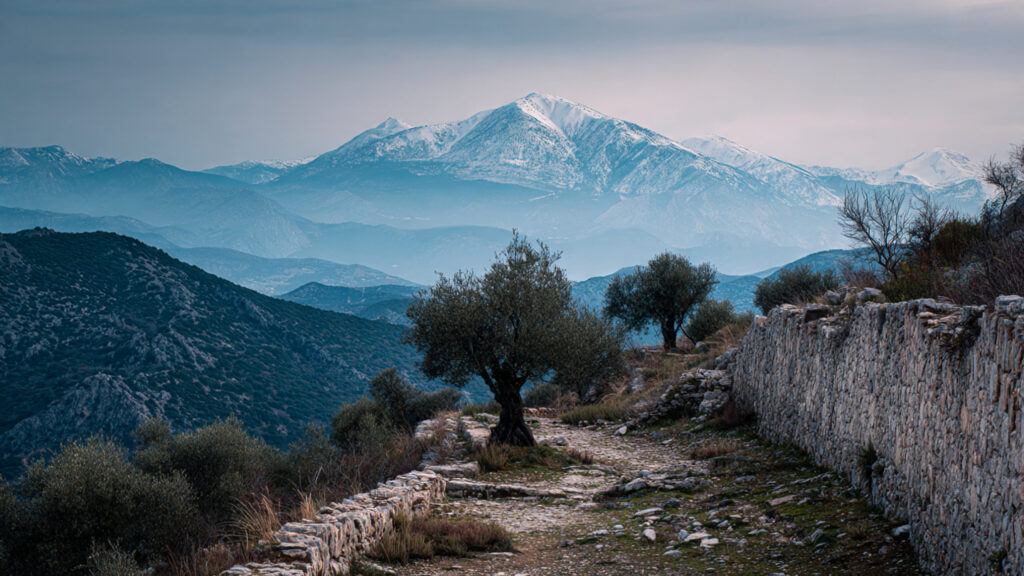
Modern life is saturated with artificial noise. We rarely confront the environment directly. This has made us fragile. The Stoic path offers a way back. Step into the winter air. Let the cold sharpen the senses. Stand in the wind without being moved. Rebuild the inner hearth.
Zeno’s Legacy and the Future of Resilience
Zeno died as he lived. Aligned with the movement of the world. His legacy was not a monument but a tradition of human excellence. The school he founded shaped minds from Athens to Rome, including Epictetus and Marcus Aurelius. The philosophy endured because it worked.
Today the pressures are different but the need is the same. We live in a world of constant change. We require structural calm. We require the discipline of Zeno. We must learn the boundary between volition and fortune. We must build the inner hearth. This is lifelong work. It is the work that matters.