





Hair in ancient Greece was a canvas for identity, a badge of divine favor, a silent storyteller of societal hierarchies. From the disciplined braids of warrior deities to the seductive cascades of love’s embodiment, these ancient adornments wove themselves into the fabric of daily life, echoing through myths, markets, and marriages.
Today, as you wander the labyrinthine alleys of Plaka or bask on the azure shores of Santorini, those same motifs flicker alive in unexpected ways. A village elder on Crete twists her silver-streaked tresses into a practical plait, unwittingly channeling Athena’s resolve. A bride in Mykonos crowns her updo with a floral wreath, her stefana gleaming like a relic from Olympus. And yes, even the subtle sparkle of gold dust—once the privilege of Athenian elites—finds its way into modern high-end salons, dusted over beachy waves for that effortless, eternal glow. This is a living thread connecting the classical world to the Greece you can touch, taste, and celebrate right now. If you’re planning a trip infused with cultural depth, understanding these hair traditions unlocks doors to authentic experiences, from hidden ateliers in Thessaloniki to sun-drenched festivals on lesser-known isles.
To explore modern interpretations of these ancient adornments, you can find contemporary Greek‑inspired wreaths and goddess headpieces that echo the motifs of classical Greece.
Disclosure
This section contains Amazon affiliate links. As an Amazon Associate, the site earns from qualifying purchases.

Laurel Wreaths Inspired by Ancient Greece
A modern gold‑leaf headpiece echoing the laurel crowns worn in classical ceremonies. Lightweight, elegant, and ideal for capturing the timeless aesthetic of Greek adornment.
The Divine Hairdressers: Myth and the Metaphor of the Tress
In the swirling cosmos of Greek mythology, hair served as a potent symbol of vitality, power, and the divine order. Poets like Homer described the gods’ tresses as flowing rivers of ambrosia-scented silk, embodying eternal youth and untamed energy. Cut a lock, and you severed a god’s essence—recall how Samson’s strength fled with his sheared mane in later tales, or how Perseus claimed Medusa’s serpentine coils as a trophy of peril and protection. For the Olympians, hair was metaphor made manifest: a cascade of chaos for the wild-hearted, a bound fortress for the wise. This celestial blueprint trickled down to mortals, shaping everything from battlefield strategies to bridal veils.
Hair intertwined with life’s rhythms—birth, battle, bereavement. Long, unbound locks signaled fertility and freedom, while shaved heads marked grief or initiation rites. In myths, deities wielded their styles like weapons or invitations, setting the stage for human emulation. As you trace these threads from myth to marble, the gods feel less remote, their hair a bridge to our own fleeting vanities.
Athena’s Braids: Wisdom and War

Picture Athena springing fully armored from Zeus’s brow, her braids already coiled like tactical scrolls, ready for the fray. The goddess of wisdom and warfare embodied restraint in every strand, her hair rarely tumbled free in reckless abandon. Instead, ancient vase paintings and Parthenon friezes depict her with sleek, interwoven plaits gathered into a krobylos, a severe bun perched high like a crown of intellect. Fine curls might peek from beneath her Corinthian helmet, a nod to femininity amid the bronze, but always controlled, echoing the geometric precision of her owl’s unblinking gaze.
This wasn’t arbitrary flair; it was philosophical armor. In a world where chaos lurked in Poseidon’s foaming waves or Dionysus’s frenzied rites, Athena’s braids symbolized logos over pathos—reason trumping raw emotion. Sculptors like Phidias captured this in the colossal Athena Parthenos statue (now lost, but vividly described by Pausanias), where her hair framed a face etched with strategic calm. Functional for helmet-wearing in mock battles or real skirmishes, these styles whispered: true power lies in preparation, not profligacy.
Travel tip: Ascend the Acropolis at dawn, when the light gilds the Caryatids’ stony tresses. Notice how their braids—carved in the 5th century BCE—drape like living rope, sturdy yet graceful. It’s a reminder that Athena’s ethos endures in modern Greek women: the entrepreneur in Athens juggling boardrooms and family, her low ponytail a subtle salute to the goddess who birthed strategy from storm.
Aphrodite’s Ribbons: Seduction and Softness

Flip the script to Aphrodite, foam-born temptress of Cyprus shores, whose hair flowed like honeyed wine, loose and luminous, begging for fingers to wander its waves. Ancient texts and artworks paint her tresses as golden-blonde, a radiant halo complementing her dove-white skin and rosebud lips—Homer’s “laughter-loving” deity, after all, demanded adoration in every curl. Adorned with ribbons of crimson silk or wreaths of myrtle and roses—her sacred blooms—these styles were engineered for enchantment, soft tendrils framing eyes that ensnared gods and mortals alike.

Silk Ribbons for a Modern Aphrodite
Soft, flowing silk ribbons that mirror the crimson fillets associated with Aphrodite’s mythic allure. Perfect for loose waves, chignons, or romantic braids.
Contrast Athena’s rigor, and Aphrodite’s hair becomes a manifesto of eros: unbound, it invited touch; scented with oils of jasmine and cinnamon, it lured like a siren’s song. Terracotta figurines from Paphos’s archaeological trove show devotees aping this look—loose chignons pinned with golden fillets, evoking the goddess’s birth from sea-spray. Yet, even her softness held power; in myths, her locks ensnared Ares in nets of passion, proving allure as lethal as any spear.
For the modern seeker, channel Aphrodite on a Cyprus pilgrimage. Stroll the Sanctuary of Aphrodite near Kouklia, where wildflowers nod like forgotten ribbons, and imagine ancient priestesses preening their curls before oracles of love. Back in Athens’ Monastiraki flea markets, snag a silk fillet to tie back beach waves—seduction, ancient style, for your Instagram sunset.
Echoes from Other Goddesses: Artemis, Demeter, and the Wild Divine

No Olympian symposium on hair is complete without Artemis, the huntress whose straight, taut ponytail—pulled back for arrow-nocking—mirrored her untamed wilderness. Her locks, often bound in a simple sakkos or left to whip like bowstrings in the wind, symbolized virginity and vigilance, a far cry from Aphrodite’s voluptuous disarray. Then there’s Demeter, earth-mother of golden sheaves, whose wheat-hued braids evoked fertility rites, heavy with barley crowns during Eleusinian mysteries.
These variations enriched the mythic palette: hair as huntress’s harness, harvest’s bounty. In temples from Brauron to Eleusis, votive statues preserve these motifs, inviting us to ponder how divine diversity inspired mortal multiplicity.
The Mortal Code: Status and Style in Classical Athens
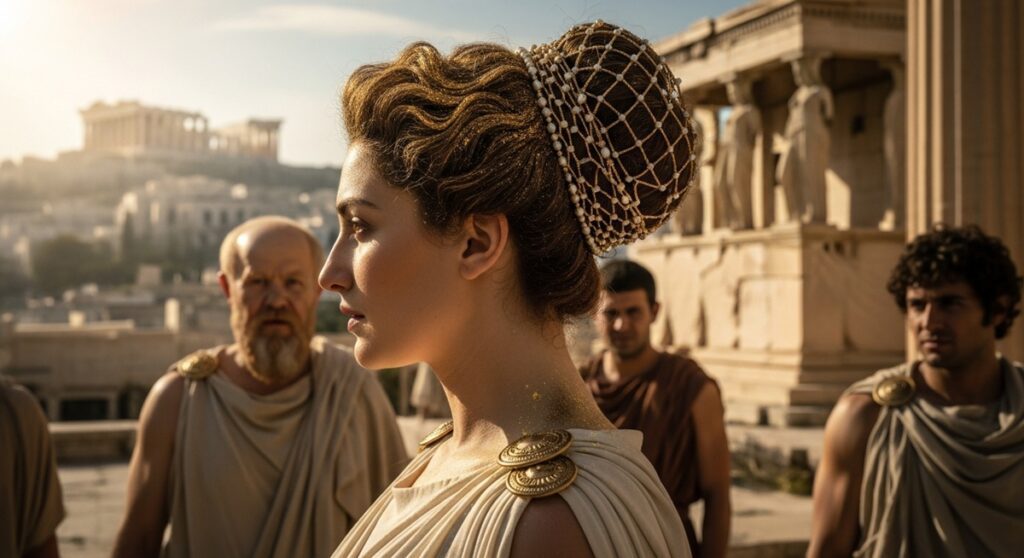
Descending from Olympus, hair in classical Athens became a social semaphore, shouting wealth from the agora, whispering virtue in the symposium. For women, whose public lives were curtailed, a impeccable coif was armor and allure, second only to peplos folds and himation drapes. Men, too, played the game: philosophers like Socrates favored unkempt beards and cropped cuts for intellectual gravitas, while athletes oiled their curls for Olympic glory. But it was the feminine arts that truly dazzled, turning tresses into treasures.
Historical papyri and Aristophanes’ comedies reveal the ritual: dawn ablutions with lye rinses, afternoons spent weaving under slave girls’ hands. A misplaced braid could scandalize; a flawless one, elevate. In this democracy of demos, hair democratized divinity, or at least pretended to.
The Art of the Kekryphalos and the Sakkos

Enter the kekryphalos, that ingenious hairnet of fine mesh, gold-threaded for elites, linen for the thrifty—cradling elaborate updos like a spider’s web cradles dew. Worn by everyone from hetairai (courtesans) to housewives, it contained the day’s loops and twists, preventing the Mediterranean breeze from unraveling propriety. Paired with the sakkos, a soft cloth sack or hood often embroidered with meanders, it transformed the head into a portable temple of modesty.

Gold‑Mesh Hairpieces Inspired by the Kekryphalos
Modern mesh‑style headpieces that echo the delicate woven hairnets of classical Athens. A subtle nod to ancient craftsmanship with contemporary wearability.
In Delphi’s sacred groves, where Pythia inhaled vapors and pilgrims sought omens, the sakkos was de rigueur—a veil of reverence, shielding mortal coils from divine scrutiny. Vase painters delighted in rendering these: a symposium siren in translucent kekryphalos, pearls glinting through the weave; a mourner in somber sakkos, edges frayed with grief’s symbolic tears. These weren’t just accessories; they were societal scripts, enforcing the veil between public poise and private passion.
Wander the National Archaeological Museum today, and Hellenistic kekryphalos replicas—delicate as lace—stir envy. For hands-on history, join a workshop in Nafplio: learn to spring-weave your own net, fingers flying like ancient artisans.
The Luxury of Lye and Gold Dust
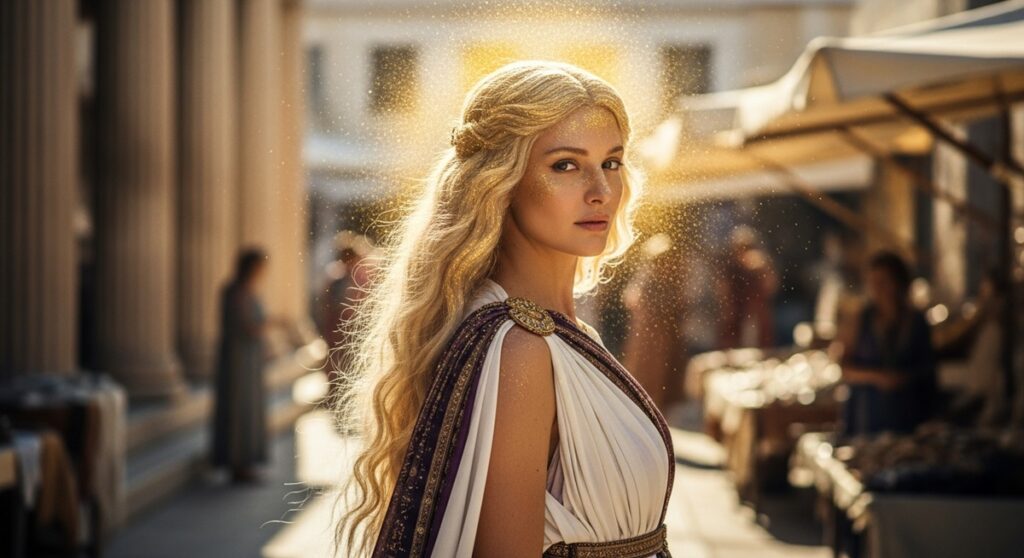
Ah, but for the oikos of Pericles’ peers, hair transcended utility into opulence. Lye from wood ash, mixed with goat’s milk or vinegar, bleached locks to sun-kissed gold—a hue envied for its northern exoticism, evoking Amazons or Hyperborean beauties. Then came the pièce de résistance: gold dust, sifted from Thracian mines and blended with oils, dusted onto damp strands for a halo that danced in torchlight.

Cosmetic Gold Dust for a Subtle Ancient Glow
Finely milled cosmetic gold mica or 24k‑style leaf flakes that recreate the soft shimmer once favored by Athenian elites. Ideal for hair, skin, or festival styling.
Plutarch notes elite women spending hours in this alchemical ballet, their hair shimmering like Athena’s aegis under Helios. It was fleeting—rinsed away by sweat or sea—but that’s what made it elite: a daily declaration of disposable wealth. In the Agora’s shadow, imagine Aspasia, Pericles’ muse, gliding past vendors, her gilded tresses turning heads and turning profit for her favored perfumers.
Echo this extravagance on your travels: In Rhodes’ old town, boutique spas offer “Olympian glow” treatments with ethical gold mica. Subtle, sustainable, and utterly Athenian.
Hair in Ritual and Mourning: The Emotional Undercurrents

Beyond status symbols, hair anchored Greek rituals, its sacrifice a currency of the soul. In mourning, widows cropped their locks short, scattering clippings on pyres as offerings to Hades—Electra’s grief in Sophocles’ tragedy a raw emblem of this catharsis. Weddings flipped the script: brides loosed maiden braids, veiling instead in flame-orange wreaths of saffron-dyed wool, symbolizing Hestia’s hearth-bound transition.
Epiphany baptisms saw children dunked, emerging with anointed curls; Dionysian festivals unleashed bacchantes’ wild manes in ecstatic frenzy. These moments reveal hair as emotional barometer—shorn for sorrow, crowned for communion. For depth, visit Eleusis’ ruins: Feel the weight of Demeter’s grief in the wind-swept fields where initiates once whispered secrets to the grain.
Echoes of Antiquity: Hair and Adornment in Modern Greek Travel
Greece’s classical legacy is entombed in frolics in the feta-scented air, the bouzouki’s twang. Hair traditions persist as quiet rebellions against globalization—braids defying urban sleekness, wreaths outshining minimalist rings. For travelers, they’re portals: chat up a yiayia in a kafeneio, and her stories unspool like forgotten fillets.
Braids of the Islands and Villages

On the Cyclades’ rugged rims—think arid Amorgos or lavender-laced Tinos—braids endure as badges of resilience. Older women, faces etched like olive bark, twist three-strand plaits with fisherman’s efficiency, pinning them with bone combs handed down generations. Practical against salt spray and siesta sun, these echo Athena’s wartime knots, yet soften with wildflowers tucked in for Easter feasts.

Handcrafted Wooden Combs
Traditional wooden combs reminiscent of the heirloom tools used in Greek island villages. Perfect for braiding, detangling, and natural hair care.
Venture to the Peloponnese’s mountain hamlets, like those near Monemvasia, where braids double as social currency, unraveled for dances at panigiria festivals, signaling readiness for joy. Hike the paths of Mani, and spot these living links: hair that has weathered Ottoman sieges and Axis occupations, still unbowed.
Pro tip: On Ikaria’s longevity-famous shores, join a braiding circle—herbal rinses included. It’s wellness with roots.
The Modern Greek Wedding Wreath

Nothing bridges eras like the stefana, twin wreaths of orange blossoms, silver filigree, or heirloom gold, crowning bride and groom in Orthodox nuptials. Exchanged mid-ceremony, they symbolize imperial unity—Byzantine echoes of ancient victory wreaths—linked by a ribbon the koumbaros (best man) holds aloft, binding fates under God’s gaze.
In island idylls like Corfu or Skiathos, stefana bloom with local twists: Cretan beeswax candles flicker beside wild thyme wreaths, while Athens’ urban affairs blend minimalist gold with LED-lit basilicas. Post-vows, rice rains down (krevati’s modern nod), and the couple dances the kalamatianos, hair flying free. Witness one in Hydra’s car-free lanes: Intimate, eternal, utterly Greek.
Planning your own? Consult a local planner for eco-wreaths from foraged blooms—tradition meets tomorrow.
Filigree and Modern Jewellery

Athens’ Plaka pulses with filigree fever: Braided gold cuffs channeling Mycenaean torques, earrings coiling like archaic braids. Byzantine influences layer in—enamel crosses dangling from pearl sakkos-inspired clips—while Thessaloniki’s silversmiths revive kekryphalos nets as statement chokers.

Greek‑Inspired Filigree Jewelry
Filigree earrings shaped in the lineage of Mycenaean and Byzantine craftsmanship. A wearable echo of Greece’s ornamental heritage.
On Mykonos, boho boutiques dust festival hair with 24k mica, a wink to ancient gold dust. It’s adornment evolved: Sustainable alloys, ethical sourcing, yet screaming heritage. Hunt in Ermoupoli’s arcades for custom pieces—your wreath of wearable history.
Travel Tips: Spotting Ancient Echoes in Contemporary Greece

To infuse your itinerary with hair lore:
- Athens: Acropolis dawn tour, then Monastiraki for fillets.
- Islands: Amorgos ferries for village braids; Santorini sunsets with gold dust glow-ups.
- Weddings: Time for summer panigyr i—uninvited? Crash politely with ouzo.
- Museums: Paphos for Aphrodite votives; Delphi for sakkos serenity.
Pack versatile: Sun hat for hikes, scarf for veiling in churches. And remember, the best souvenir? A photo of a local’s braid, capturing Greece’s undying luster.
In Greece, hair isn’t just grown—it’s grown into, a narrative spun from myth to agora to azure horizon. From Athena’s braids to a bride’s wreath, these adornments remind us: Beauty binds us to the ancients, gold dust to gold standards. Next time you finger your own locks under Mediterranean stars, know you’re part of the weave. Safe travels, and may your tresses tell tales as timeless.