


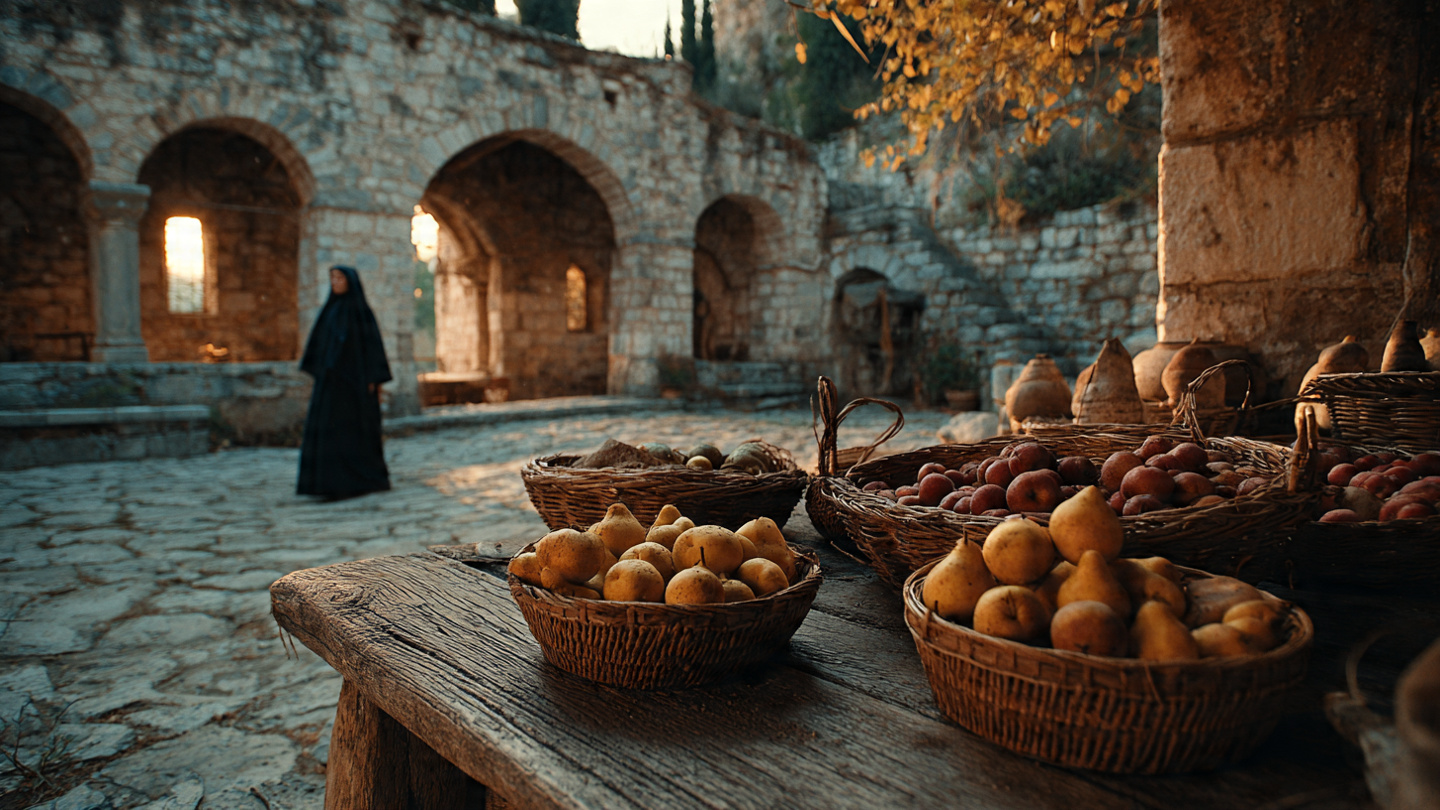
There is a fleeting, magical moment in Greece, arriving just after the first cool breath of September sweeps down from the mountains. The relentless chorus of the cicadas finally falls quiet. In the village squares, the chimneys are lit for the first time in months, sending trails of woodsmoke into the crisp blue sky. And behind the high stone walls of Byzantine monasteries, something ancient begins: the ritual of the autumn fruit harvest.
Here, under the slow, rhythmic toll of a bronze bell, nuns move through the orchards, gathering baskets of golden pears and crisp apples. Step into the courtyard, and you are greeted by an aroma that transcends time, the scent of boiled Greek honey, wood fire, cinnamon sticks, and wild mountain herbs. These are the same perfumes that once drifted across the kitchens of nymphs, heroes, and wandering gods.
The Sacred Fruit of Greece: Pears in Myth and Memory
Pears of the Goddess
Long before the first monastery was built, the pear was already a fruit of divine significance. In ancient Greek mythology, pears were sacred to Hera, the queen of the gods, the deity of marriage, and the protector of household abundance.
The fertile orchards of the Peloponnese were often whispered to be her personal gifts to mortals—sacred fields where the fruit grew, as the poets described, “like drops of honey suspended from branches.” Even Homer, the great bard of the Odyssey, described pears as a “gift of the gods,” a fruit that graced the legendary gardens of King Alcinous.
When you step into a monastery kitchen in the highlands of Arcadia or the cliffs of Achaia, you are not just entering a place of Christian prayer. You are stepping into a living thread of history. You are witnessing a culinary lineage that stretches back thousands of years.
From Myth to Monastery

As antiquity faded, the Christian monasteries became the great guardians of these agricultural traditions. Their orchards—protected by high walls, tended with absolute devotion, and planted in perfect silence—became arks of biodiversity. They preserved ancient fruit varieties that the bustling outside world often forgot.
Today, the pears simmering in a copper pot owe their existence to a dual heritage:
- The goddess Hera, who gave the fruit its symbolic weight of abundance.
- The Byzantine nuns, who preserved the recipes through centuries of invasion, famine, and change.
It is a perfect blend of mythology and monastic discipline—the very essence of Greek culinary heritage.


Autumn in the Monastery Courtyard: A Scene of Living Heritage
Imagine arriving at a hilltop monastery in Arcadia travel guides often miss, just as the sun breaks over the mountain peaks. A nun in a deep blue robe unlocks a heavy iron gate. The scent of frankincense from the morning liturgy still lingers in the cool air.
Baskets appear, heavy with fruit. These are often the Kountoura pears, an old local variety prized for its firmness and fragrance, once traded by Venetian merchants across the Mediterranean. On a weathered wooden table, worn smooth by centuries of use, the nuns lay out the ingredients of the harvest:
- Thick, raw Greek honey gathered from the fir trees of Mount Mainalon.
- Bark-like sticks of Ceylon cinnamon.
- Aromatic cloves.
- Dried mountain tea (Sideritis), gathered from the rocky crags.
- Fresh lemon peel, bursting with oil.
- A jar of aged monastery wine vinegar.
These ingredients have barely changed since Hellenistic times. Many were the same offerings placed in ancient temples, burned in rituals, or used in Hippocratic medicine. As the nuns begin to peel the pears in quiet concentration, the line between history and the present moment dissolves. Mythology becomes entirely real.
The Recipe They Still Make Today: Byzantine Pears in Honey and Wine

This is the recipe still made in many Peloponnese monasteries, often sold in tiny glass jars during feast days or offered to pilgrims as a gesture of hospitality (filoxenia). It is a dish of Greek traditional desserts that relies on patience rather than sugar.
Ingredients
- 6–8 ripe, firm Greek pears (Kountoura or Bosc varieties are best).
- 1 cup quality Greek honey (preferably fir, pine, or thyme).
- 1 cup local white wine or sweet monastery wine (like Samos Vin Doux).
- 1 cinnamon stick.
- 2–3 whole cloves.
- The thin peel of 1 lemon (pith removed).
- 1 tsp high-quality wine vinegar.
- A pinch of dried mountain tea (optional, for an herbal note).
Instructions
- The Preparation: Peel the pears gently. Crucially, keep the stems attached—in monastic symbolism, this represents the wholeness of the fruit and the connection to the earth.
- The Alchemy: Place the pears upright in a heavy copper pot or Dutch oven. Pour in the honey, wine, lemon peel, spices, and just enough water to cover the bottom inch of the pears.
- The Simmer: Cover and allow to simmer on low heat. Do not rush this. Let them cook until the pears turn a translucent amber-gold and are soft, but not collapsing. This is the art of slow food.
- The Finish: Just before removing from the heat, add the teaspoon of wine vinegar. This ancient trick brightens the sweetness and acts as a natural preservative.
- The Cooling: Let them cool in the pot, absorbing the syrup, perhaps in the cool breeze of a courtyard.
The result is a dessert that tastes like a hymn, a myth, and the first chapter of autumn. It is eaten slowly, often with fresh walnuts or a slice of crusty bread to soak up the elixir.
Travel the Monasteries Where Autumn Recipes Still Live

If you wish to taste this history at its source, you must travel to the mountains.
Monastery of Philosophou, Arcadia
Hidden deep in the Lousios Gorge, this is one of Greece’s quiet gems. The Philosophou Monastery is actually two sites—the old, ruined one built into the rock, and the “new” 17th-century structure. Its gardens and terraces are heavy with fruit trees. Visitors often swear its silence feels “older than time.” This is exactly the sort of place where our pear recipe would have been perfected over centuries.
Mega Spilaio, Aigialeia
Carved directly into a dramatic cliff face, the Mega Spilaio (Great Cave) monastery has a long tradition of producing honey, preserves, and herbal remedies. Their autumn kitchens are legendary among travelers who seek out ancestral food. The backdrop of the jagged rocks against the soft autumn light is breathtaking.
Saint Patapios, Loutraki
Although known primarily for its holy relics and stunning sea vistas overlooking the Corinthian Gulf, the monastery grows remarkable fruit in its steep, terraced gardens. Local women still gather pears and apples here during harvest festivals, keeping the rhythm of the seasons alive.
These monasteries are more than tourist sites. They are guardians of Greek food memory, keeping ancient flavors alive through devotion and repetition.
Myth Meets Mindfulness: What This Recipe Teaches Us
The pear, in the deep well of Greek tradition, is a fruit of humility. It requires patience to ripen; it requires gentleness to cook. It nourishes the soul before the body.
Watching the nuns prepare this dish is an exercise in mindfulness. They peel slowly. They breathe in silence. They stir with intention.
It echoes the spirit of old Greek philosophy and the Delphic Maxim: “Nothing in excess.” It mirrors the wisdom of Epicurus: “Pleasure must be accompanied by measure.”
This simple bowl of poached fruit captures the essence of Greek wellness: Simplicity. Balance. Ritual. Slowness.
A Taste of Greece You Can Bring Home
Even if you never visit a monastery in Arcadia, you can recreate this Byzantine cooking tradition in your own kitchen.
Light a candle. Turn off your phone. Peel the pears slowly. Let them simmer as you listen to the wind, the birds, or the silence of your own home.
This is not just cooking. This is reenacting an unbroken chain of memory—from the orchards of Hera, to the verses of Homer, to the copper pots of Byzantine nuns, to modern Greece, and finally, to your table.
And this is what makes Greek food eternal.