
In the shadowy realms of Ancient Greek mythology, a pantheon of monsters emerges, not just as terrifying foes for heroes, but as powerful symbols woven into the very fabric of human understanding. These creatures are manifestations of primal fears, tests of courage, and cautionary tales that echo through millennia. From multi-headed serpents to one-eyed giants and guardians of the underworld, these mythological beasts held a chilling and undeniable sway over the imaginations of the ancients, inspiring both terror and awe. Their tales served as profound lessons about the natural world, the human spirit, and the eternal struggle between order and chaos.
The Lernaean Hydra: A Serpent of Unending Dread
Among the most iconic and truly formidable monsters of ancient Greek mythology is the Lernaean Hydra. This creature, often depicted as a colossal serpent with a monstrous body and nine dragon heads, was a living nightmare. Its very presence was a harbinger of death and destruction. The air around it, even when the beast was dormant, was thick with a deadly poison, capable of suffocating life and blighting crops. But the Hydra’s most terrifying attribute, the one that truly defied conventional heroism, was its regenerative power: for every head severed, two more, even more ferocious, would burst forth in its place. This made it a seemingly unconquerable foe, a truly hydra-headed problem in the most literal sense.

The task of vanquishing this blight upon the land of Argolis fell to the legendary hero, Hercules, as his second monumental labor. Accompanied by his loyal nephew, Iolaus, Hercules journeyed to the swampy lair of the Hydra in Lerna. Employing flaming arrows, Hercules forced the behemoth from its watery sanctuary. The Hydra, with its cold, slippery tail, ensnared Hercules’s leg, its nine heads hissing menacingly around him.

Hercules, a warrior of unparalleled strength, began to cleave off the Hydra’s heads with his mighty sword. Yet, true to the legends, for every head he removed, two more erupted, a testament to the monster’s horrifying vitality. To further complicate matters, a colossal crayfish emerged from the swamp, clamping onto Hercules’s other leg, a minor but infuriating impediment. It was at this critical juncture that Iolaus’s quick thinking proved invaluable. Setting fire to a nearby grove, he used burning tree trunks to cauterize the wounds instantly after Hercules severed a head, preventing any regeneration. Finally, with relentless effort and the ingenious aid of Iolaus, Hercules managed to sever the Hydra’s immortal head. He then buried it deep within the earth and secured it with a massive stone, ensuring its permanent demise. This arduous and cunning victory marked one of Hercules’s most significant achievements, demonstrating not just his strength, but his strategic prowess in the face of an seemingly impossible challenge.
Scylla and Charybdis: The Perils of the Strait

The narrow, treacherous strait between Italy and Sicily was home to two of Ancient Greek mythology’s most infamous sea monsters: Scylla and Charybdis. These twin terrors were positioned so perilously close to each other that sailors, attempting to avoid one, invariably found themselves ensnared by the other, a chilling embodiment of the phrase “between a rock and a hard place.”
Scylla: The Multi-Headed Terror of the Cliffs

Scylla was a creature of pure monstrous horror, dwelling in a hidden cave high on the cliffs, virtually unattainable. Her grotesque form was described as having twelve paws and a truly terrifying array of six heads, each adorned with three rows of razor-sharp teeth. Her voice was a chilling cacophony of barks and growls, echoing through the strait. She was an indiscriminate predator, snatching anything that passed within reach of her multiple mouths, from innocent dolphins to unfortunate sailors. With each gaping maw, she could simultaneously seize six men from passing ships, a horrifying and efficient harvester of human lives.
Charybdis: The Vortex of Devouring Waters
In stark contrast to Scylla’s overt savagery, Charybdis was a more subtle, yet equally devastating, threat. Legend has it that she was once a beautiful and intelligent daughter of Poseidon, transformed into a nightmarish entity by the wrath of a powerful Olympian god. Charybdis found her dark sanctuary beneath a fig tree, where she perpetually “drank” the sea. Three times a day, she would swallow vast quantities of water, along with everything within it, only to violently disgorge a torrent of dead, brackish water. Entire ships, caught in her colossal whirlpool, would be dragged down into her bottomless belly, never to be seen again.

The most famous encounter with these two perils involved the cunning hero Odysseus and his crew. Faced with the impossible choice, Odysseus, with his characteristic pragmatism, reasoned that it was better to pass by Scylla, who would claim a limited number of men, rather than risk the complete annihilation of his entire crew by Charybdis’s insatiable vortex. His decision, though costly in lives, ultimately saved the majority of his men and himself, solidifying the legend of their harrowing passage. The enduring phrase “to be between Scylla and Charybdis” perfectly encapsulates the terrifying dilemma of facing danger on two inescapable fronts.


Gorgon Medusa: The Gaze of Stone
Among the most iconic and terrifying figures in Ancient Greek mythology is Medusa the Gorgon, a creature whose very gaze could turn living flesh to cold, lifeless stone. Originally, Medusa and her sisters, Euryale and Stheno (not Seno as sometimes misremembered), were described as beauties, with the latter two possessing the gift of immortality. However, Medusa’s fate took a tragic and grotesque turn. After being seduced by Poseidon within the sacred temple of Athena, the vengeful goddess, consumed by fury, transformed Medusa into a hideous winged monster. Her once beautiful hair was replaced by writhing, venomous snakes, and her eyes, once captivating, now held the power to petrify anyone who dared to look upon her. Athena, in a cruel act of collateral punishment, also inflicted a similar, though less potent, transformation upon Medusa’s innocent sisters.

Confronting Medusa was a perilous undertaking, and few dared to challenge her. It was the brave hero Perseus who was tasked with the seemingly impossible feat of slaying this formidable Gorgon. Fortunately, Perseus was aided by the Olympian gods themselves, specifically Athena and Hermes. On their divine counsel, he first sought out the enigmatic Graeae, the ancient prophetic sisters who shared a single eye and a single tooth. They guided him to the secluded lair of the Gorgons.
During the epic confrontation, Medusa was pregnant with Poseidon’s child. From the droplets of her blood that fell upon the sands of Libya, a land now cursed, emerged a multitude of poisonous snakes, forever tainting the landscape. Conversely, legend also holds that from the stream of her blood spilled into the ocean, the delicate beauty of coral came into being, a stark contrast to the death she brought.
Even after her demise, Medusa’s essence held powerful properties. Athena gifted Asclepius, the god of medicine, with the blood that flowed from Medusa’s veins. The blood from her left side was said to bring immediate death, while the blood from her right side possessed the miraculous ability to resurrect the dead, a testament to the potent and paradoxical nature of this iconic monster.
The Cyclopes: One-Eyed Giants and Divine Smiths
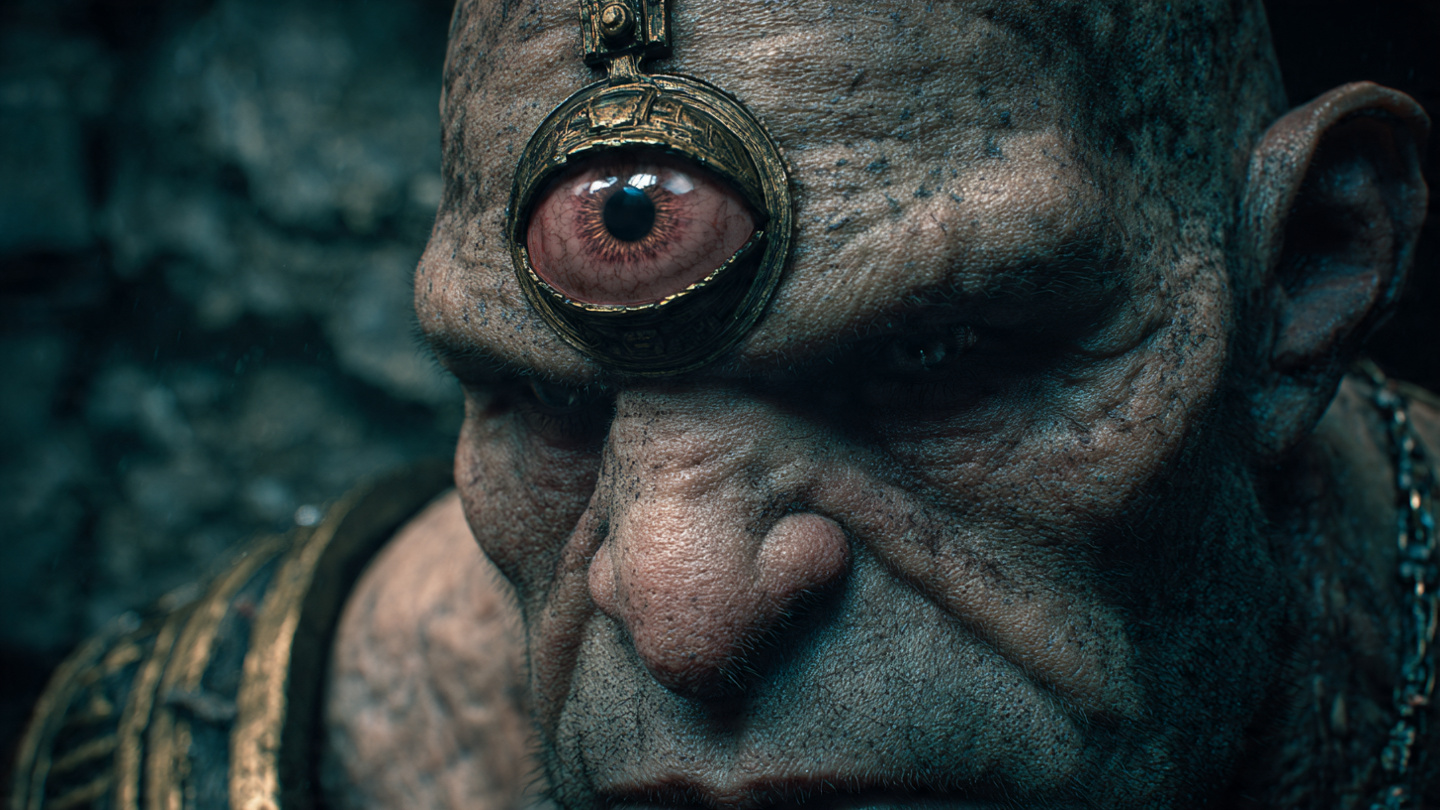
In the sprawling tapestry of Ancient Greek mythology, the Cyclopes stand as a fascinating and formidable race. Homer, in his epic Odyssey, describes them not merely as individual giants, but as a distinct “people,” a tribe of colossal, one-eyed beings. Their lineage, according to ancient myths, traced back to three primordial Cyclopes who were, upon their birth, cruelly imprisoned in Tartarus by their tyrannical father.

It was only amidst the ferocious conflict of the Titanomachy, the epic war between the Olympian gods and the Titans, that the Cyclopes were finally liberated. In this pivotal war, they allied themselves with Zeus, becoming his master armories and blacksmiths. Their unparalleled skill in forging metal manifested in the creation of Zeus’s most potent weapon: the mighty thunderbolts, with which the King of the Gods relentlessly assailed the Titans. These divine weapons, crafted by the powerful hands of the Cyclopes, were instrumental in securing the Olympians’ victory and establishing their reign.
The eventual demise of this mighty and glorious race of “round-eyed” giants came at the hands of the god Apollo. Driven by a vengeful fury, Apollo slaughtered many of the Sicilian Cyclopes after they forged the very thunderbolt that Zeus used to strike down Apollo’s beloved son, Asclepius. This tragic end marked the decline of a truly remarkable and powerful people, forever etched into the annals of myth.
The Chimera: A Hybrid of Horrors
One of the most bizarre and truly terrifying creatures to stalk the imaginations of the ancient Greeks was the Chimera. The name itself, derived from the Greek for “young goat,” hints at its composite nature, though in reality, it borrowed only its belly from the humble goat. Homer, in his seminal epic The Iliad, provides the canonical description of this monstrous hybrid: a beast with the head and neck of a lion, a tail that morphed into a venomous snake, and the terrifying ability, bestowed upon it by its mythological father, Typhon, to breathe scorching flames from its mouth.
However, the poet Hesiod offers an even stranger, more unsettling portrayal of the Chimera, endowing this mythical creature with a third head. While retaining the lion’s head and the snake’s head as its tail, Hesiod’s Chimera features a goat’s head positioned disturbingly in the middle of its body. This unusual configuration is famously depicted on the renowned bronze statue from Arezzo, a striking visual representation of Hesiod’s unique vision.

Over time, as rational thought gained prominence, the very real existence of the Chimera began to be questioned. Researchers and philosophers came to view the Chimera as a profound metaphor, rather than a literal creature. Consequently, the concept of “chimera” evolved beyond its mythological origins to signify a false idea, an empty fiction, or an impossible dream. This linguistic evolution reflects the enduring power of myth to shape language and thought, transforming a creature of terrifying reality into a symbol of illusion and unreality.
Cerberus: The Hound of Hades
Guarding the chilling entrance to the Underworld of Hades was Cerberus, a monstrous and eternally vigilant dog. His singular purpose was to ensure that no soul, once claimed by the realm of the dead, could ever return to the world of the living. Cerberus was most famously depicted as a terrifying beast with three heads, each snarling and fearsome. Instead of a mane, his back bristled with writhing, poisonous snakes, and his tail was not merely a tail, but a distinct dragon’s head with a gaping, tooth-filled maw. This horrifying amalgamation of reptilian and canine features made him an utterly formidable guardian.

One of the most famous tales involving Cerberus features the legendary musician Orpheus. When Orpheus descended into the Underworld in a desperate attempt to retrieve his deceased wife, Eurydice, he managed to lull the fearsome Cerberus to sleep with the enchanting melody of his lyre and his captivating singing. Alas, despite overcoming this formidable guardian, Orpheus ultimately failed in his quest to bring Eurydice back from the clutches of Hades, a poignant reminder of the unyielding nature of death.
The ultimate test involving Cerberus was reserved for Hercules, as one of his final and most perilous labors. Under the direct command of King Eurystheus, Hercules undertook the daunting task of descending into the very kingdom of Hades to bring the terrifying Cerberus back to Mycenae. Appearing before the formidable throne of Hades, Hercules, with his characteristic respect and unwavering resolve, humbly requested permission to take the dog. Despite his harsh and gloomy demeanor, Hades, perhaps recognizing the divine lineage of Hercules, could not refuse the son of Zeus. He set only one condition: Hercules had to subdue and tame Cerberus without the use of any weapons.

Hercules, accepting the challenge, fearlessly grappled with Cerberus. The monstrous hound howled menacingly, struggling fiercely against the hero’s grip. The dragon’s head on its tail snapped and bit, while the countless snakes on its back writhed and stung, but Hercules only tightened his powerful hands. Finally, the half-strangled Cerberus, overwhelmed by Hercules’s immense strength, succumbed. Hercules then led the subdued Cerberus all the way to the awe-struck walls of Mycenae. King Eurystheus, horrified at the mere sight of the terrifying dog, immediately commanded Hercules to return it to Hades as swiftly as possible, a testament to the primal fear that Cerberus inspired even in the bravest of men.