


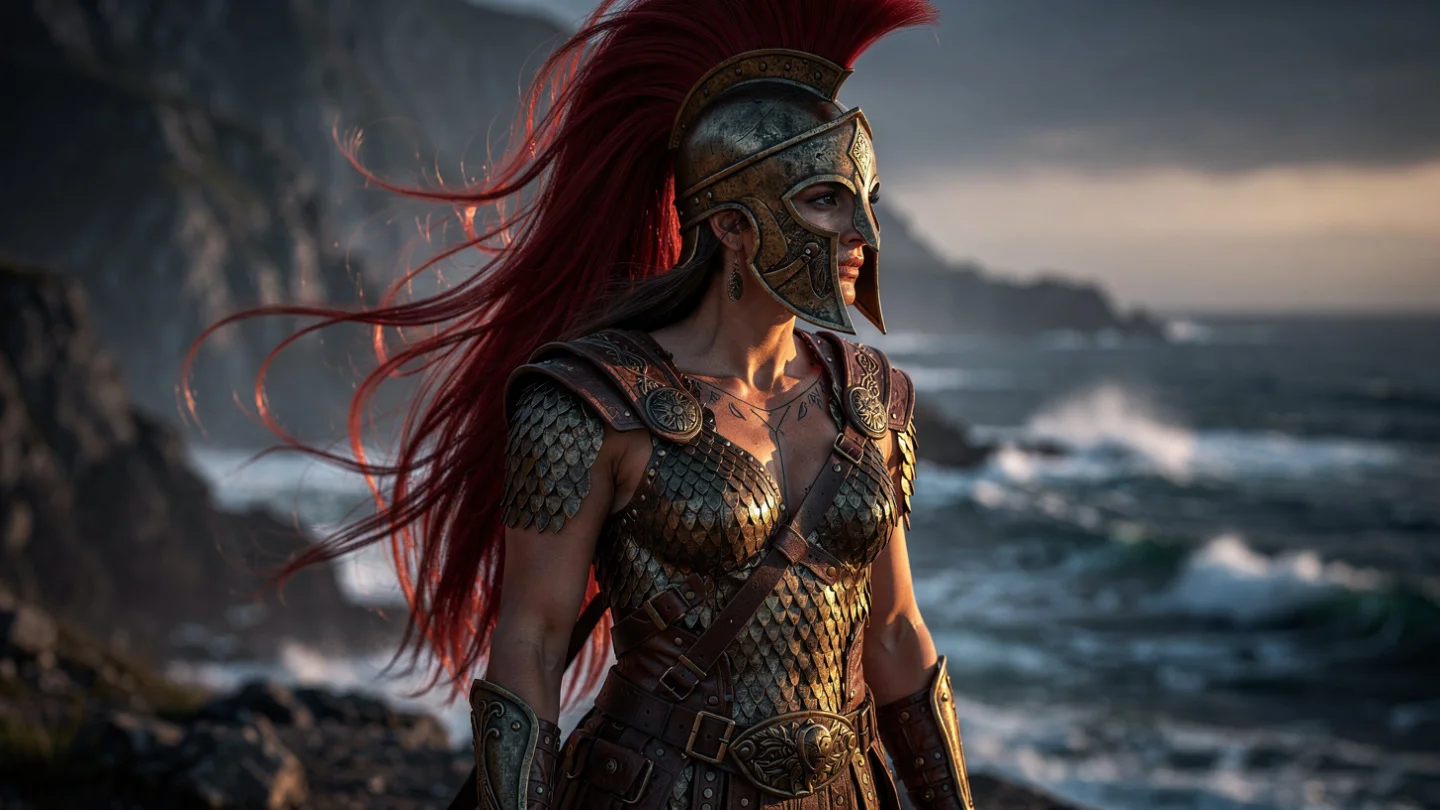
The Amazons fought Achilles and he wept over the body of the queen he had killed.
This detail, preserved in the post‑Homeric epic cycle through the lost Aethiopis attributed to Arctinus of Miletus and known to us from Proclus’s summary, is the moment that most clearly reveals how the ancient imagination understood the Amazons. Achilles killed Penthesilea, the Amazon queen who had come to Troy after his withdrawal from battle in the grief for Patroclus. At the instant of her death, when the spear had struck and she was falling from her horse, their eyes met, and Achilles loved her. The greatest warrior of the Greek world killed the greatest warrior of the Amazon world, and the recognition of what he had destroyed arrived at the same moment as the destruction itself.
What follows in the fragmentary record is the account of Achilles’ grief. It was intense enough that Thersites mocked him for it, and Achilles killed Thersites for the mockery. The grief for the dead Amazon queen was the grief that could not be ridiculed without consequence. What the Amazon world was doing in this episode was what it always did in Greek myth. It placed the figure of the warrior woman at the boundary of the Greek heroic imagination, at the point where the encounter forced a recognition that the heroic code did not fully know how to absorb yet could not deny.
Who the Amazons Were in the Ancient Tradition
The Amazon presence in ancient Greek literature was the presence of a people imagined at the outer limit of the known world, positioned at the boundary where the Greek world ended and the barbarian world began. The Greeks populated that frontier with societies whose differences clarified their own values by contrast, and the Amazons were the most striking of these imagined others.
Most ancient sources placed them near the Thermodon River on the southern coast of the Black Sea, in the region that is now northern Turkey. Their city was called Themiscyra, and the narrative tradition consistently located it at the point where the Greek coastal world gave way to the steppe world of the Scythians and the other nomadic peoples of the Eurasian interior. This geographical placement was the first expression of the Amazon story’s cultural function. The warrior women who lived at the edge of the Greek world represented the extreme inversion of Greek gender norms. They fought, rode, governed, and lived in a society without male citizens in any permanent sense that the Greek polis would have recognized. Their distance from Greece was not only spatial. It was conceptual, and the geography made the concept visible.
The Amazon presence in Olympian mythology placed them inside two of the most important heroic narratives. One was the ninth labor of Heracles, in which he was sent to retrieve the golden belt of Hippolyta, the Amazon queen. The other was the Amazonomachy, the Amazon assault on Athens that the Athenian tradition located in the time of Theseus and commemorated in the sculptural programs of the city’s most significant buildings of the fifth century BCE.
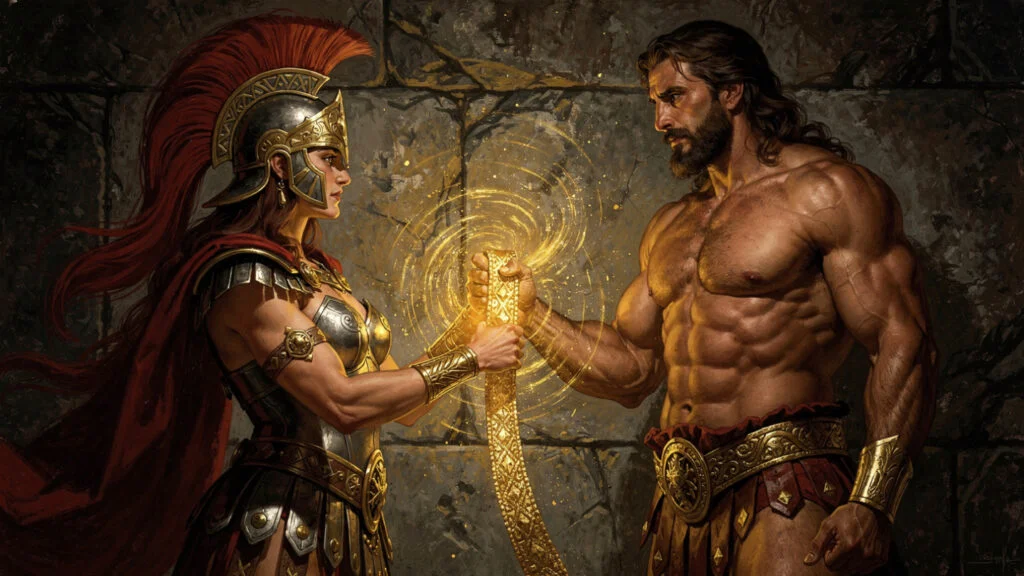
The story of Heracles and Hippolyta is the older of the two in the textual record, and it carries the ambiguity that the Amazon world consistently maintained. In some versions, Hippolyta gave Heracles the belt freely, moved by admiration or love, and Hera’s intervention created the conflict by convincing the Amazons that Heracles was abducting their queen. In other versions, Hippolyta refused and the battle followed. The ambiguity is the narrative’s way of expressing the difficult position the Amazon queen occupied in the heroic imagination. She was a warrior whom the hero needed to overcome, yet she was also a figure whose courage, authority, and possession of the divine belt placed her among the admirable rather than the merely adversarial.
The story of Theseus and the Amazons, which the Athenian imagination developed into the Amazonomachy, gave the Amazon attack a distinctly Athenian character. The Amazons who marched on Athens were seeking revenge for Theseus’s abduction of their queen Antiope, and the battle was fought in the geography of the city itself, on the Areopagus and through its streets. The narrative that Amazon warriors reached the very center of Athens and were driven back only through immense effort became the version that the Athenian sculptural program enshrined as the defining test of the city’s courage and military strength.
The Amazonomachy in Athenian Art
The Amazonomachy was one of the three great mythological battles that the Athenian artistic tradition of the fifth century BCE placed on the most significant buildings and objects of the city as the emblems of the city’s values and its place in the Greek world: alongside the Gigantomachy, the battle of the gods and the Giants, and the Centauromachy, the battle of the Lapiths and the Centaurs, the Amazonomachy constituted the pictorial program of civilization’s victory over barbarism that the Parthenon’s sculptural decoration expressed across its multiple surfaces.
The Parthenon’s south metopes showed the Centauromachy in the thirty-two surviving panels of the metope sequence. The west pediment showed Athena and Poseidon’s contest for Athens. The Athena Parthenos, Pheidias’s chryselephantine cult statue in the temple’s interior, carried the Amazonomachy on the outside of Athena’s shield: the combat of the Greeks and the Amazons on the shield of the goddess who patronized Athens was the visual statement about what Athens was fighting for and what it had already defeated.
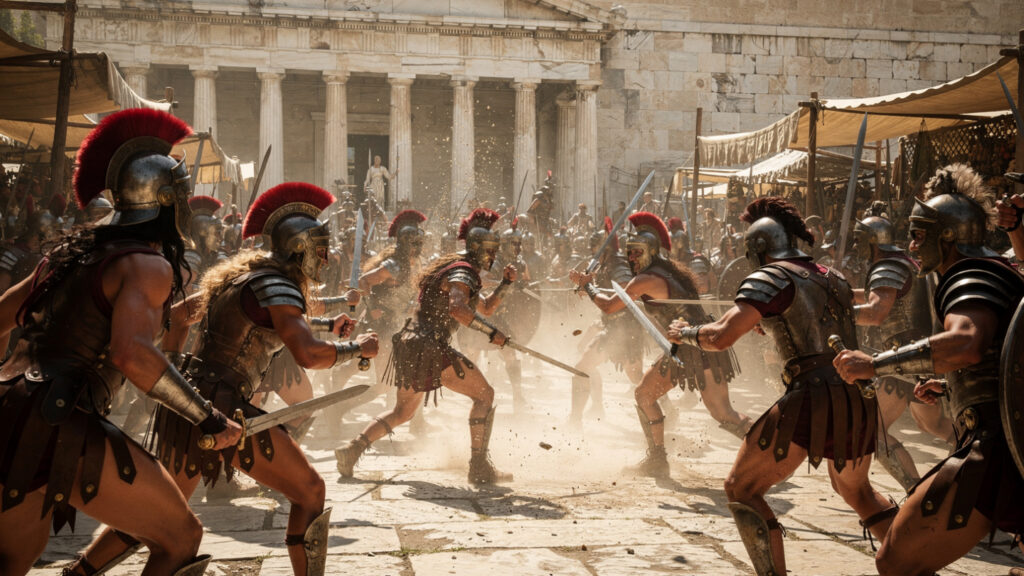
The Stoa Poikile, the Painted Stoa in the Athenian agora, carried Polygnotus’s and Mikon’s paintings of the battle of Marathon alongside the Amazonomachy and the Iliou Persis, the sack of Troy: the three battles were the three defining military victories in the Athenian imagination, one legendary against the Amazons, one mythological against Troy, and one historical against Persia. The placement of the Amazonomachy alongside Marathon was the explicit statement that the Amazon attack on Athens and the Persian invasion of Greece were the same kind of threat, the barbarian assault on the civilized polis, and that Athens’s victory over both was the same kind of achievement.
The vase‑painting record places the Amazon image exactly where it belongs from the sixth century BCE onward. When the red‑figure technique emerged in Athens around 530 BCE, it gave painters the ability to show the Amazons with a level of individual detail that the earlier black‑figure method could not support. Armor, weapons, posture, and expression could finally be rendered with the clarity that matched the complexity of the figures themselves.
The Amazon vases held in the National Archaeological Museum and the Acropolis Museum are among the most complete surviving evidence of how Athenian artists imagined these women. They appear consistently as capable warriors equipped with the military gear of the period, wearing the Phrygian cap and carrying the combination of weapons that the eastern warrior woman was understood to possess. The painters did not treat them as curiosities. They treated them as fighters whose presence demanded the full seriousness of the Athenian artistic vocabulary.
The Scythian Archaeological Evidence
The question of the historical basis for the Amazon tradition has been substantially advanced by the archaeological investigation of Scythian burial mounds in the Black Sea region and the Eurasian steppe over the past fifty years, and the evidence that has emerged from this investigation is genuinely significant rather than the folkloric coincidence that the skeptic’s position would suggest.
The Scythians, the nomadic and semi‑nomadic peoples of the Eurasian steppe from the Black Sea to the Altai Mountains, were the group that Greek sources most consistently placed near the Amazons. The geographical alignment between the Amazon story’s placement of Themiscyra and the documented spread of Scythian archaeological material in the Black Sea region is the first layer of the correspondence.
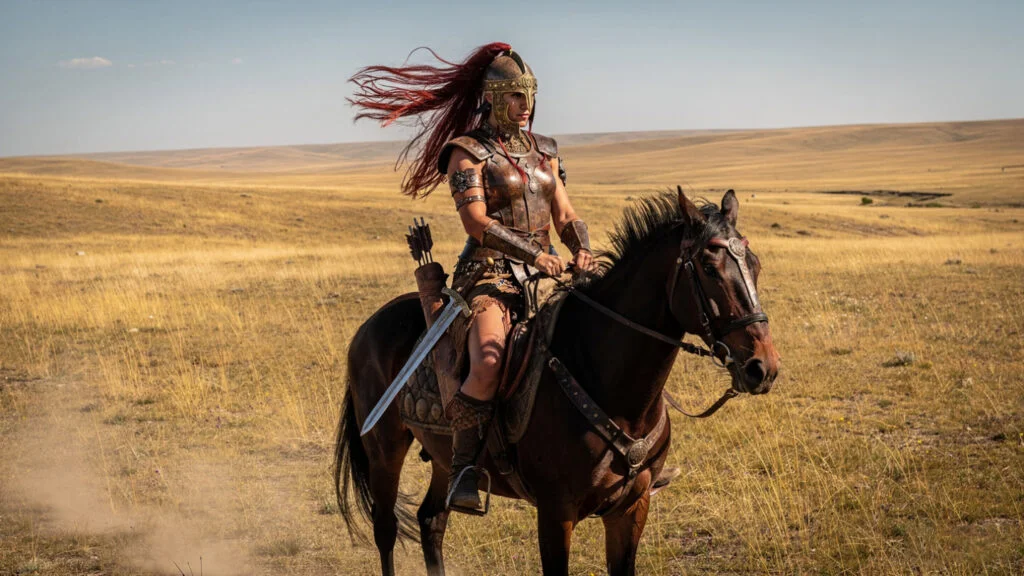
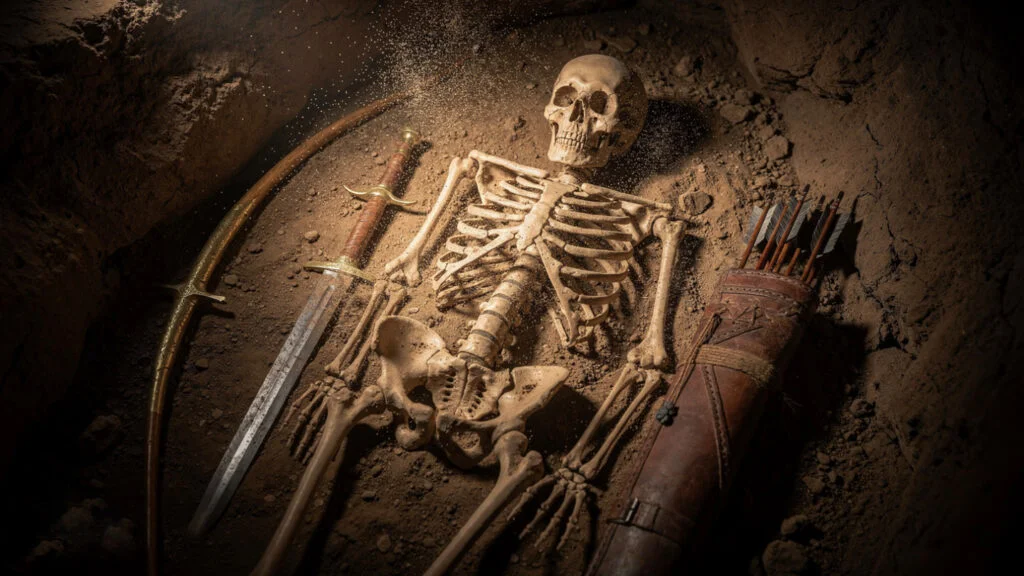
The more direct correspondence is the burial evidence: the systematic excavation of Scythian burial mounds, the kurgans, in the region of the Black Sea steppes, particularly in Ukraine and the southern Russian steppe, has produced a consistent pattern of female burials with weapons. Approximately twenty percent of the warrior burials in the Scythian archaeological record from the fifth to the third centuries BCE are the burials of women, with the weapons, the quivers of arrows, the iron swords, and in some cases the bronze armor that identify the grave as a warrior grave. Some of the female skeletons show the bone deformations associated with regular horseback riding in childhood and adolescence, and some show healed weapon wounds that document combat experience.
The claim that Amazon warriors were primarily mounted archers aligns directly with the military practices documented in Scythian female warrior burials. The composite bow and the horse were the essential equipment of the steppe fighter, and the female graves that contain bows and show physical evidence of riding from childhood belong to the women who participated in the military life that the steppe demanded.
The most systematic scholarly identification of these burials with the Amazon story was made by the American archaeologist Jeannine Davis‑Kimball. Her excavations of Scythian kurgans in the Ural steppes in the 1990s produced the most extensively documented examples of female warrior graves in the archaeological record. The combination of weapons, ritual objects, and skeletal evidence in these burials has been interpreted as proof of a society in which a defined group of women, perhaps a priestly‑warrior class rather than the entire female population, took part in the military activities required by nomadic life.
The Greek travelers and traders who met the Scythians along the Black Sea coast and through the commercial routes of the steppe were encountering the culture whose female participants in warfare generated the Amazon image in Greek imagination. The Amazons of myth were not the Scythian women as they actually lived. They were the Scythian women transformed by the Greek imagination into the extreme case of inverted gender norms, shaped into figures who marked the boundary between the Greek world and the world beyond it.
The Brauron Connection
The sanctuary of Artemis at Brauron on the eastern coast of Attica, the site where Athenian girls between five and ten performed the ceremony of the arkteia, the bear ritual, before marriage, carried an Amazon association that the ancient sources preserve in a form that the modern scholarship has found genuinely interesting.
The arkteia at Brauron asked the girls, called arktoi or bears, to perform ritual actions that included running, the athletic activity most closely associated with the Amazons in ancient art. The link between the Artemis cult and the Amazon story was the link between the goddess who governed the wild spaces beyond the polis and who oversaw the female passage from the wild to the domestic, and the warrior women who lived permanently in the wild and never made that passage. The Amazons were the extreme case of what the girls of the arkteia enacted only for a moment before returning to the ordered life of the polis. They represented the permanent occupation of the space outside the city’s gender norms.
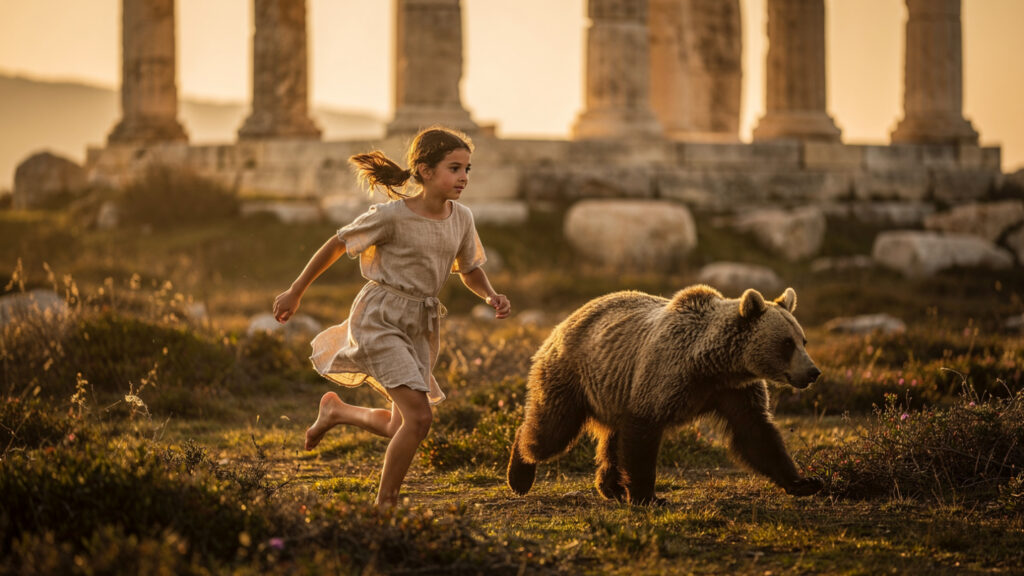
The Brauron sanctuary’s topography, the coastal marsh landscape with the quality of the Attic coast in this location, the archaeological remains of the sanctuary including the stoa where the votive offerings and the garments dedicated to Artemis were stored, and the small museum that holds the sculpture from the sanctuary including the remarkable portraits of the arktoi girls, are together the most direct encounter with the Artemis cult and its relationship to the Amazon tradition that the Attic landscape provides.
The Amazon Queens | Penthesilea, Hippolyta, Antiope
The named Amazon queens are the figures through whom the Greek imagination developed the Amazon not only as a type but as a mythological person. The three principal queens, Penthesilea, Hippolyta, and Antiope, each represent a different dimension of the warrior woman’s place in the story world.
Penthesilea is the queen whose story the Aethiopis shaped in the episode described at the opening of the article. She came to Troy as Priam’s ally, fought with exceptional courage, and was killed by Achilles at the moment when the recognition of her worth arrived at the same instant as her destruction. The tradition that Achilles loved her at the moment of her death is the tradition that ancient artists found most compelling. The cups and vases that depict their encounter consistently give the scene the visual quality of an embrace as much as a combat. Achilles catches her as she falls, and the configuration of their bodies makes the moment of death indistinguishable from the moment of recognition.
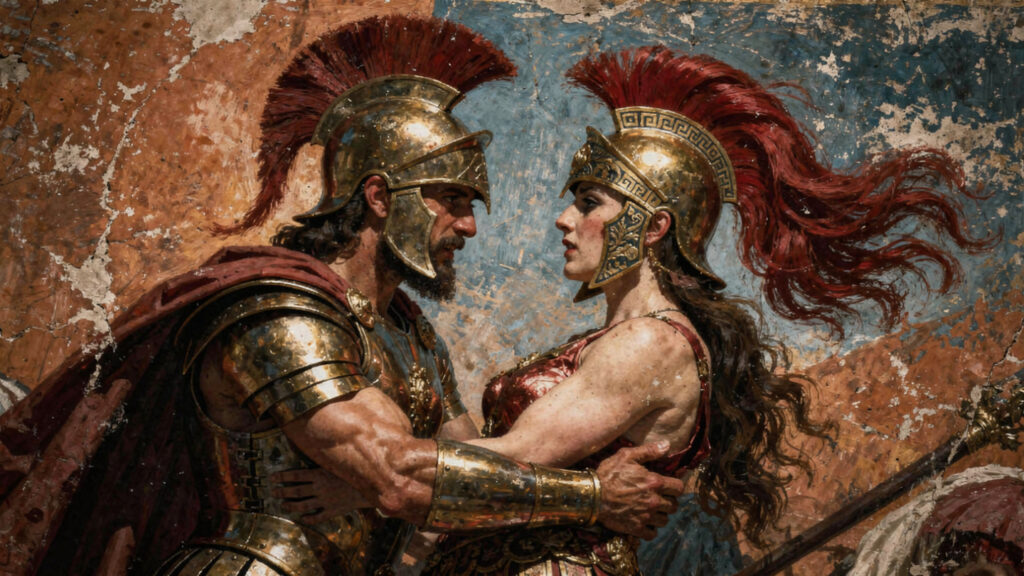
Hippolyta is the queen whose belt defined her authority: the golden girdle that Zeus gave her as a mark of her position as the leader of the Amazon warriors was the divine gift that made her the Amazon queen in the sense that the divine attributes of the Olympian gods made them the divine powers they were. The ninth labor of Heracles and the conflict that developed around the belt was the tradition’s engagement with the question of what happened when the heroic world’s ultimate male warrior and the Amazon world’s ultimate female warrior were placed in the same narrative space and required to interact.
Antiope was the Amazon queen whose abduction by Theseus set the Amazonomachy in motion. The Athenian narrative that made her capture the cause of the Amazon attack gave the story its personal and political weight. The assault on Athens was not simply a barbarian incursion into a Greek city. It was the Amazons’ attempt to recover their queen and punish the man who had taken her. The Athenian victory was therefore both the defense of the city and the assertion that Theseus’s possession of Antiope was rightful rather than criminal.
Why the Amazons Were Necessary
The Amazon story served a purpose in the Greek imagination that no other mythic cycle fulfilled in quite the same way. It placed the reversal of Greek gender norms at the heroic level rather than in the domestic sphere or the comic stage, and it forced the heroic world to confront that reversal through real military encounter rather than through simple social disapproval.
The Amazons were not a cautionary tale about what happened when women refused their proper domestic role: they were a people of genuine martial excellence whose excellence required the Greek tradition’s greatest heroes, Heracles, Achilles, Theseus, to engage with them at the full extent of the heroes’ own capacities. The Amazon queen who required Heracles’ ninth labor to defeat, the Amazon queen whose death made Achilles weep, the Amazon army that penetrated to the Areopagus before being repulsed: these were not easily defeated opponents whose defeat reflected well on the heroes who defeated them by contrast with their weakness. They were formidable opponents whose defeat reflected well on the heroes precisely because the defeat was genuinely difficult.
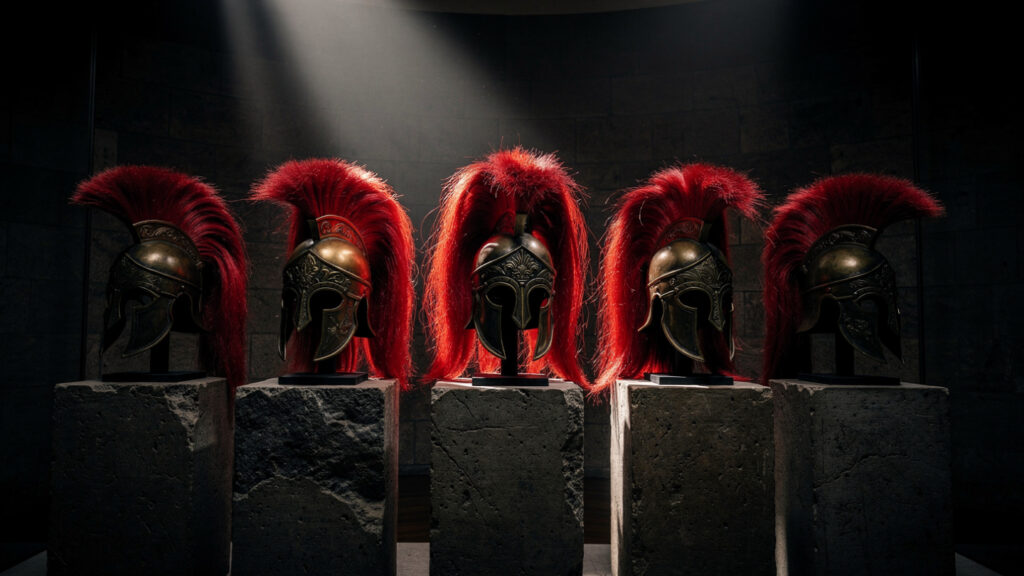
The Amazonomachy’s consistent placement alongside the Gigantomachy and the Centauromachy in the Athenian pictorial program was the placement that gave the Amazon encounter its fullest ideological dimension: the Gigants were the divine adversaries whose defeat required the Olympians, the Centaurs were the semi-human adversaries whose defeat required the Lapiths’ and the heroes’ combined effort, and the Amazons were the human adversaries whose difference from the Greek norm was the inversion of the gender norms that the polis was organized around. The defeat of all three was the Athenian artistic program’s declaration that the civilized order had been defended against the three categories of challenge to it: the divine, the hybrid, and the gendered-other.
The Amazon who wept at Achilles’ feet and the Amazon whose death made Achilles weep were both essential to the story. The narrative needed the Amazons to fall, because their defeat affirmed the values of the heroic world. It also needed the defeat to carry weight, because a victory that cost nothing against opponents who offered no real resistance was not a heroic victory at all.
At Olympus Estate, Mythic Essays moves through the deeper currents of the Greek tradition. Achilles killed Penthesilea and wept. The Scythian female warrior burials in the Ukrainian steppe are real and the weapons in them are real. The Amazon tradition was the Greek imagination’s way of placing the inversion of its own gender norms at the heroic level and requiring its greatest heroes to take that inversion seriously. They did. The tradition recorded that they did. Penthesilea’s name is in the sources. Her face is on the vases. She fell and he wept and the tradition could not suppress either fact.