




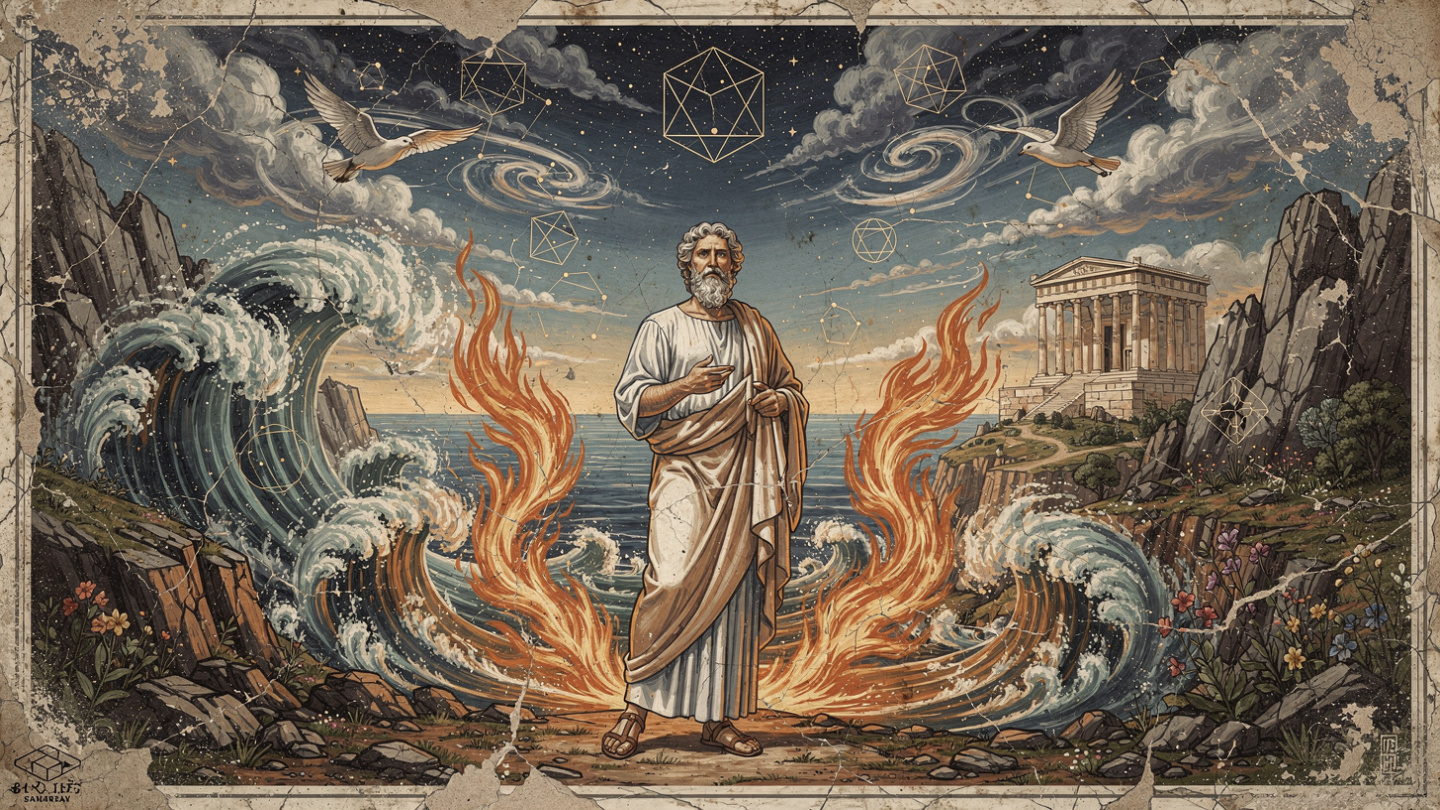
The first Greek philosopher proposed a single element.
Thales of Miletus, working in the early sixth century BCE in the Ionian city that was then one of the most intellectually active in the Greek world, proposed that water was the fundamental substance of which everything else was composed. This was not the claim that water was important or abundant or necessary for life, though all of those things were also true. It was the claim that water was the archē, the beginning or first principle, the substance that underlay all other substances and from which the diversity of the observed world was produced through transformation.
The claim seems wrong in the terms that modern chemistry would apply to it. But it was not a claim that modern chemistry would recognize as the kind of thing it evaluates, because it was not the kind of claim that modern chemistry makes. Thales was not proposing a chemical analysis of the physical world. He was proposing an answer to a different question: what is the most fundamental kind of thing that exists, and in what relationship does everything else stand to it? This question, which the pre-Socratic philosophers developed across the sixth and fifth centuries BCE through a series of proposals each of which criticized and refined the ones that preceded it, is not the question that modern science answers when it identifies the elements of the periodic table. It is a question about the structure of explanation itself, about what it means for one thing to be more fundamental than another, and about the relationship between the unity of the cosmos and the diversity of its appearances.
The four-element theory that emerged from this investigation over the course of two centuries, reaching its clearest expression in Empedocles and its most developed philosophical form in Aristotle, was the most sustained and most influential attempt in the history of Western thought to answer this question. Understanding what the four elements were requires understanding what question they were answering.
The Pre-Socratic Search and Its Stakes
The intellectual project that produced the four-element theory began in the Greek cities of Ionia, on the Aegean coast of what is now Turkey, in the sixth century BCE. The Ionian philosophers, of whom Thales was the earliest surviving name, were attempting something that the Greek world had not previously attempted in this form: an account of the natural world that explained its diversity and its change without appealing to the narratives of divine action that the Hesiodic and Homeric traditions had employed.
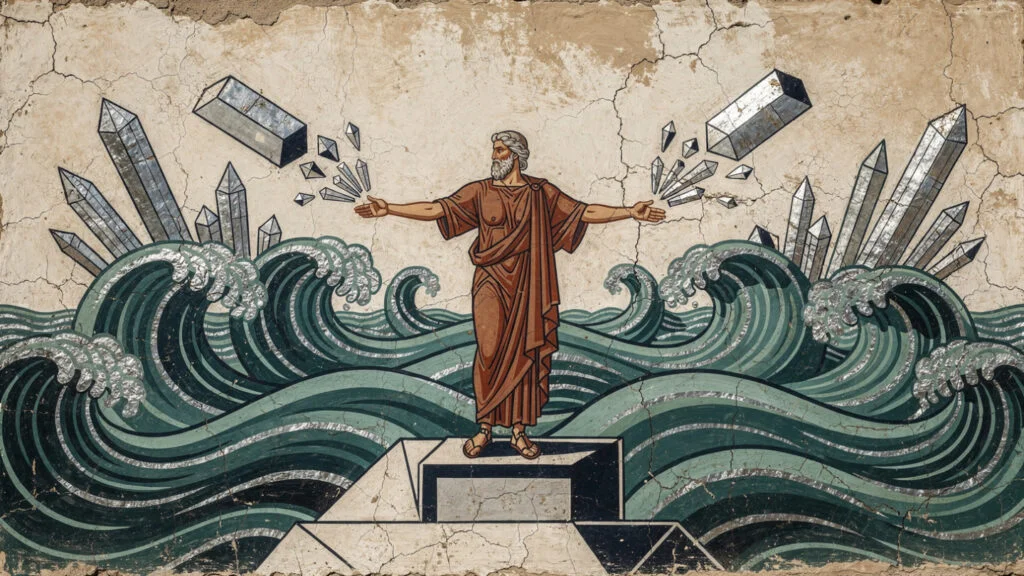
This was not a rejection of the divine. The Ionian philosophers were not atheists, and their understanding of the fundamental substance of the cosmos typically attributed divine or quasi-divine qualities to it. What they were rejecting was the explanatory structure of the mythological tradition, in which events in the natural world, the rising of the sun, the change of seasons, the occurrence of storms, were explained by reference to the intentions and actions of divine persons. They wanted an account of the natural world’s behavior that referred to the properties of the natural world itself rather than to the characters and motivations of the beings who governed it.
Anaximenes, who succeeded Thales in the Milesian tradition, proposed air as the primary substance, arguing that the other substances were produced from air through the processes of condensation and rarefaction: compressed air becomes water, compressed water becomes earth, rarified air becomes fire. This was a more sophisticated proposal than Thales’s because it provided a mechanism by which the primary substance could produce the diversity of observed substances rather than simply asserting the identity between them.
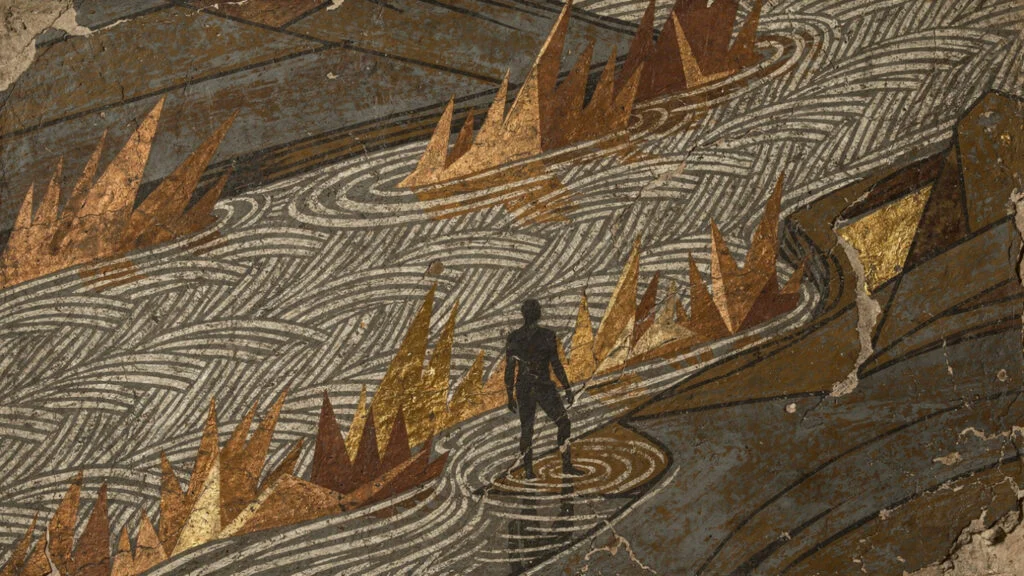
Heraclitus of Ephesus, working in the early fifth century, proposed fire not as a single primary substance in the Milesian sense but as the best symbol for the most fundamental feature of the cosmos: its constant change. For Heraclitus, the cosmos was not composed of a stable primary substance that transformed into other substances while remaining itself. It was constituted by transformation as such, and fire, which is always consuming and always producing and never static, was the image that most directly expressed this constitutive change. The river that you cannot step into twice, because the water is always different, and the fire that is always dying into smoke and ash while always being fed by new fuel, are the Heraclitean images for a cosmos in which identity across change is not a fixed substance but an ongoing ratio or proportion.
Empedocles and the Four Roots
The synthesis that established the four-element framework as the dominant paradigm of ancient natural philosophy was the achievement of Empedocles of Akragas in Sicily, who was working in the middle of the fifth century BCE.
Empedocles proposed that the cosmos was not composed of a single primary substance that underwent transformation into apparent diversity. It was composed of four unchanging and eternal roots, as he called them, earth, water, air, and fire, whose combination and separation produced all the diversity of the observed world. The roots themselves did not transform into one another. They mixed in varying proportions to produce the substances that populated the world. Bone was a proportion of earth, water, fire, and air. Blood was a different proportion. Rock was different again.
The mechanism by which the roots combined and separated was provided by two non-material forces that Empedocles added to the system: Philia, Love or Attraction, which brought the roots together into combinations, and Neikos, Strife or Repulsion, which drove them apart. The history of the cosmos, in the Empedoclean account, was the history of the alternating dominance of these two forces: at the maximum of Love, the four roots were entirely combined in a single undifferentiated unity, the Sphairos, a perfect sphere of mixed elements in complete harmony. At the maximum of Strife, the four roots were entirely separated, each in its own exclusive domain. The world as it exists in observable experience was the world in the intermediate states, when Strife had disrupted the Sphairan unity but Love had not yet achieved complete combination, and the partial mixing of the roots produced the diversity of observed phenomena.
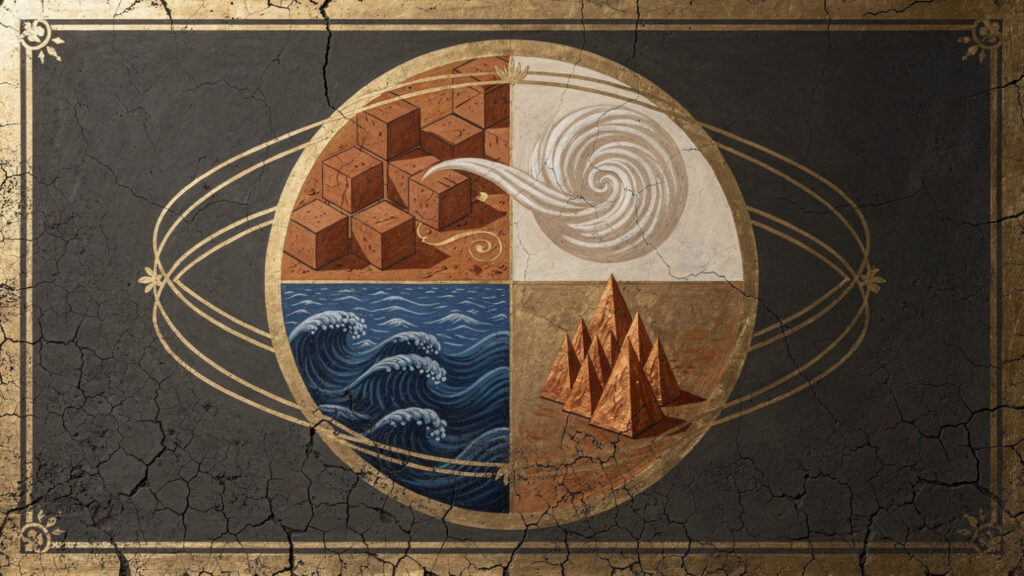
The Empedoclean system was the first in the Western philosophical canon to distribute the explanatory burden across four co-equal principles rather than subordinating everything to a single primary substance. The four-fold structure he established persisted in the discipline for more than two thousand years precisely because this distribution of labor across multiple elements was more flexible and productive than the single-substance approaches of his predecessors had been.
Plato and the Geometric Solids
Plato’s treatment of the four elements in the Timaeus, the dialogue in which he presents his most developed account of the physical cosmos, is the treatment that most directly reflects the specifically Platonic philosophical agenda rather than the tradition of natural philosophy he was inheriting.
In the Timaeus, the Demiurge, the divine craftsman who organizes the physical cosmos, creates the four elements by giving them the geometric forms that make them what they are. Fire is the tetrahedron, the solid with four triangular faces, because its sharp points make it the most penetrating and most capable of producing sensation in what it contacts. Air is the octahedron, with eight triangular faces, intermediate in sharpness and capable of movement in the way that air moves. Water is the icosahedron, with twenty triangular faces, the most rounded of the triangular-faced solids and therefore the most capable of flowing and filling containers the way water does. Earth is the cube, the only regular solid with square faces, which gives it the stability and immobility that earth exhibits compared to the other elements.
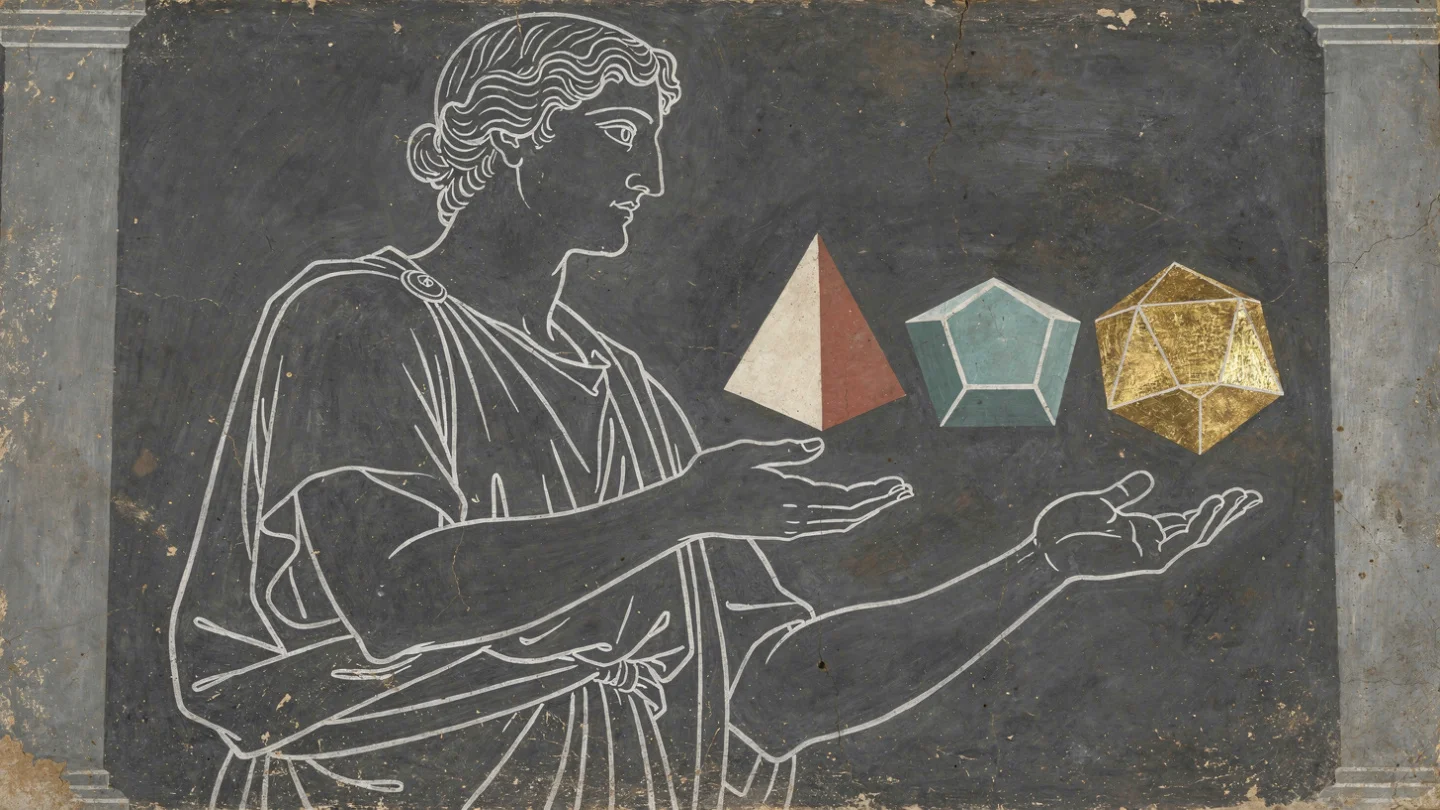
The fifth solid, the dodecahedron with twelve pentagonal faces, Plato assigns to the cosmos as a whole rather than to any terrestrial element, and this is the basis for the later identification of the fifth element, aether or quintessence, with the dodecahedron and with the substance of the heavenly bodies.
The geometric specification of the elements was not a decorative addition to the Empedoclean system. It was the Platonic claim that the physical world was constituted by mathematical structure, that the properties of the elements were the consequences of their geometric form rather than irreducible qualities, and that the intelligibility of the physical world was therefore the same kind of intelligibility as the intelligibility of geometry: the intelligibility of a system of necessary relationships between precisely defined forms. This claim, that the book of nature is written in mathematical language, is one of the foundational commitments of the natural science that developed in Europe from the sixteenth century onward, and Plato’s Timaeus is one of the earliest and most systematic expressions of it.
Aristotle’s Qualitative Analysis
Aristotle accepted the four-element framework from his predecessors but gave it a different philosophical foundation than the one Plato had provided. Where Plato explained the elements through their geometric forms, Aristotle explained them through their qualities. The quality analysis he developed dominated the Western natural philosophical canon most persistently, because it was formulated in terms that the biological and medical applications of elemental theory could use directly.
The four primary qualities in Aristotle’s system were hot and cold, wet and dry, and the four elements were constituted by the combinations of these qualities: fire was hot and dry, air was hot and wet, water was cold and wet, and earth was cold and dry. Each element shared one quality with each of its neighbors in the cycle, which meant that transformation between adjacent elements was possible through the alteration of the shared quality’s partner: water could become either air by heating or earth by drying, because it shared wetness with air and coldness with earth.
This system of qualities made the theory of the elements directly applicable to the Hippocratic medical school’s theory of the four humors, which associated the bodily fluids, blood, phlegm, yellow bile, and black bile, with the four elements and the four quality pairs. The medical application of the elemental theory was the dimension that gave it the longest practical influence in the Western world: the theory of humoral medicine, which the Galenic lineage transmitted from the classical era through the Arabic medical canon and into European practice, maintained its authority in the diagnosis and treatment of disease until the seventeenth century, when the experimental physiology of Harvey and others established the alternative frameworks that replaced it.
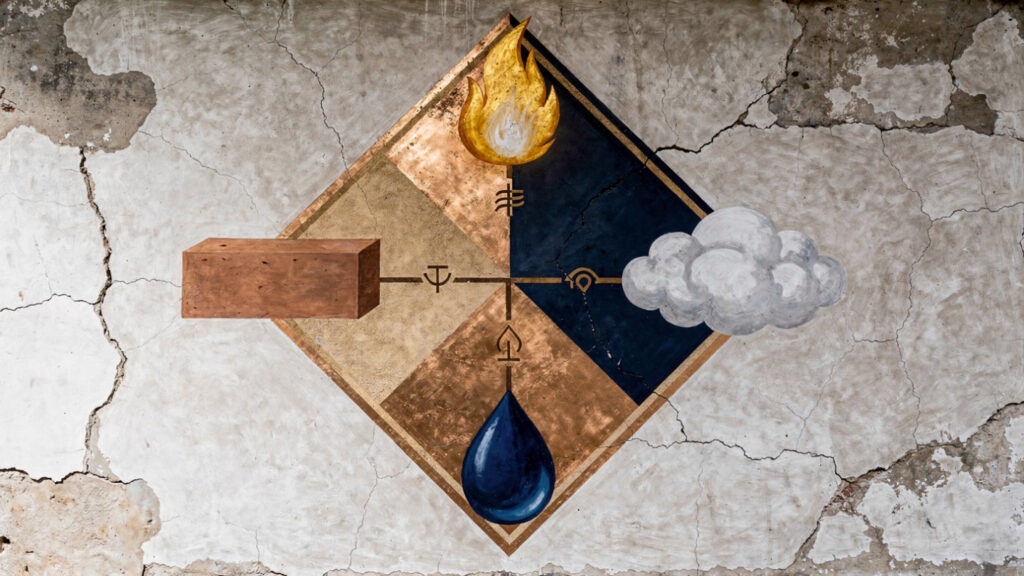
Aristotle added a fifth element, the aither, to handle the problem of the heavenly bodies, which exhibited a type of motion, the eternal circular motion of the celestial spheres, that differed categorically from the rectilinear motion of the terrestrial elements. The terrestrial elements moved toward their natural places in straight lines: fire upward, earth downward, air and water to their intermediate positions. The celestial bodies moved in perfect circles with no beginning and no end. This quality of circular motion, which was eternal and uniform in a way that the motion of the terrestrial elements was not, required a distinct substance whose natural motion was circular rather than rectilinear, and the aither, composed of none of the four terrestrial qualities and therefore immune to the change and decay that those qualities produced in the terrestrial world, was Aristotle’s proposal for this substance.
The Stoic Pneuma and the Active Elements
The Stoic philosophers, working in the Hellenistic period that followed Aristotle, took the elemental theory in a direction that emphasized its cosmological and theological dimensions over its physical and medical ones.
The Stoic cosmos was permeated by the pneuma, the breath or spirit, which the Stoics identified with the most active and most intelligent of the elements, fire and air in their most refined forms. The pneuma was the substance that gave the cosmos its unity and its intelligence: not a separate divine substance standing outside the material world but the finest and most active material that permeated the entire cosmos and constituted its soul. The Stoic god was not a transcendent creator standing outside the cosmos but the pneuma itself in its most fully rational form, immanent in every part of the physical world and constituting the principle of its organization.
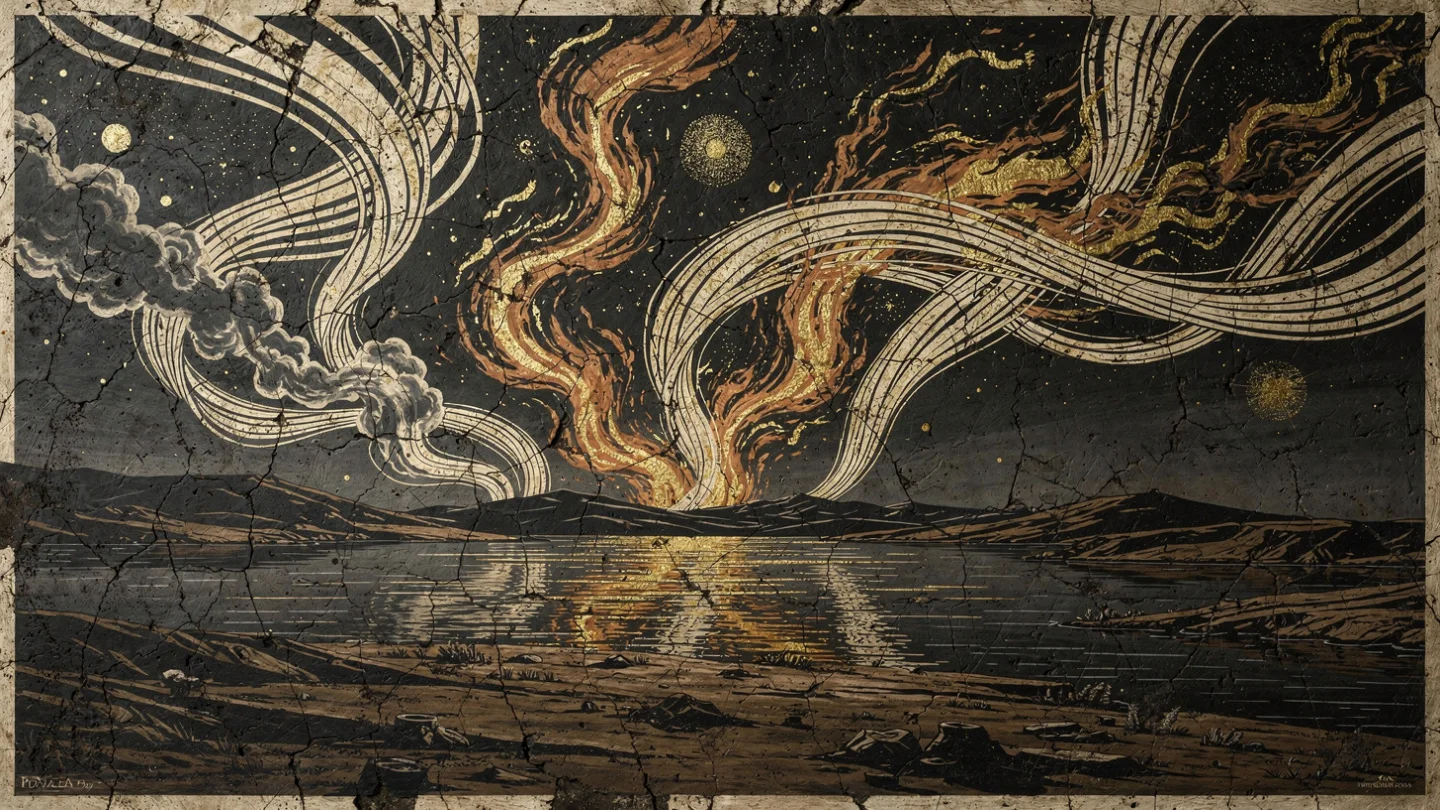
This Stoic pneumatology gave the elemental theory a specifically theological dimension that the Platonic and Aristotelian versions, while not non-theological, had not developed in the same direction. For the Stoics, the four elements were not only the physical constituents of the cosmos but the expression of the divine intelligence that permeated it: fire and air as the active, intelligent, and divine elements, earth and water as the passive, material, and inert elements that the active elements organized and ensouled.
The Stoic version of the elemental theory was the version that most directly influenced the alchemical tradition of late antiquity and the medieval period: the idea that the elements were associated with spiritual principles, that fire was the most divine and most active, and that the transformation of elements was simultaneously a spiritual process and a physical one, is the foundational assumption of alchemical practice as a spiritual discipline rather than merely a proto-chemical technology.
What the Theory Was Doing
The four-element theory of the ancient Greek philosophers was not a failed attempt at the kind of explanation that modern chemistry provides. It was an attempt at a different kind of explanation, answering a different kind of question, and its failure to anticipate the results of modern chemistry does not measure its success or failure at the task it was actually undertaking.
The question the four-element theory answered was not what are the ultimate constituents of matter in the sense that the periodic table provides an answer. It was: what are the most general principles of change in the natural world, and how do they interact to produce the diversity of observed phenomena? The four quality pairs that Aristotle identified as the basis of the elements, hot and cold, wet and dry, are the most general qualitative distinctions that the ordinary observation of the natural world makes available, and the combinations he proposed for the four elements encoded the most basic observed relationships between them: fire is hot and dries things out, water is cold and wet, earth is stable and dry, air is mobile and associated with moisture.
The theory maintained its power in the canon not because it correctly identified the chemical constituents of the natural world, but because it provided a framework of sufficient generality to accommodate the full range of natural phenomena that the ancient schools were attempting to understand. From the cosmological to the medical and the meteorological, the model functioned within a single system of principles whose interactions could be described and analyzed using the same vocabulary across all these diverse domains.
The replacement of the four-element theory by the modern chemical framework did not solve the philosophical problem the ancient theory was addressing. It changed the question: modern chemistry asks what matter is made of in the sense of its ultimate compositional constituents, while the four-element theory asked what change is in the sense of its most general principles. These are different questions, and the periodic table does not answer the question that Empedocles and Aristotle were working on any more than their elemental theory answers the question that Lavoisier and Dalton were working on.
At Olympus Estate, Mythic Essays moves through the deeper currents of the Greek tradition. The four elements were not wrong science. They were the answer to a question that modern science does not ask, which is why the answer persists in the imagination long after the laboratory has moved on. Fire transforms. Water flows. Earth holds. Air moves. These are still the most immediate things the natural world does.