


Every year, as the vibrant greens of summer fade into the muted grays of the cold months, the landscape of Ancient Greece prepares for a profound spiritual transition. While modern culture often views winter as a time of barrenness or death, the ancients saw it as a necessary part of a majestic seasonal cycle governed by one of the most complex figures in Greek mythology. To understand why the earth sleeps, one must understand the story of Persephone, the goddess who bridges the gap between the warmth of the sun and the silence of the grave. Her journey is not merely a tale of abduction, but a narrative of transformation, sovereignty, and the eternal rhythm of rebirth.
The Ancient Roots of the Mother Goddess
Long before the poets of the classical age recorded her stories, the figure of the goddess existed in the deep shadows of history. Her cult dates back as far as the Mycenaean era, making her one of the oldest deities in the Mediterranean world. In those earliest times, she was not the vulnerable maiden we often imagine today. Instead, Kore was worshipped as a powerful mother goddess in her own right, a figure of absolute authority over life and the earth.
As the mythic traditions evolved, the Greeks adopted this ancient cult and integrated her into the pantheon of Olympus. It was during this transition that she became the daughter of Demeter, the goddess of agriculture and fertility. This shift in her identity created one of the most poignant mother-daughter relationships in all of human storytelling. She ceased to be just a singular force and became the personification of the grain itself, the tiny seed that must break through the heavy layer of earth to ripen under the bright and warm rays of the sun. Because of this connection to the soil, the goddess was forever associated with eternal youth, beauty, and the fragile hope of every harvest.
A Golden Youth in the Shadow of Olympus
The birth of the goddess was shrouded in secrecy and divine tension. She was the daughter of Zeus and Demeter, born in a hidden cave far from the watchful eyes of the other gods. Demeter lived in constant fear of the wrath of Hera, knowing that the queen of the gods would not look kindly upon yet another affair involving the Thunderer. Despite the complicated circumstances of her arrival, the girl was raised with immense love and protection.

Persephone spent her childhood surrounded by the most powerful goddesses of Olympus, including Athena, Aphrodite, and Artemis. She was famous for her gentle character, known by all as a girl who was remarkably naive, cheerful, and kind. She was the light of her mother’s life, a well-mannered beauty who delighted her parents and unknowingly attracted the attention of the divine world. While Apollo and Ares held tender feelings for the young beauty, it was Hades, the dark ruler of the Underworld, who watched her from the shadows with a secret, burning intent.
The Maiden in the Meadow of Helios
Before her descent, the young goddess loved to walk through the lush domains of Helios, the sun god. These were beautiful fields where the air was thick with the scent of wild flowers and the music of murmuring streams. In these moments, she was perfectly happy, frolicking with the nymphs and enjoying a measured, carefree life. She was the embodiment of spring, a maiden who had never known grief or the chilling touch of the world below.

However, fate had already been decided by the higher powers. A number of ancient sources claim that the Thunderer had already promised his daughter to Hades as a wife. But the ruler of the Kingdom of the Dead knew that taking her would not be easy. Demeter guarded her daughter with a fierce, maternal intensity, allowing no suitors to approach. The opportunity finally arrived when Demeter left for Olympus, leaving the girl under the supervision of the sirens. It was in this moment of vulnerability that the earth itself conspired against her.
The Abduction and the Birth of the Long Night
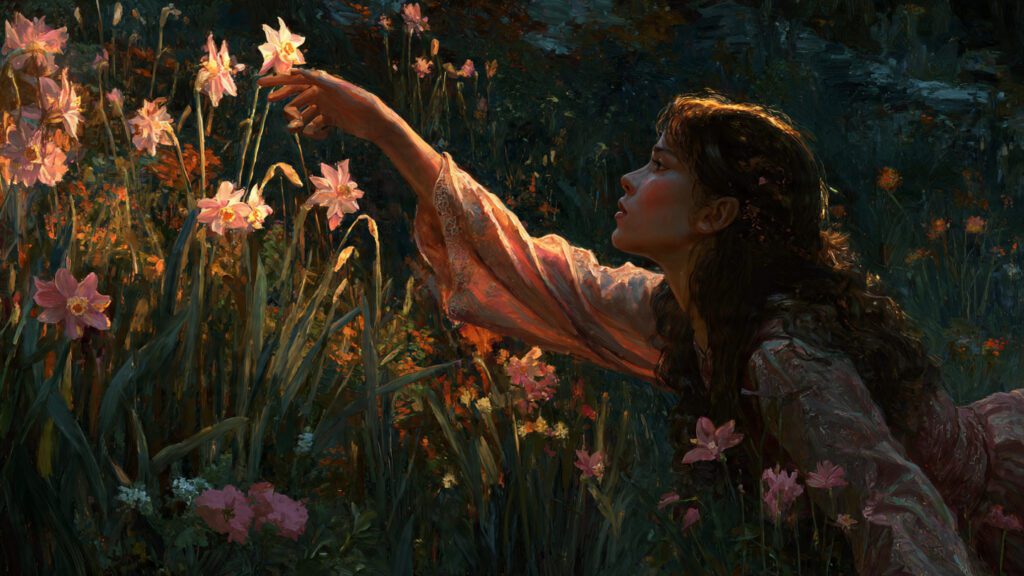
To trap the maiden, Hades sought the help of Gaia, the mother of the earth. She sent up a narcissus of such unnatural beauty that the girl could not resist it. As the goddess rushed to collect the plant, she wandered farther and farther from the sirens and into the center of the field. Suddenly, the ground split open with a roar like thunder. Hades emerged from the darkness in his golden chariot and dragged the screaming goddess down into his gloomy kingdom.


The search for the missing girl was desperate and agonizing. Demeter wandered the earth with torches, but her efforts yielded no results until Helios, who sees all from his solar chariot, finally reported the truth. In her despair, Demeter abandoned her duties. She refused to care for nature, and soon the trees stopped growing, the flowers withered, and the grain failed to sprout. The world faced its first true winter. Eventually, Zeus was forced to intervene, decreeing that the girl would spend half the year with her mother on the surface and the other half in the kingdom of the god of death.

Transforming into the Dread Queen of Silence
When she returns to the world of the living, everything around her blossoms in a riot of color and life. But when she returns to the throne of the Underworld, everything on the surface withers and falls asleep. This cyclical movement defines the seasons, but it also defined her soul. Finding herself in the cold and terrible world of the dead, the girl began to change. She lost her youthful naivety and acquired the features of a cruel, ruthless, and domineering woman. She became the true Queen of Hades, the one who decides the fate of the souls who enter her domain.

Initially, she refused to eat, her strength fading as she mourned her lost life. Hades, desperate to keep her, devised a plan. He offered her a farewell dinner and tempted her with pomegranate seeds. By eating the seeds of this sacred fruit, the goddess was bound to the Underworld and to her husband forever. Among all the deities of Ancient Greece, it was actually Hades and the Queen who became the ideal married couple. Their marriage was considered flawless and stable, a dark but perfect union of two powerful forces.
The Symbols of the Queen Below
The attributes of the goddess reflect her dual existence. The narcissus flower remains her most famous symbol, the beautiful trap that led to her descent. Pomegranate seeds are also vital to her imagery, representing both her marriage to the King of the Dead and the concept of marital fidelity among the ancient Greeks. Her sacred animal is the deer, a creature of the forest that represents her lingering connection to the wild, untouched parts of the world.

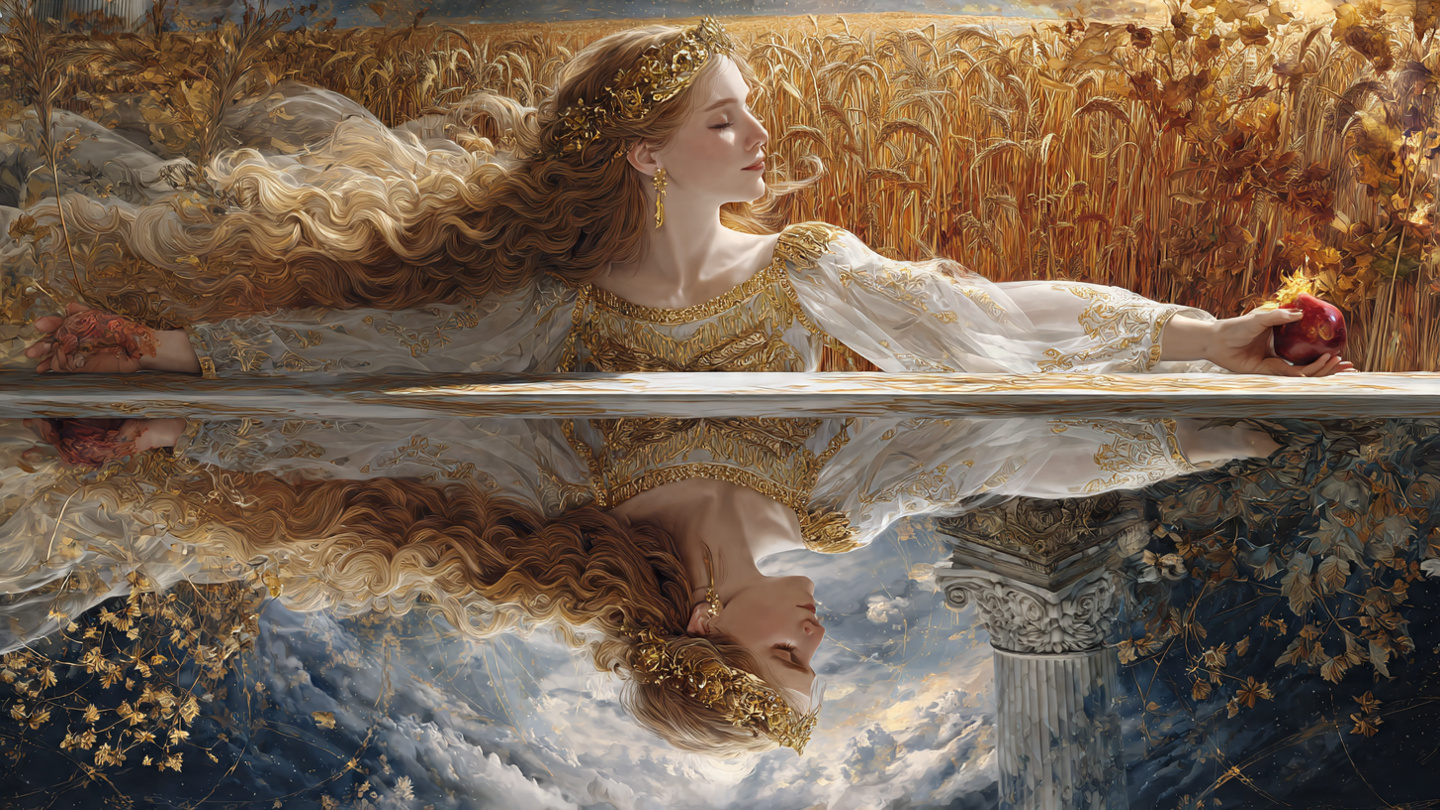
In art and traditional descriptions, she is a tall and stately girl with long brown hair that once shone in the sun but now carries the weight of a crown. She is often depicted with flowers in one hand and the fruit of the dead in the other. This image reminds us that winter is not a time of ending, but a time of sacred pause. It is the season where the seeds of the future are being protected in the darkness, just as the Queen herself waits in her marble halls for the moment of her glorious return.
A Sacred Pause for the Modern Soul
Modern culture often fears the silence and the cold, but the myth of the goddess teaches us to value the “inner winter.” She represents retreat without failure and silence without emptiness. To the ancients, the Eleusinian Mysteries provided a way to understand these cycles, offering hope that what disappears is not gone, and what rests is not dead.

Winter belongs to the Queen because she is the only one who truly knows both worlds. She understands the pain of the descent and the joy of the rising. When we stand in the cold air of December, we are standing in her season. It is a time for reflection, for protecting our own inner seeds, and for remembering that the light always returns to those who have the patience to wait for it.