

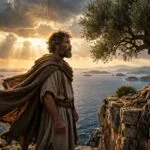


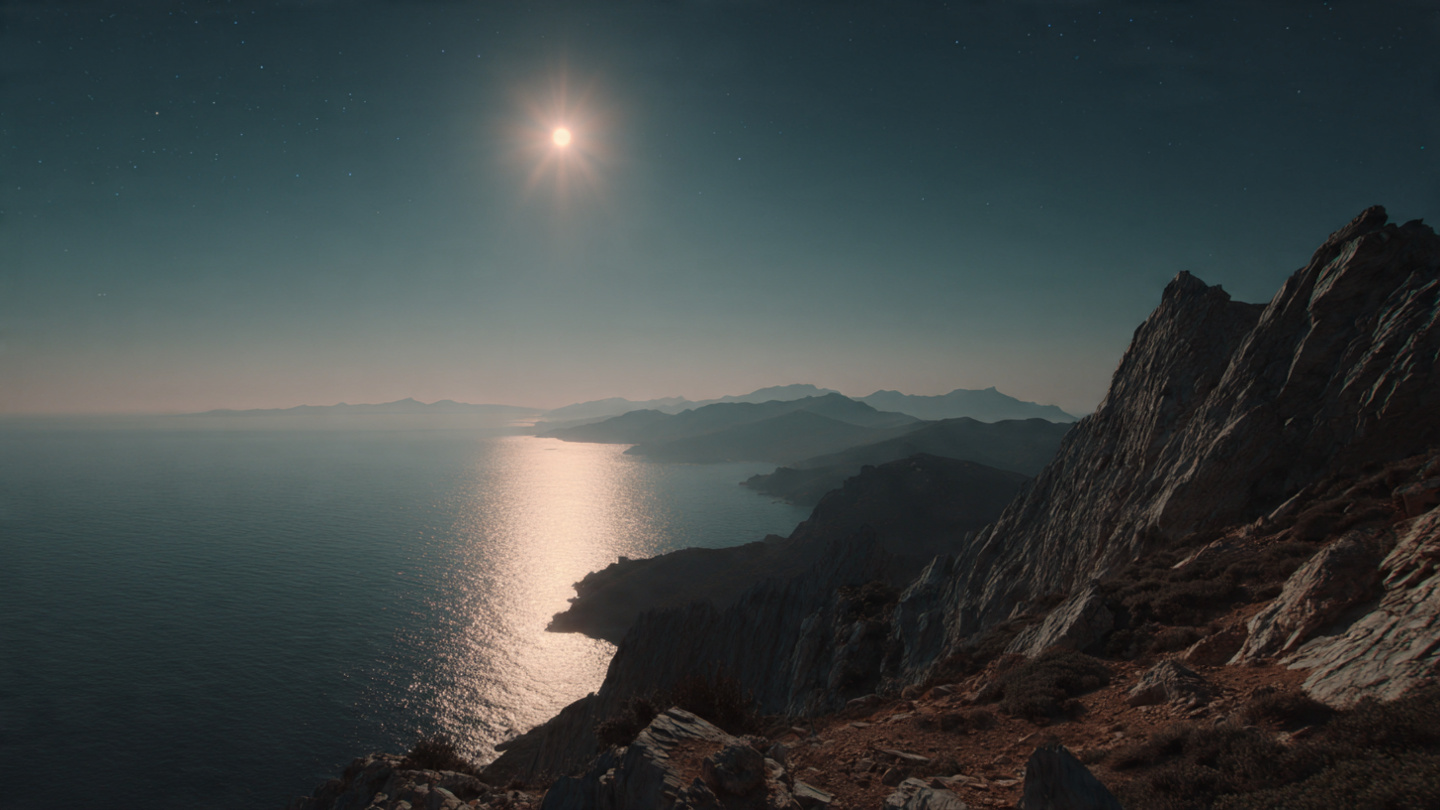
Where the instruments of modern astronomy organize the celestial bodies into classified categories and measured distances, the people of ancient Greece looked upward and saw something more particular and more alive: the Astra Planeta, the Wandering Stars, five lights that moved with a deliberate, independent grace against the fixed and orderly procession of the constellations.
The fixed stars, the Pleiades, Orion, the Bear, provided the ancient observer with continuity and orientation, rising and setting in patterns that repeated with the reliability of the agricultural calendar and the sailing season. Sailors crossing the Aegean between the islands of the Cyclades and the coastal harbors of the Peloponnese and Crete read these fixed stars as a grid of reference, stable enough to navigate by on moonless nights when the sea and the sky merged into a single dark field broken only by starlight. The fixed stars told the observer where he was. The Astra Planeta told him something different and less easily defined.
These five wandering lights, which the later astronomical tradition identified as Saturn, Jupiter, Mars, Venus, and Mercury, moved against the background of the fixed stars in paths that were complex and sometimes apparently contradictory, advancing, halting, reversing, and advancing again in cycles that required sustained observation across months and years to understand. In the mythological imagination of the early Aegean world, this movement was not the mechanical consequence of orbital mechanics but the expression of individual character. Each of the five wandering stars was understood as a living presence, a radiant figure with a temperament and a role in the governance of the sky.
Five Radiant Lights and Their Celestial Roles
The ancient Greek names for the visible planets carried, in each case, a precise description of the quality of light that the planet displayed to the naked eye observer. Phainon, the planet of Saturn, was the Shining One, visible as a steady, pale light that moved most slowly of all the wanderers and carried associations with time, endurance, and the long cycles of agricultural and historical life. Phaethon, the planet of Jupiter, was the Blazing One, the brightest of the wanderers after Venus, associated with Zeus himself and with the ordering power that the king of the gods exercised over the cosmos.
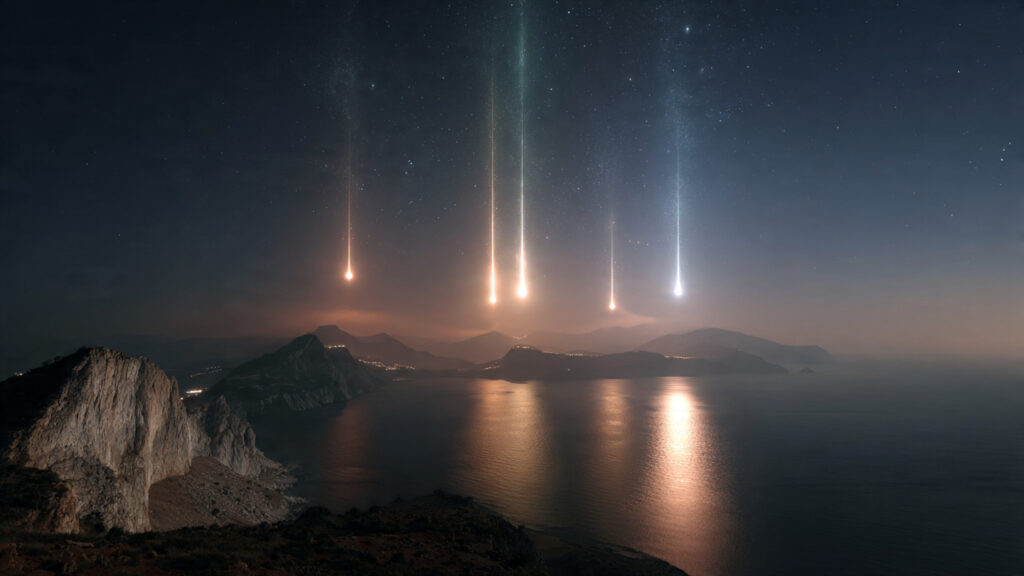
Pyroeis, the planet of Mars, was the Fiery One, identified by the red-orange quality of its light that distinguished it unmistakably from every other object in the sky. In the maritime culture of the Aegean, where the weather could change within hours and the relationship between a sailing crew and the sea was one of continuous negotiation, Pyroeis carried associations with the unpredictable intensification of natural forces, with the kind of energy that could not be directed but only read and responded to.
Stilbon, the planet of Mercury, was the Twinkling One, the most elusive of the five, visible only briefly in the twilight sky close to the horizon because of its proximity to the sun. The messenger god Hermes, with whom Mercury was associated, shared precisely this quality of brief, brilliant appearance and rapid disappearance, arriving with decisive information and departing before there was time to fully absorb what he had brought.
Phosphoros, the Light-Bringer, was Venus in its morning appearance, the brightest object in the sky after the sun and moon, rising before dawn to announce the end of the night and the imminent arrival of Helios across the eastern horizon. Its counterpart, Hesperos, was the same planet in its evening appearance, the first light to emerge in the western sky after sunset, guiding those still at sea toward the harbor and those already ashore toward the warmth of the household. The ancient Greeks understood Phosphoros and Hesperos as a single entity seen in two different contexts, a recognition of the planet’s identity that predates by many centuries the formal astronomical demonstration of why it is true.
Sanctuary Stone and the Path of the Wandering Stars
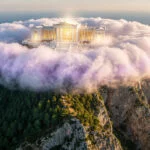
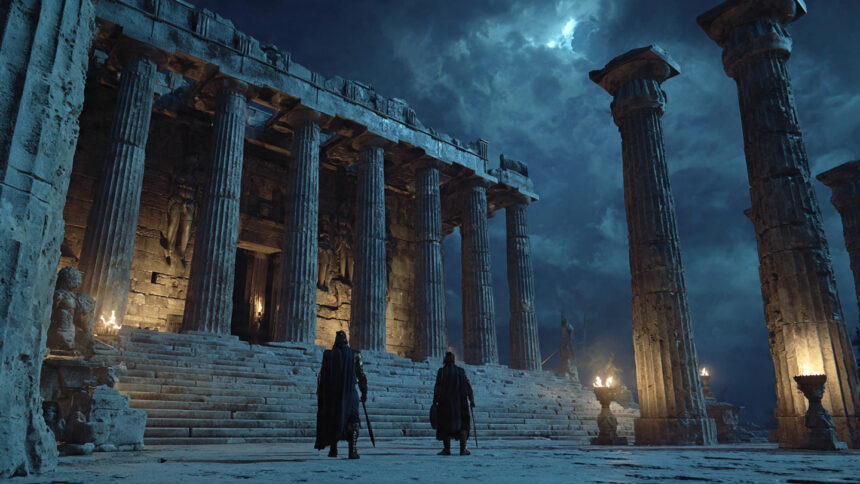
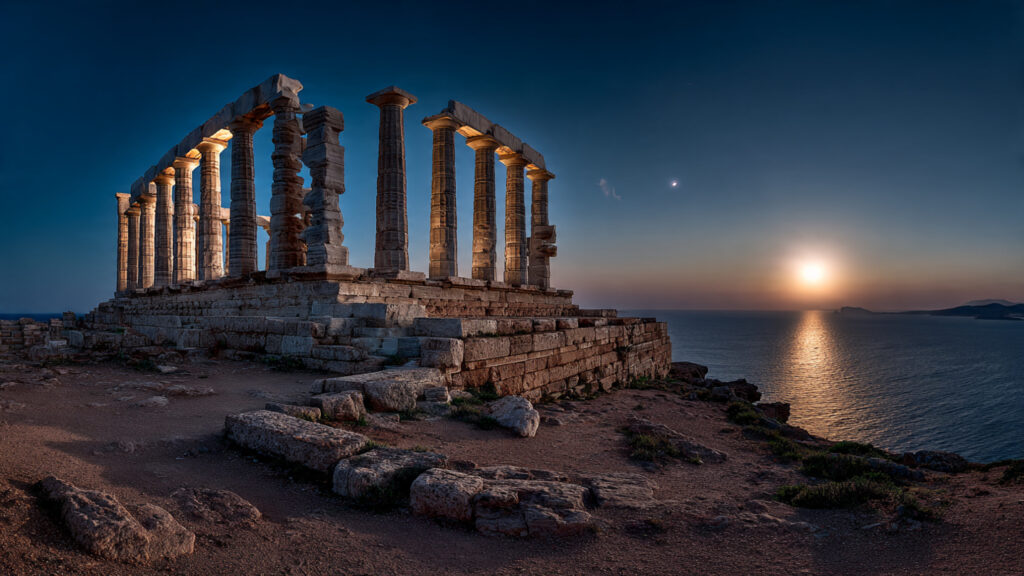
The ancient Greeks did not build their temples in isolation from the celestial landscape. The placement and orientation of sanctuary architecture across the Greek world reflects a sustained understanding of the relationship between the movements of the sky and the positions of sacred sites on the earth below. At Delphi, where the sanctuary of Apollo occupied a dramatic natural theater of rock and atmosphere on the southern slope of Parnassos, the orientation of the temple was calculated in relation to the rising and setting positions of the sun at significant points in the seasonal calendar. At Sounion, where the temple of Poseidon stands on a promontory above the sea at the southern tip of Attica, the positioning was both practical and cosmological: the temple was visible to sailors approaching from the south, and its location at the horizon-point between sea and sky placed it at a threshold that the ancient observer, watching the planets set in sequence beyond the temple’s columns, would naturally have read as meaningful.
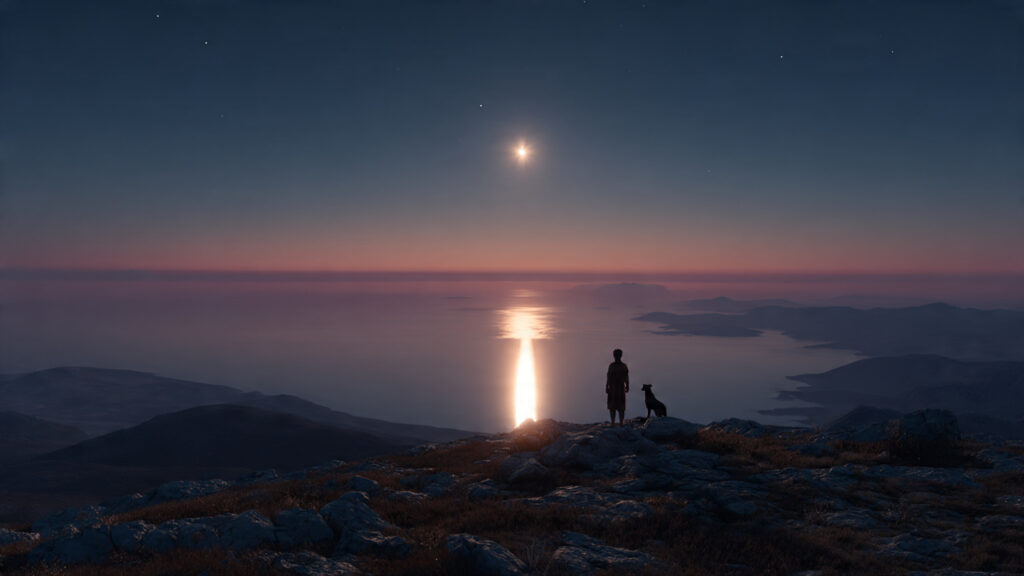
The island sanctuaries of the Cyclades were similarly positioned with attention to celestial events. Delos, the birthplace of Apollo and therefore the most direct earthly connection to the god of light and order, sat at the geographic center of the Cyclades with a horizon unobstructed by higher land on any side. From the sanctuary, all five of the Astra Planeta could be tracked across their full arcs from rising to setting, and the relationship between their movements and the seasonal calendar of festivals, plantings, and sailings was directly observable without the mediation of calculation.
Sailors, Seasons, and the Planets Above the Cyclades
In the seafaring communities of the Cyclades, the Dodecanese, and the coastal settlements of the Peloponnese and Crete, the movements of the Astra Planeta were integrated into the practical knowledge that governed the timing of voyages, the prediction of weather, and the management of the agricultural calendar. This knowledge was not separated from the mythological understanding of the planets as living guardians. It was the same knowledge, expressed simultaneously in narrative and in practice.
The appearance of Phosphoros before dawn on a clear morning indicated settled atmospheric conditions, the kind of clear, stable sky that promised a day of reliable winds and predictable seas. A hazy or reddened appearance of the same planet, particularly in combination with a reddened sunset the evening before, was read as a sign of changing conditions, and experienced sailors in the harbors of Naxos or Paros would adjust their departure plans accordingly. The planet was not merely a symbol of the dawn. It was a practical instrument of weather reading, its visual quality carrying direct information about the state of the atmosphere above the Aegean.
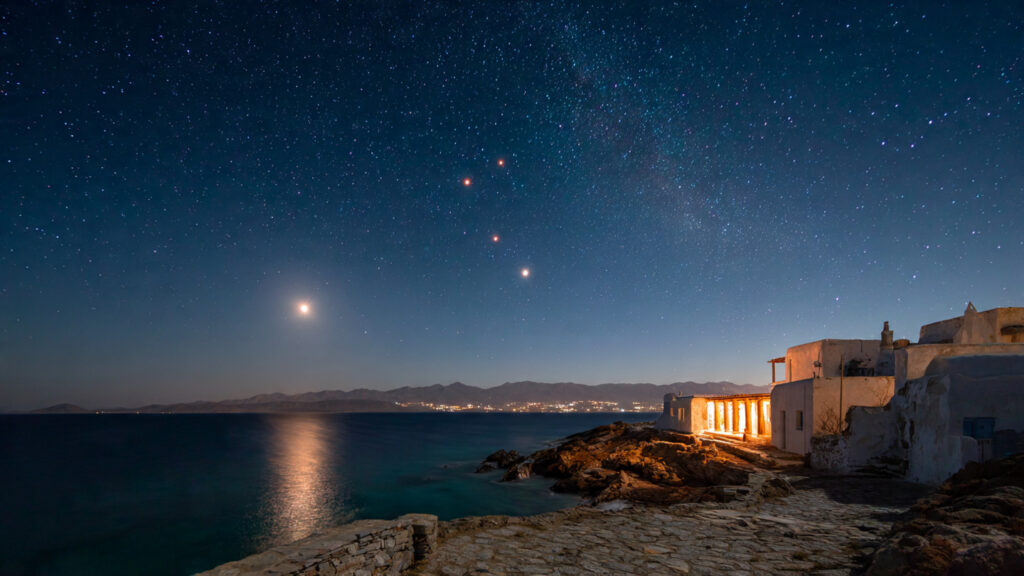
The slower-moving planets, Phainon and Phaethon, were read across longer cycles. Their positions within the band of constellations that the Greeks called the Zodiac, the path along which all the planets move, provided markers for the agricultural year and for the longer cycles of human and civic life. A farmer in the Thessalian plains or a shepherd in the uplands of Arcadia who tracked the position of Phaethon against the background stars knew, within a margin of a few days, the time of year without any instrument more sophisticated than memory and continued observation.
The Setting Planet and the Sea
One observation deserves to be offered here as interpretation rather than as a documented ancient myth, because that distinction matters. The ancient sources are clear and specific about the names of the five wandering stars and the qualities of light each displayed. What they do not preserve, at least not in any text that has survived to us under a fixed and named tradition, is a single formal myth describing the planets diving nightly into the sea.
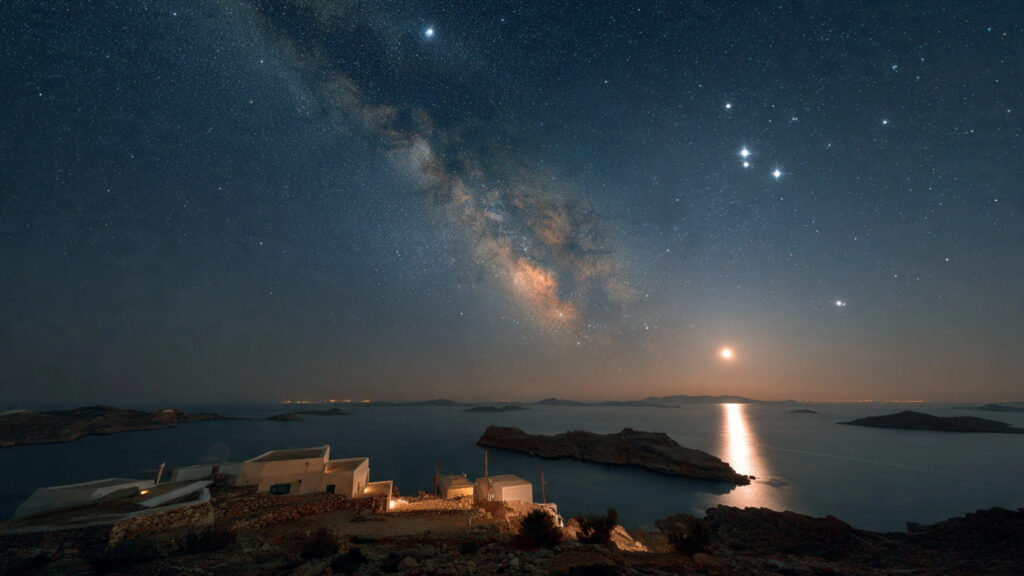
What can be said with confidence is this: the Greeks understood the sea as the domain of Poseidon, the element associated with the deepest and most fundamental processes of transformation, and they understood descent and immersion, in myth after myth, as a necessary passage rather than a defeat. Odysseus must descend to the realm of the dead before he can complete his return to Ithaca. Persephone must pass through the underworld before spring can return to the earth. Against this consistent pattern, and against the plain visual fact that a planet near the western horizon does appear, from a clifftop on Kythira or the eastern coast of Crete, to sink directly into the sea in a single unbroken arc, it is not difficult to see why an observer steeped in this mythological grammar would have read the setting of Phosphoros or Hesperos in exactly these terms. Whether any specific ancient author wrote this connection down as a named myth, or whether it lived only as an unspoken way of seeing shared among sailors and shepherds who never needed to write it down at all, is something the surviving evidence cannot fully settle. The image remains true to the way the Greeks thought, even where it cannot be pinned to a single attested source.
What Ancient Eyes Saw, Still Visible Tonight
Across Greece, from the clifftop sanctuaries of the Cyclades to the open plains of Thessaly where the horizon in every direction is unobstructed, the Astra Planeta continue their movements through the sky with the same regularity that the ancient world observed and named. The cycles have not changed. Phosphoros still rises before the sun and sets after it according to the same geometry that guided the sailors of the Bronze Age Aegean. Pyroeis still burns with its distinctive red-orange light. Phainon still moves with the slow, steady patience that the ancient world associated with the deepest cycles of time.

What has changed is the quality of attention that most people bring to these movements, and the degree to which the sky is understood as a living part of the environment rather than a backdrop to activities that take place on the ground. In the clear, cold air of early spring, when the Aegean atmosphere has not yet taken on the haze of summer, the five wandering stars are visible in their full distinctiveness to the naked eye. The ancient names for their qualities, the Shining One, the Blazing One, the Fiery One, the Twinkling One, the Light-Bringer, are not poetic exaggerations. They are precise observational descriptions that any careful watcher of the pre-dawn or post-sunset sky can verify directly, exactly as the sailors and shepherds who named them first did, looking up at the same five lights that still move across the same sky tonight.
At Olympus Estate, Sacred Geography explores the places across Greece where landscape and myth read as a single text. The Astra Planeta, Phainon, Phaethon, Pyroeis, Stilbon, and Phosphoros, were the five wandering stars the ancient Greeks tracked against the fixed constellations, each named for the precise quality of light it showed to the naked eye. Greek sanctuaries from Delphi to Sounion to Delos were oriented with genuine attention to these celestial movements. The same five lights are still visible above the Aegean tonight, carrying the names the ancient world gave them.