






There is no symbol more instantly recognizable across the sun-drenched landscape of Greece than the humble blue eye. It is omnipresent. You will find it hanging securely from car mirrors, carefully stitched into friendship bracelets, boldly painted onto fishing boats, and even discretely etched into the walls of traditional tavernas and contemporary cafés. This ubiquitous emblem, known locally as the mati or the evil eye, serves as a silent, powerful guardian against unseen forces.
What many visitors fail to grasp, however, is that this simple charm is far more than a modern superstition or a recent cultural fad. The mati represents one of the oldest living rituals in the entire Mediterranean basin. Its roots stretch back through millennia, embedded deeply within the fabric of ancient Greek religion, immortalized in classical literature, and traceable to the earliest known forms of apotropaic magic.
The moment one truly comprehends the profound antiquity of its origins, the entire Greek landscape transforms. The whitewashed, labyrinthine alleys of the Cycladic islands and the sturdy, stone-built mountain villages of Epirus cease to be merely picturesque backdrops; they become a palpable, living museum of ancient belief. This is the compelling, unbroken story of why the eye of protection has persevered across thousands of years of shifting empires and ideologies, and why the people of Greece still implicitly trust its guarding power today.
A Ritual Older Than Myth Itself
The belief system supporting the mati long predates the rise of Christianity, the flourishing of philosophical thought, and even the establishment of the great city-states like Athens and Sparta. The very earliest Greek cultures were unified by an intrinsic conviction in the immense, potentially harmful power of the human gaze.
An overly heavy or focused stare, particularly one charged with powerful negative emotion, such as envy or malice, was believed to possess the capacity to physically harm, weaken, or drain the vitality of another person, animal, or object. This pervasive belief is not relegated to fringe texts; it appears throughout the foundational works of the classical world. It is documented in the challenging philosophical works of Hesiod, referenced implicitly in the vast sweep of the Homeric epics, discussed in the early medical writings of Hippocrates, and subjected to later detailed sociological analyses by thinkers like Plutarch.
To the early Greeks, the world was a vibrant tapestry teeming with invisible, influencing forces. They understood that potent human emotions had tangible, physical consequences in the world. Anything considered exceptional—whether due to excess wealth, outstanding success, or singular beauty—was considered to be in immediate need of protection. Infants, children, and valuable livestock were regarded as especially vulnerable to this malign influence.
It was out of this deep-seated necessity that the counter-ritual was born: an eye to serve as a perpetual guard against the malevolent eye.
Why the Eye? The Symbolism Behind the Amulet
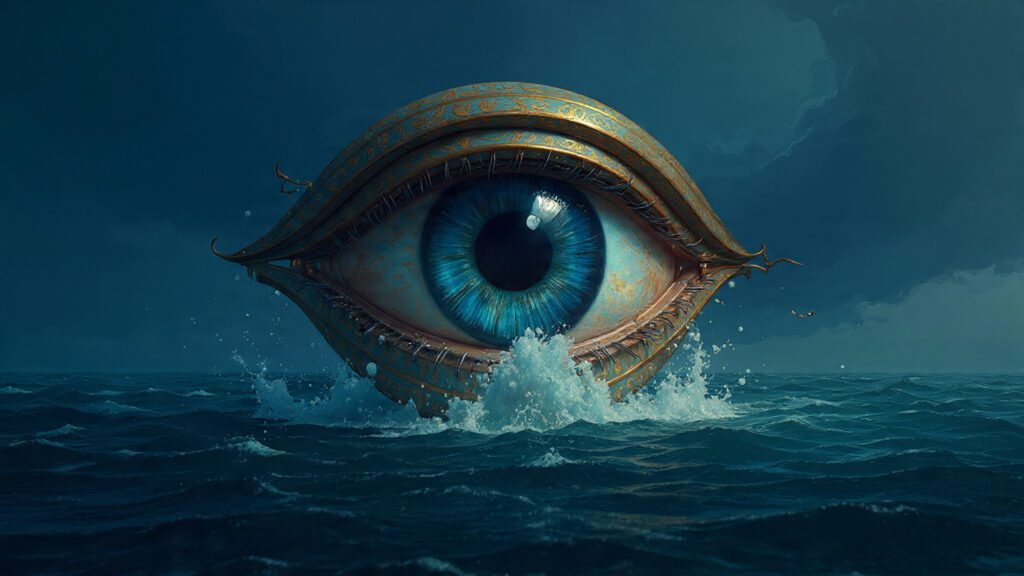
To fully grasp the mechanism of the protective eye, one must first explore the foundational ancient Greek concept of phthonos. This was not merely simple resentment, but a destructive, divine envy that sought to restore cosmic balance by punishing excess or overweening pride (hubris). Even the immortal gods themselves were often shown to be susceptible to its power in mythology. Figures such as Hera, Artemis, and Nemesis were frequently depicted as deities who meted out harsh punishments for arrogance or the flaunting of exceptional beauty.


The creation of the protective amulet serves a multifaceted purpose within this complex framework. The protective eye acts simultaneously as:
A Shield Against Destructive Jealousy
The charm is the first line of defense, a visual obstacle intercepting the direct path of the jealous gaze before it can inflict damage.
A Mirror Reflecting Bad Intentions Backward
The amulet possesses a reflective quality, conceptually seizing the malicious energy and sending the source of the envy back to the sender.
A Watchful Guardian That Never Blinks
Unlike humans, the mati remains perpetually vigilant. It provides ceaseless, passive defense, ensuring the vulnerable entity is never exposed to the unseen forces.
In the context of Greek philosophical thought, the eye itself possessed a potent duality. It was simultaneously the most vulnerable part of the body—the gateway through which harm could enter—and yet, through ritualistic design, it became the most potent tool for protection. This inherent contrast is precisely why the symbol evolved into one of the most effective and enduring defensive images across the entire ancient world.
The Ritual That Survived Empires
The most extraordinary feature of the mati is its astonishing historical continuity. Unlike monumental temples that crumbled into ruin or great statues that were deliberately toppled, the ritual surrounding the protective eye was never truly abandoned. It merely adapted and transitioned through every major historical period.

Classical Greece
During the Hellenic age, apotropaic eye amulets were an indispensable part of daily life. They appear consistently on domestic pottery, crafted into fine jewelry, affixed to the surface of soldiers’ armor shields, and placed within domestic shrines. Sailors and merchants famously painted large, watchful eyes (oculi) on the bows of their ships, not only to guide them but to protect against sudden storms and the ill-will of hostile sea spirits.
Hellenistic Greece
As the culture spread following Alexander the Great’s conquests, the belief in the evil eye spread across the entire Eastern Mediterranean. The wealthy commissioned luxurious, finely crafted glass eyes for personal use, often importing superior craftsmanship from established centers like Egypt and Phoenicia.
Byzantine Greece
Crucially, the ascendance of Christianity did not eradicate the ritual; rather, it absorbed and transformed it. The Orthodox Church strategically adopted specific prayers and blessings directed against the evil eye, known formally as vaskania. This integrated ancient pagan practices and their powerful language of spiritual defense directly into the Christian ritual lexicon, ensuring the belief’s survival.
Modern Greece
Today, this unbroken lineage is maintained across the archipelago and mainland. The ritual of xematiasma—the ritual “unbinding” or “undoing” of the evil eye—is still widely practiced. It is most often performed by a family elder, typically a grandmother, who whispers a secret, inherited prayer or incantation. This astonishing continuity makes the tradition of the mati one of the most remarkable examples of living myth found anywhere on the globe.
The Blue Color: Meaning, Myth, and Mystery
The question of why blue is central to the mystery of the protective eye.
In the lexicon of ancient Greek symbolism, blue was highly significant. It was the color most associated with purity, divine clarity, and protection. Sailors believed that the colour held the innate power to calm agitated seas and repel bad fortune during voyages. Due to its associations with the celestial and oceanic realms, it was linked to the supreme deities: the colour of the distant sky (the realm of Zeus) and the boundless sea (the domain of Poseidon).
Furthermore, there is a socio-historical dimension. In the Mediterranean, blue eyes were—and remain—a relative rarity. Invaders or outsiders (such as Northern tribes or occasional raiders) often possessed lighter eyes, and their gaze was frequently believed to be particularly potent and even more capable of inflicting the evil eye. By wearing the colour blue, the Greeks were essentially creating an immediate counter-spell. The colour blue thus became the perfect defensive weapon—a serene, watchful hue that conceptually soothed, protected, and mirrored harm away from the wearer.
The Evil Eye in Modern Greek Life

It is genuinely impossible to understand the nuances of modern Greek culture without first grasping the pervasive presence and function of the mati. It is integrated into almost every layer of daily existence, bridging the gap between sacred tradition and secular life.
Household Protection
A blue-eye charm is a standard, expected gift presented when a family moves into a new home. This simple object is intended to guard the threshold and the inhabitants within, acting as a modern echo of the ancient doorway rituals once dedicated to household guardian gods.
Children and Newborns
Babies and young children almost universally wear tiny blue beads or lightweight amulets. The ancient logic—that the most beautiful and vulnerable beings are the most susceptible to envy—is followed today with loving, practical adherence.
Fashion and Jewelry
From high-end, luxury designers in Athens’ upscale Kolonaki district to simple, handmade pieces found in remote village markets, the mati remains the most iconic and recognisable Greek motif in fashion.
On Boats, Cars, and Shops
Following a tradition unchanged since the age of Odysseus’s triremes, modern fishing boats are routinely painted with protective eyes. Likewise, cars, buses, and storefronts frequently bear the charm to guard against accidents, bad business luck, or theft.
Xematiasma: The Last Greek Magic
If a person suffers from dizziness, an unexplained run of bad luck, or feels inexplicably drained of energy—symptoms traditionally associated with the evil eye—a family elder will often perform the xematiasma, or the ritual “untying.” This often involves a secretive whispered prayer while dropping a small quantity of olive oil into water to accurately diagnose and banish the presence of the malign influence. It remains one of the last widely practiced forms of folk magic in Europe—ancient, intimate, and intrinsically cultural.
Where Travelers Can See the Ritual Come Alive

The mati is a geographic marker of cultural resilience, appearing in different forms depending on the region and the context:
Mykonos & Santorini – The Boutique Evolution
In the Cycladic hubs, modern Greek designers have taken the mati and elevated it into high fashion, blending ancient symbolism with sophisticated, contemporary jewelry and home décor pieces.
Epirus & Thessaly – Home of Xematiasma
The mountain villages of the mainland preserve the purest forms of the folk tradition. Here, you will find the whispered prayers and deep-rooted folk rituals that are direct, unbroken descendants of antiquity.
Hydra & Symi – The Maritime Tradition
On these beautiful maritime islands, fishing boats, yachts, and harbour storefronts are frequently decorated with eyes, reflecting traditions of naval protection unchanged since the age of the trireme.
Athens – The Old and the New
From the workshops of artisans in the ancient Plaka district to the chic boutiques of Kolonaki, the Greek capital showcases the seamless transition of this protective symbolism from the ancient past to the bustling present.
Wherever you travel in Greece, the eye is waiting—on walls, on water, on wrists, in stories whispered from grandmother to grandchild.
A Ritual that Defines Greece
The evil eye is far more than a simple blue charm; it is a profound cultural memory, a myth that steadfastly refused to die, and a protective gesture that has been consciously passed down through thousands of hands across the centuries.
It simultaneously represents ancient spirituality, cultural resilience, and a defining collective identity. To understand the mati is, ultimately, to understand the very soul of Greece—a culture that never ceases to weave the profound beauty and wisdom of its ancient world into the vibrant reality of the modern one.