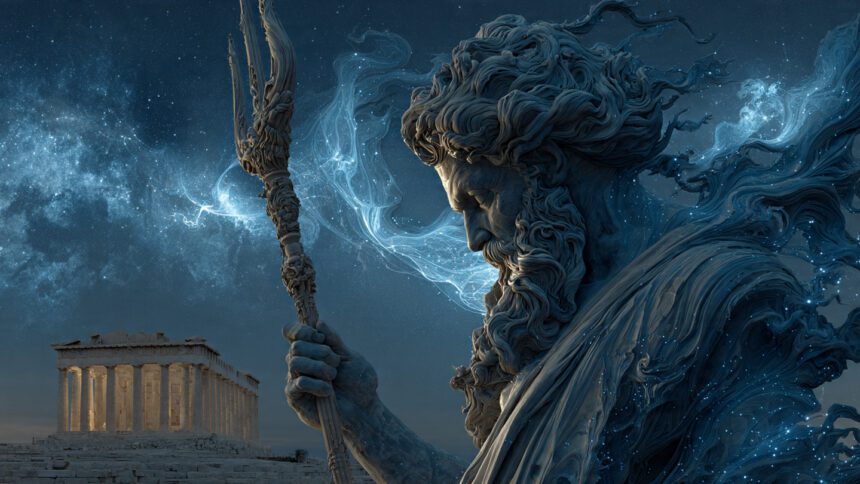






“The only true wisdom is in knowing you know nothing.” — Socrates
A colossal, eternal sky pressed down upon his shoulders. The unimaginable, crushing weight of the firmament bent him towards the ground every single moment, yet Atlas remained straight and resolute as a rock. He would not bend under the tremendous pressure, nor would he allow himself to tremble or weaken his mighty arms for even an instant. How deeply he must have longed to simply abandon his burden, straighten his shoulders, and look up at the clouds! And yet, he stood firm, believing that a moment of relief would surely come.
The legend of Atlas holding the sky in his mighty hands first appeared in Ancient Greece, and later, this powerful image became one of the most resonant and popular archetypes in global culture. Painters, poets, sculptors, and writers have all sought to reproduce their unique vision of the colossal Titan. But what is the profound underlying meaning of the legend? How did Atlas manage to temporarily relinquish his burden? And why are not only historians and classicists, but also modern psychologists, still actively talking about this eternally suffering figure?
The Resistant Titan: Etymology and Fortitude
First, let’s meet the formidable figure of Atlas (or Atlantean). Starting with his name reveals immediate clues to his nature. Interestingly, researchers have found it challenging to agree on the definitive origin of the word. Some scholars theorize that it originated from a dialect spoken by a civilization that preceded the Mycenaean era, suggesting that the legends about Atlas appeared a very, very long time ago, placing them among the most ancient myths of the Hellenes.
However, a more compelling and pertinent assumption for modern interpretation is that the name Atlas comes from the Ancient Greek word atlaō (ἄτλαω), which translates as “to endure” or “to sustain.” This interpretation is strongly supported by historical epithets. The Roman poet Virgil, for instance, invariably used the Latin word durus alongside Atlas’s name, a term meaning “hard,” “steadfast,” or “unyielding.” Both definitions—”to endure” and “steadfast”—are profoundly accurate for the character. He certainly did not lack patience, and he definitively showed his unwavering fortitude for many centuries as he held the immense sky. But why was this colossal burden placed on the Titan’s shoulders at all?
The Price of Defiance: Atlas’s Lost Battle

As detailed in the ancient retellings of the myth, Atlas was a first-generation Titan, the son of the powerful Titan Iapetus and the Oceanid Asia. Though other versions exist—Hyginus, for example, called him the son of the earth goddess Gaia and Aether—the crucial fact remains that Atlas belonged to the generation of Titans who were largely considered to be the formidable offspring of Gaia.
A terrible ten-year war, the Titanomachy, broke out between the old order of the Titans and the new Olympian gods led by Zeus. This conflict arose after the young Zeus freed his siblings from the womb of his father, the Titan Kronos. Naturally, Atlas fought fiercely on the side of his own tribesmen. However, in this cataclysmic battle, the younger Olympian gods were victorious, and the defeated Titans were decisively thrown into the dark abyss of Tartarus. The only one whom Zeus consciously left on Earth was Atlas.
The supreme god planned a painful, unending punishment for the Titan: he placed the entire firmament—the celestial sphere, or the sky—upon Atlas’s shoulders and head. He was condemned to hold this weight day and night, forbidden from resting and having no one to replace him even for a single minute. It was a sentence of eternal, unceasing effort. Yet, surprisingly, one day, the myth tells us, there was indeed someone who was able to briefly take the place of the suffering Titan.
The Man Who Replaced Atlas: A Moment of Clever Relief

One of the most famous legends about Atlas connects him directly with the hero Hercules (Heracles). During his eleventh grueling labor, Hercules was commanded to fetch the wonderful golden apples from the sacred Garden of the Hesperides. This magical, forbidden place was located not far from the mountain where Atlas stood frozen under his immense burden.



Because the garden was notoriously difficult to enter, Hercules saw an opportunity. He asked Atlas himself to go into the garden and retrieve the apples, promising that during the Titan’s absence, he would hold the vast, heavy sky on his own shoulders. Atlas readily agreed.
The Titan did pick the apples, but upon his return, he had no intention of taking the firmament back. He immediately announced to Hercules that he would happily deliver the apples to Zeus himself. Realizing he was about to be tricked into an eternal, inescapable punishment, the hero resorted to a clever ruse. Hercules asked Atlas to take the sky back for just a moment, explaining that he needed to fold his cloak into a cushion to protect his shoulders from the crushing weight. Not anticipating the trick, Atlas foolishly erected the firmament back onto his own shoulders. At that very instant, Hercules snatched the golden apples and fled, leaving the resigned Titan once more alone with his eternal burden.
The Evergreen Meaning: From Earth’s Axis to the Atlas Complex

There are many insightful interpretations of the powerful myth of Atlas holding the sky. Some classical scholars believe the story is an allegorical reference to the Earth’s axis, thanks to which there is a verified cycle of seasons and a predictable calendar period. Others suggest that the legend speaks of immense knowledge or wisdom that lay like a heavy burden on the shoulders of the Titan. By briefly handing over the firmament to Hercules, he symbolically shared his wisdom with humanity.
However, the most immediately relevant version of Atlas is offered by modern psychologists. They have even formalized a clinical concept known as the “Atlas complex.” This term describes a person who, often since childhood, has developed an ingrained, unhealthy compulsion to assume responsibility for everything that happens—even for matters that are entirely outside of their personal control. Then, already in adulthood, this relentless self-imposed burden can cause serious psychological problems (such as burnout, chronic stress, and anxiety), as the individual is not truly able to bear the gargantuan emotional and practical weight they have taken upon themselves.
As these interpretations show, the name and image of Atlas remain profoundly relevant in science and philosophy today. Beyond this, we are reminded of the mysterious Atlantis, which, according to some myths, was once inhabited by a powerful Atlantean people, another historical layer to the Titan’s name. Ultimately, the profound victory of Atlas lies not in the fact that he holds the sky, but in the unwavering fact that he continues to stand. Do you, the reader, ever feel the weight of Atlas in yourself—the one who holds up someone else’s sky?