

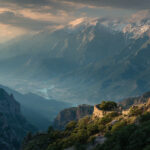


The wind in the White Mountains carries a specific sharpness that smells of sun-baked limestone and crushed mountain tea. It is a vertical world where the earth seems to have been pushed upward by a restless god. Within these jagged folds of stone, a shadow moves with a grace that defies the pull of the planet. This is the agrimi, the wild one, known to the world as the Kri-Kri goat. To watch this creature navigate a cliff face is to witness a living piece of Minoan history. The Kri-Kri is the breathing pulse of the Cretan wilderness, a silent witness to the rise and fall of civilizations that have tried, and failed, to tame these peaks.
Modernity has a way of flattening the world, yet the Kri-Kri goat remains stubbornly three-dimensional. It occupies the spaces where human footprints fade into the scree. This animal is more than a biological curiosity. It is a symbol of an older Greece, a place where the boundary between the human and the wild was porous and sacred. The goat represents a survival that is both physical and spiritual. It has endured through the bronze age, the Venetian occupations, and the brutal winters of the high mountains. Its presence in the Samaria Gorge is a reminder that some things are meant to remain unreachable.
The Ancestral Hoofbeats of the Aegean
The origins of the Capra aegagrus cretica are found in the deep migrations of the Neolithic era. Around eight thousand years ago, the first seafaring farmers brought these animals to the island. They were not the weary, heavy-set livestock we see in modern pens. These were lean, intelligent creatures that carried the DNA of the Middle Eastern wild goat. Once they reached the shores of Crete, they did something remarkable. They returned to the wild. They climbed into the Lefka Ori and chose the wind over the shepherd’s crook.
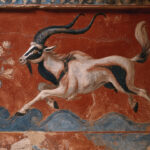
In the palaces of Knossos and Phaistos, the Minoan artists saw the Kri-Kri goat as an emblem of vitality. You see them still on ancient seals and pottery, their horns swept back like the sails of a ship, their bodies caught in mid-leap. For the Minoans, the goat was not merely meat. It was an inhabitant of the sacred heights. It belonged to the goddess of the mountains. This animal was the bridge between the cultivated valley and the divine peak. The ancient Greek lifestyle was one of balance, and the goat represented the untamable side of that equilibrium.

Archaeological finds suggest that the agrimi was a centerpiece of ritual life. The horns were often used in religious ceremonies, or perhaps as composite bows for hunters who respected the speed of their prey. There is an unspoken continuity here. The same goat that stared down at a Minoan hunter now stares down at a hiker in the Samaria Gorge. The animal has not changed its habits. It still seeks the highest ledge at midday. It still moves with the silence of a cloud. It is a rare example of a living antiquity that refuses to be placed behind glass.
The Vertical Architecture of Survival

To understand the Kri-Kri goat is to understand the physics of the cliff. These animals possess a skeletal structure that is a masterpiece of evolution. Their hooves are split and padded with a leathery texture that grips the smoothest limestone like a suction cup. They do not fear the void. A Kri-Kri can stand on a ledge no wider than a human palm and look down a thousand meters without a tremor. This surefootedness is their primary defense. When a predator or a hunter approaches, the goat does not run away. It runs up.
The coat of the Cretan wild goat is a study in camouflage. It is the color of dry earth and sun-bleached brush. During the summer, the males develop a dark stripe across their shoulders and a beard that gives them an air of ancient authority. Their horns are their most striking feature, growing in great scimitar curves that can reach nearly a meter in length. These are are tools for hierarchy and defense, instruments of a social order that is as rigid as the rock itself.

In the high summer, the goats retreat to the summits where the air is thin and cool. They survive on a diet of mountain herbs that would be toxic to lesser creatures. They eat the prickly shrubs and the aromatic greens that define the Cretan wildlife profile. This diet gives their presence a sensory connection to the land. If you are lucky enough to find a place where they have bedded down, the air smells of musk and wild oregano. They are the land turned into flesh and bone.


The Sanctuary of the Iron Gates
The twentieth century was a period of darkness for the agrimi. During the years of the Second World War, the mountains became a refuge for resistance fighters. Hunger was a constant companion. The goats were hunted for survival, and their numbers plummeted until they were nearly a memory. By the early 1960s, it was estimated that fewer than two hundred remained. The extinction of the Kri-Kri seemed inevitable, a final casualty of a world that had forgotten how to share space with the wild.
The establishment of the Samaria National Park in 1962 was a turning point. It was an act of cultural reclamation as much as ecological conservation. The Greeks decided that an island without the agrimi was an island that had lost its soul. The gorge became a sanctuary. This sixteen-kilometer gash in the earth, with its towering walls known as the Iron Gates, became the fortress where the goat would make its final stand. It worked. The population began to recover, finding safety in the absolute verticality of the canyon walls.

Today, the gorge is a UNESCO Biosphere Reserve. It is a place where the heritage and continuity of the Greek landscape is protected by law. However, the protection is fragile. The greatest threat now is not the hunter’s rifle but the domestic goat. Hybridization threatens to dilute the pure genetic line of the Kri-Kri. If they interbreed with the common farm goats that wander the foothills, the unique characteristics of the agrimi—their size, their speed, their instinct for the high cliffs—could vanish forever. Conservationists work tirelessly to keep the wild blood pure, ensuring that the goat remains a distinct inhabitant of the heights.
Living Rhythms of the Samaria Gorge
For the traveler, the encounter with a Kri-Kri goat is never guaranteed. It is a reward for those who know how to be still. Most visitors march through the gorge with their eyes on their boots, missing the movement in the shadows above. The goats are masters of invisibility. They will stand perfectly still against a rock face, watching the human parade with a cool, detached intelligence. They do not beg for food. They do not seek attention. They simply exist in a parallel world of stone and sky.
In the abandoned village of Samaria, halfway through the trek, you might find a few goats that have become accustomed to the presence of people. They linger near the old stone houses, their hooves clicking on the ancient threshing floors. Here, you can see the intelligence in their amber eyes. There is a prehistoric depth to their gaze. They look at you not as a tourist, but as a transient visitor in a kingdom that has belonged to them for eight millennia. This is the essence of Crete travel—the sudden realization that you are the newcomer.

The village itself is a ghost of a different era, but for the agrimi, it is just another part of the terrain. They climb the crumbling walls and sleep in the doorways where families once lived. The transition from human habitation back to wild territory is complete. The goats have reclaimed the village, turning the ruins into a high-altitude playground. It is a vivid illustration of how the Greek landscape absorbs the works of man and returns them to the earth.
The Spirit of the Fouriariko
In the local dialect, the people of the mountains use the word fouriariko to describe the Kri-Kri. It is a word that is difficult to translate. It implies something that is swift, something that belongs to the open air, something that cannot be caught. It is a term of respect. The Cretans see themselves in the goat. Both have a history of fierce independence. Both have survived by retreating into the mountains when the world below became too dangerous. The goat is a mirror of the Cretan spirit.
This connection is evident in the music and poetry of the island. In the mantinades, the rhyming couplets of Crete, the agrimi is a frequent metaphor for a lover who is hard to reach or a soul that refuses to be broken. The goat is the personification of Greek wellness in its most primal form—raw, energetic, and perfectly attuned to its environment. To lose the goat would be to lose a piece of the Cretan language itself. It is a living vocabulary of freedom.

The preservation of the Kri-Kri is therefore a cultural mandate. It is not just about biodiversity. It is about maintaining the integrity of the Greek imagination. As long as the agrimi leaps across the gorge, the stories of the Minoans remain true. The myths of Pan and the mountain goddesses remain anchored in reality. The goat is the tether that keeps the modern world connected to the deep time of the Aegean.
Islets of the Silent Sentinels
While the Samaria Gorge is the most famous habitat, the Kri-Kri goat also survives on a few uninhabited islets off the coast, such as Dia and Thodorou. These islands act as genetic lifeboats. Here, away from the domestic herds of the mainland, the goats live in a state of absolute isolation. They roam the salt-sprayed cliffs, drinking from hidden springs and eating the hardy scrub that survives in the maritime air. These populations are a safeguard against catastrophe on the main island.

Visiting these islets is a different experience altogether. There are no hiking trails, no crowds. There is only the sound of the sea and the occasional rattle of stones as a goat moves across a ridge. On Thodorou, the goats share the land with ancient ruins and rare birds. It is a microcosm of the Mediterranean winter diet and lifestyle, where every creature must be hardy to survive the exposed conditions. The goats here are even more wary of humans, their instincts sharpened by the solitude.
These islands represent the final frontier of Cretan wildlife. They are places where the human presence is a rarity, and the agrimi is the undisputed master of the terrain. The sight of a male Kri-Kri silhouetted against the blue of the Aegean is one of the most powerful images in Greece. It is a vision of an ancient world that persists in spite of everything. It is a reminder that there are still places where the wild heart beats without interference.
Continuity in the High Peaks
The story of the Kri-Kri goat is a story of resilience. It is a narrative that moves from the holds of Neolithic ships to the frescoes of bronze age palaces, through the fires of war, and into the modern era of conservation. It is a cycle of return and renewal. The goat has become a permanent part of the Cultural Chronicles of Greece, a creature that embodies the rugged beauty of the land.
As we look toward the future, the fate of the agrimi remains tied to our own. Their survival depends on our willingness to leave the high places alone. It depends on our respect for the vertical world. The Kri-Kri does not ask for much. It only requires the silence of the cliffs and the integrity of the mountain air. In return, it offers us a glimpse of the eternal. It provides a sense of continuity that is rare in our fractured age.
The next time you find yourself on a trail in Crete, stop for a moment. Look up toward the ridges where the limestone meets the sky. You may see nothing but stone and heat. But if you wait, and if you are quiet enough, you might see a shadow move. You might hear the faint clatter of a pebble falling into the depths. In that moment, you will know that the wild spirit of Greece is still there, watching, waiting, and leaping into the future with a surefootedness that we can only hope to emulate.

The mountain belongs to the ones who can climb it without a path. The agrimi is the true owner of the heights, a ghost in the limestone that reminds us that the world is still full of mystery. As long as the White Mountains stand, the wild goat will remain, a living bridge between the ancient soul of Greece and the world that is yet to come.


