




“Let food be thy medicine and medicine be thy food.” — Hippocrates
In the early weeks of spring, the islands of the Aegean begin to reflect a different quality of light. The sharpness of winter softens, and a warmer tone settles across stone, water, and the low cultivated terraces where citrus trees have spent the cold months quietly completing their fruit. On Delos, the small uninhabited island at the geographic center of the Cyclades and long regarded in the ancient world as the birthplace of Apollo, this change in light is especially visible. There is little shade on Delos. The open ground, the pale ruins of the sanctuary, and the shallow vegetation of the hillside hold the returning sun without diffusing it, and the quality of illumination in these early spring weeks has a directness and clarity that later in the year, when the heat has thickened the atmosphere, it will not recover.
The association of Delos with Apollo was not incidental to the island’s physical character. The god of light, of order, and of the clarity that makes both art and knowledge possible, was understood by the ancient Greeks to be present in the quality of the light itself, in its precision, its capacity to reveal form without distortion, and its seasonal rhythm of departure and return. The spring arrival of strong light across the Aegean was an event with religious significance as well as agricultural consequence, and the foods of the season were understood within this larger framework: as preparations that aligned the body with the returning energy of the landscape.
The lemon arrived in the Mediterranean world later than the olive, the fig, and the vine, carried westward through Persia and the Near East into Greece during the Hellenistic period and becoming fully integrated into the food culture of the Aegean islands over the centuries that followed. By the time the citrus groves of Naxos, Crete, and the coastal Peloponnese had established themselves as part of the cultivated landscape, the lemon had taken on the cultural associations that the climate and the light of the region naturally invited: brightness, acidity, the capacity to clarify and sharpen whatever it touched. In the seasonal kitchen of the Aegean, it became the primary medium through which the quality of spring light was translated into food.
The Ingredients and Their Origins
A spring lemon cake prepared in the tradition of the Aegean islands is not a dessert of abundance. It is a preparation shaped by the same values of restraint, proportion, and attention to primary ingredients that characterize the best of Greek cooking across all its regional expressions. Each element carries its own origin and its own significance, and the quality of the result depends on the quality of what goes into it at least as much as on the skill of the preparation.
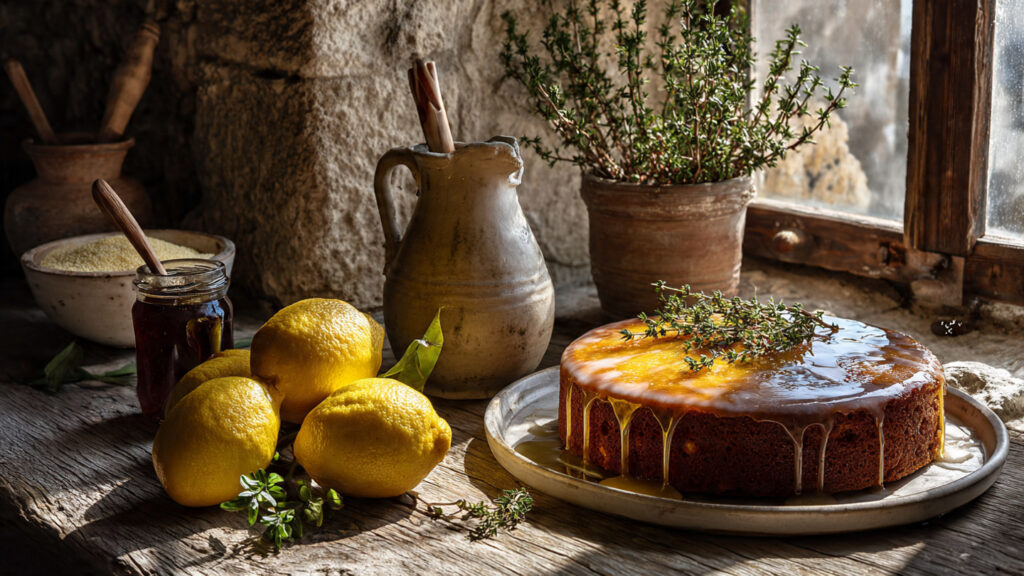
The lemons of the Cyclades, grown in mineral-rich volcanic and limestone soils and ripened slowly through the long months of winter, carry essential oils in their skin that are more concentrated than those of fruit grown in richer, more irrigated conditions. The zest of a Naxos or Crete lemon, rubbed between the fingers, releases a scent of extraordinary sharpness and depth, carrying the character of the soil and the particular quality of Aegean light that shaped the fruit across its months of development. This is the ingredient that gives the cake its identity, and it cannot be substituted without changing the essential nature of the preparation.
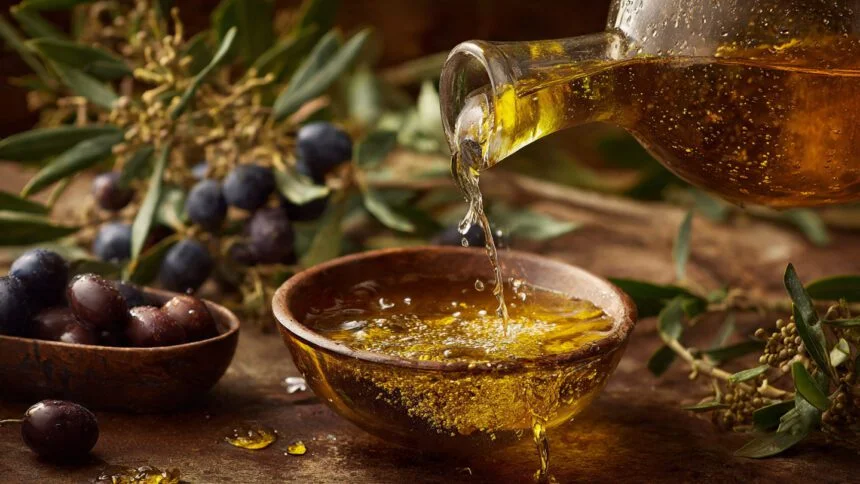
The oil that forms the structural base of the cake comes from the Peloponnese, where olive cultivation has been continuous since the Bronze Age and where the traditions of cold pressing have been refined across generations of practice. Extra virgin olive oil from this region has a quality of flavor, simultaneously fruity, herbaceous, and faintly peppery, that provides the fat content of the cake with character rather than merely with function. It produces a crumb that is moist without heaviness and that carries the faint presence of the grove through the sweetness of the other ingredients.
The sweetness comes from thyme honey, preferably from Mount Hymettus above Athens or from the apiaries of Kythira, where the spring flowering of wild thyme produces a honey of particular aromatic complexity. Hymettus honey has been celebrated since Classical Athens: Athenaeus described it as the finest honey in the world, and the beekeeping traditions of the mountain slopes above the city have been maintained with remarkable continuity across more than two thousand years. This honey carries the essential oils of wild thyme, the same herb that appears in the traditional medicine and ritual practice of Greece since the Bronze Age, and it introduces into the cake a floral, slightly resinous sweetness that refined sugar cannot replicate.
The grain comes from fine semolina, honoring the cereal traditions of the Aegean world that extend back through the Bronze Age settlements of the Cyclades and the palace economies of Mycenae and Minoan Crete, where grain storage and processing were central to the organization of the state. Semolina gives the cake a slightly open, grainy texture that absorbs the lemon glaze at the end of baking with a thoroughness that finer flours do not achieve, and it connects the preparation to a longer tradition of grain-based cooking in the island kitchens of the Aegean.


The Recipe
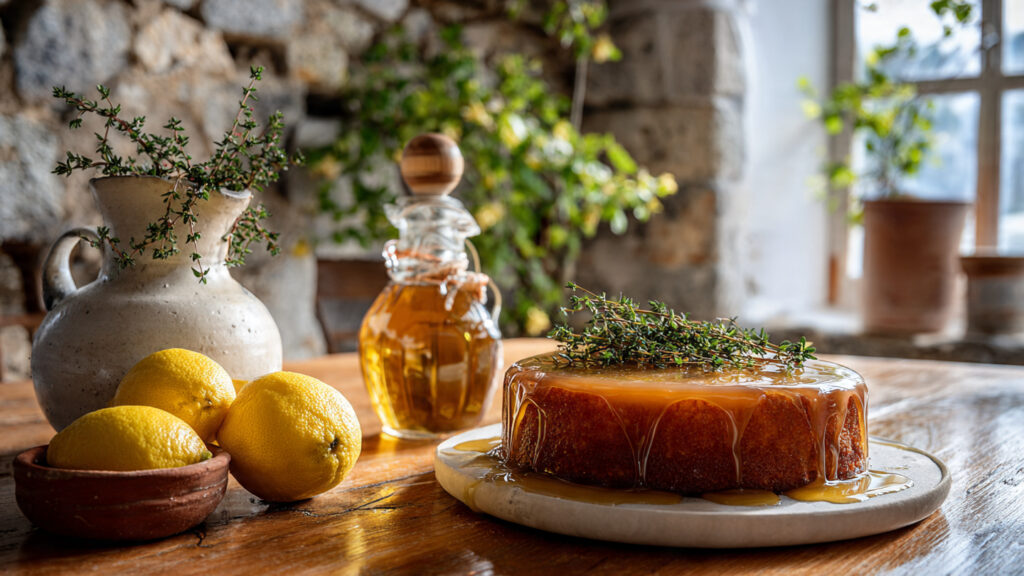
Serves 8. Preparation time 20 minutes. Baking time 40 to 45 minutes.
Ingredients
3 large organic lemons, zest and juice separated 200ml extra virgin olive oil from the Peloponnese 200g Greek thyme honey, preferably from Hymettus or Kythira 3 large eggs 250g fine semolina 1 tsp baking powder A pinch of sea salt Fresh sprigs of wild thyme for garnish
The Practice
Begin by preparing your ingredients with care. Zest all three lemons before juicing them, working the grater slowly to take only the outer yellow layer of the skin where the essential oils are concentrated, leaving the white pith untouched. Set half the juice aside for the glaze. Preheat the oven to 180°C and prepare a round cake tin, approximately 22 centimeters in diameter, with a light coating of olive oil.
In a large ceramic or earthenware bowl, whisk the eggs together with the honey until the mixture is pale, uniform, and slightly thickened. The honey should be fully incorporated rather than pooling at the base. Add the olive oil in a slow, steady stream while continuing to whisk, allowing the mixture to emulsify gradually into a smooth, pale liquid with the faint color of late afternoon light.
Fold in the lemon zest and half the juice, working with a broad spoon rather than a whisk at this stage to preserve the texture of the mixture. The scent that rises from the bowl at this moment, the combined fragrance of fresh citrus, aromatic honey, and grassy olive oil, is the concentrated smell of an Aegean spring, particular and unmistakable.
Sift the semolina, baking powder, and salt together and add them to the wet ingredients in two additions, folding rather than stirring to maintain the lightness of the batter. The mixture should be pourable but not thin, with a consistency that falls from the spoon in a slow, even ribbon.
Pour the batter into the prepared tin and place it in the center of the oven. Bake for 40 to 45 minutes, checking at 40 minutes by inserting a thin wooden skewer into the center. When it comes out clean, the cake is ready. The surface should be a deep golden color, approaching the tone of polished Pentelic marble in the late afternoon sun, and the kitchen should carry the warm scent of citrus and honey that has been developing throughout the baking.
Remove the cake from the oven and allow it to cool in the tin for ten minutes. While it is still warm, pierce the surface at regular intervals with the wooden skewer, working across the entire surface to create channels through which the glaze will travel into the interior. Warm the reserved lemon juice gently with one additional tablespoon of honey until the honey has dissolved completely, then pour this glaze slowly and evenly over the surface of the cake, allowing it to absorb gradually rather than collecting in pools.
Scatter fresh sprigs of wild thyme across the surface before serving. The herb connects the honey in the cake to its source and adds a visual restraint to the presentation that is in keeping with the spirit of the preparation.
Apollo, Light, and the Symbolism of the Circular Form
The circular form of the cake is not incidental. In the sacred geometry of the ancient Greek world, the circle was the form associated with completeness, with the path of the sun across the sky, and with the return of the seasonal cycle that Apollo embodied in his annual journey. The sanctuary at Delos was organized around the understanding that the island stood at the axis of the Aegean world, the point from which Apollo departed in winter and to which he returned in spring, bringing light, order, and the conditions for growth with him.
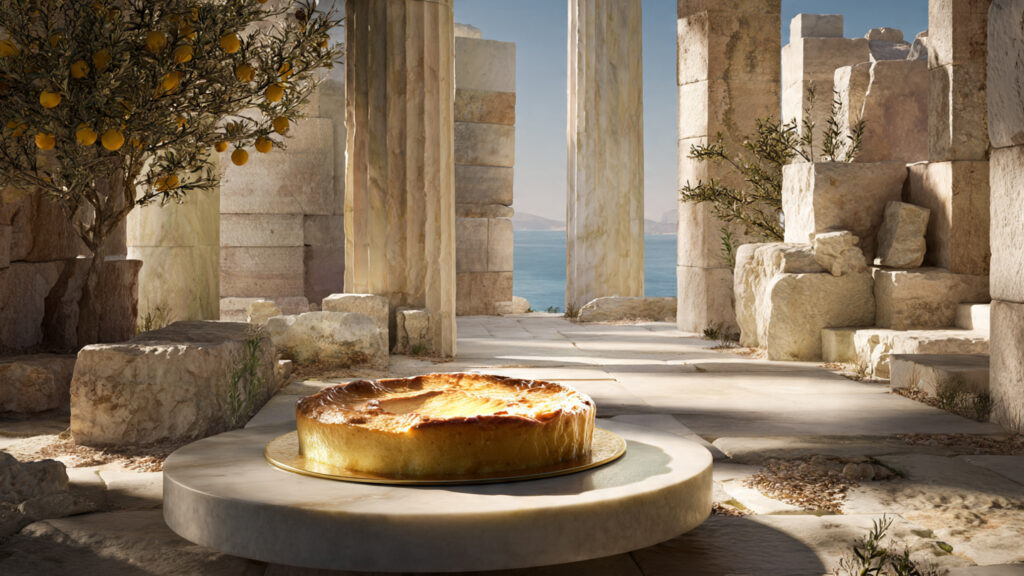
To prepare a circular cake in the early weeks of spring, in a kitchen warmed by the oven and scented with citrus and honey, is to participate in a domestic version of this seasonal acknowledgment. The ancient Greeks did not separate the domestic from the sacred as completely as later traditions have suggested. The hearth of the household was under the protection of Hestia, and the preparation of food was understood as an activity with both practical and ritual dimensions. The care brought to the quality of ingredients, the attention given to proportion and process, and the sharing of the result with family and guests: all of these were acts that honored the continuity of the household and its relationship to the larger world of seasons, gods, and landscape.
The lemon glaze that finishes the cake, poured over the warm surface and absorbed slowly into the semolina crumb, performs a function similar to the libations poured at ancient altars: it is the final act of the preparation, the moment at which the work of the kitchen meets the generosity of the landscape that provided its materials. The honey dissolves into the juice, the juice soaks into the grain, and the result is a cake that carries, in every element of its texture and flavor, the specific conditions of an Aegean spring.
The Citrus Harvest and the Seasonal Kitchen
Across the Cyclades, the Peloponnese, and the coastal regions of Crete, the late winter and early spring citrus harvest has long been integrated into the seasonal rhythm of the Greek kitchen. Lemons gathered at this time of year, after the long slow ripening of the winter months, are at their most aromatic and their most balanced in the relationship between acidity and essential oil content. The skin is firm and richly colored, the juice is full without excessive sharpness, and the zest releases its fragrance immediately and completely when it comes into contact with any form of heat.
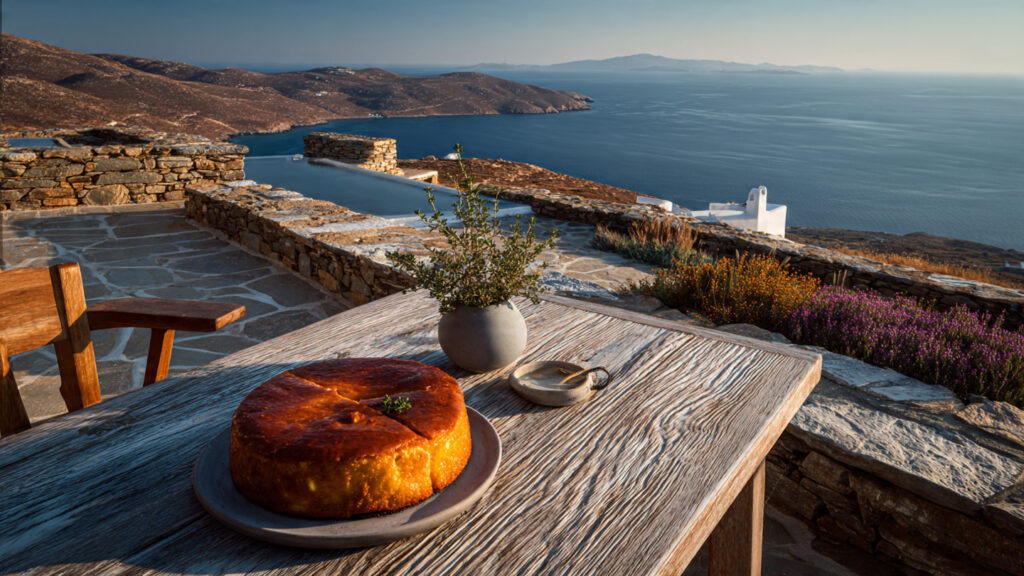
In the rural kitchens of the island communities, citrus has traditionally been used with the restraint that characterizes good Greek cooking at every level of the social scale. A lemon is not the dominant element of a dish; it is the clarifying one, the ingredient that brings the other flavors into focus and prevents them from settling into heaviness or monotony. This principle applies in the baked preparations of the spring kitchen as much as in the dressed salads and grilled fish of summer: the lemon is always present, always purposeful, and never excessive.
The tradition of the olive oil cake, into which this preparation fits, extends across the island and coastal communities of the Mediterranean in forms that vary by region but share the same underlying logic: that the fat of the olive, the sweetness of local honey or fruit, and the grains that have sustained the region since antiquity combine into preparations that are satisfying without being heavy, flavorful without being elaborate, and deeply connected to the specific character of the landscape that produced their ingredients.
A Spring Table in the Aegean
To prepare this cake and share it in the early weeks of spring is to participate in a seasonal rhythm that remains visible across Greece to anyone who pays attention to the calendar of the natural world rather than only to the calendar of the commercial one. The act requires no specialized equipment, no rare ingredients, and no technical skill beyond the patience to fold a batter gently and the attention to watch an oven with enough care to know when what is inside has reached the right moment of completion.
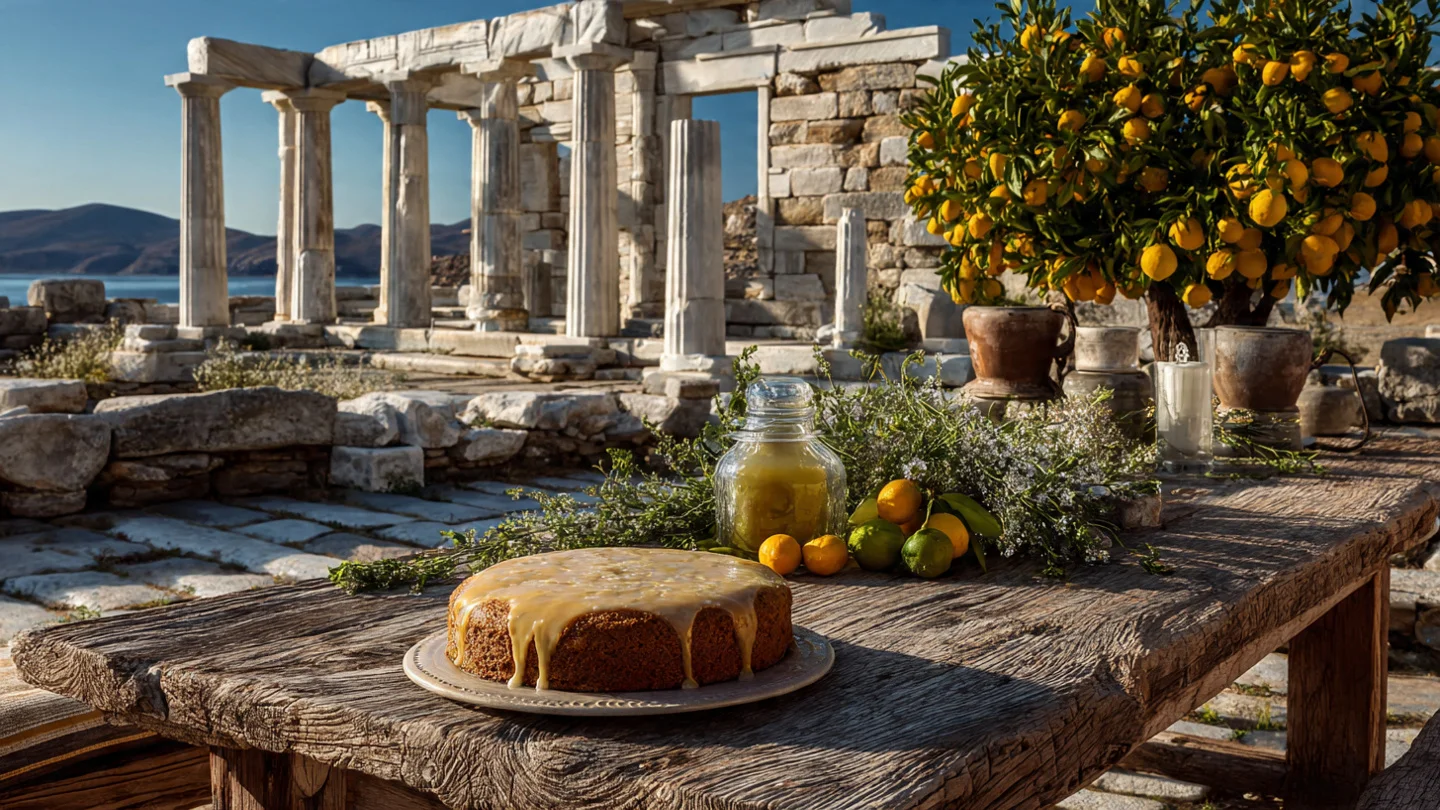
Set on a simple table, perhaps on a stone terrace catching the afternoon angle of the sun, or near a window through which the early spring light enters with the particular directness that it has before the heat of May softens it, the cake becomes part of the environment rather than a statement within it. It is eaten without ceremony, accompanied by water or a light infusion of mountain herbs, in the company of people who have been invited to share the seasonal transition that the preparation marks.
In this way, the most ordinary domestic act, the baking and sharing of a cake made from lemons and oil and honey and grain, becomes a small form of continuity with the tradition of a culture that has always understood food as the most direct and most reliable medium through which the qualities of a landscape can be transmitted to the people who live within it.
Across Season and Place
Across the Cyclades, along the citrus-planted coastal terraces of the Peloponnese, and in the village kitchens of Crete and the smaller islands of the Aegean, the arrival of spring continues to be marked by the preparation of seasonal foods that draw their character from what the land provides at that particular moment in the year. The lemon cake is one of these seasonal expressions, shaped by the quality of the citrus harvest, by the honey of the spring flowering, and by the oil of groves that have been producing their fruit in the same soils for centuries.
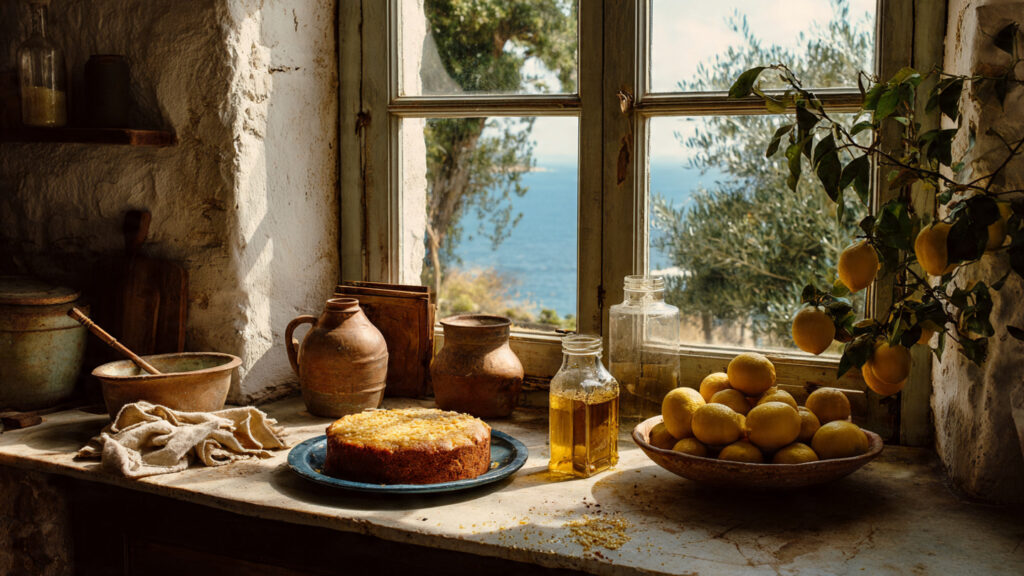
Its preparation is not a reconstruction of an ancient practice. It is a continuation of a living one, adapted over time to the kitchens and conditions of each generation while retaining the essential relationship between ingredient, season, and place that gives it meaning. Whether made in a farmhouse kitchen in Naxos, a coastal home above Nafplio, or a modern apartment in Athens with lemons brought from the market, it carries forward a pattern of seasonal attentiveness that connects the person preparing it to the longer tradition of the Aegean hearth.
Across Greece, where the light changes with each season in ways that are specific to the particular quality of the atmosphere above the sea and the limestone hills, this attentiveness to the character of the natural world remains one of the most enduring and most quietly powerful aspects of the culture. The spring cake, with its brightness of citrus and its warmth of honey and oil, is one of its clearest and most immediate expressions.