




In the coastal towns of the Cyclades, where whitewashed walls face the open sea and the light in summer months is sharp enough to cast shadows at noon with the precision of a blade, a shade of blue appears on shutters, doorframes, ceramic vessels, and the small glass talismans known as the mati. The same blue appears in the mountain villages of Epirus, on the painted lintels of farmhouses in the Peloponnese, and in the harbor settlements of the Aegean islands, where fishing boats carry a painted eye on their prows as they have done since antiquity. This is not decoration in the modern sense of the word. It is a continuation of one of the oldest and most consistently maintained protective practices in Greek cultural history, one whose roots extend to a rigorous and sophisticated ancient understanding of vision, influence, and the relationship between the human gaze and the world it falls upon.
“The eye is the lamp of the body”
Aristotle
The concept of the Baskania, the Evil Eye, was not treated in Classical Athens as popular superstition to be distinguished from serious thought. It was embedded in the natural philosophy of some of the most rigorous thinkers of the ancient world. Plato, in the Timaeus, engaged directly with the question of how vision operates, proposing that the eye participates actively in the act of seeing rather than functioning as a passive receiver of light. Empedocles of Akragas developed what later commentators called the extramission theory of vision, arguing that the eye emits rays of fire or energy that travel outward to meet the objects of perception. In this understanding, seeing is not merely the reception of an impression from outside. It is an outward act, a projection of the self into the space between the observer and the observed.

Within this theoretical framework, the Baskania was a coherent and logical possibility. If the eye emits energy in the act of looking, then a gaze charged with intense emotion, particularly with phthonos, the Greek word for envy or resentful longing, could transmit a harmful force to whatever or whoever it fell upon. A person of particular intensity, whether through beauty, prosperity, or simply a quality of concentrated attention, was considered especially capable of causing the Baskania without intention. The harm was not always deliberate. It was understood as a consequence of the force of the gaze itself, a form of involuntary influence that required no malicious intent to cause real damage.
The Color Blue and the Architecture of Protection
The traditional Greek response to the Baskania was built into the physical environment with a directness and practicality that reflects the Greek approach to abstract problems generally: the philosophy was translated into material form, and the material form was integrated into daily life with such thoroughness that it eventually became invisible as a system, persisting as habit and aesthetic preference long after its original logic had ceased to be consciously articulated.
The color kyanos, the deep blue associated with the Aegean sea and sky, occupied a protective function in this system. It was believed that blue, as the color of clear sky and open water, carried qualities that could absorb, deflect, or neutralize the concentrated energy of an envious gaze before it reached its intended target. Painted on a doorframe or shutter, the color served as a threshold guardian, a visual buffer between the exposed facade of a house and the interior life it contained. The logic was environmental rather than magical: the eye of an envious passerby, encountering the blue surface, would expend its charge on the color rather than penetrating through to the household within.

This understanding shaped architecture in ways that are still visible in the older quarters of Greek towns and islands. The enclosed courtyards of traditional houses in Nafplio and the island settlements of the Cyclades were designed to present a minimal surface to the public gaze. Exterior walls were kept plain and windows small. The richness of the household, its garden, its decorated interior, its family life, was kept within spaces that were not visible from the street. This was not poverty of imagination but a deliberate architectural philosophy that understood the public gaze as a force to be managed rather than simply endured.
Glass, Stone, and the Tradition of the Counter-Eye
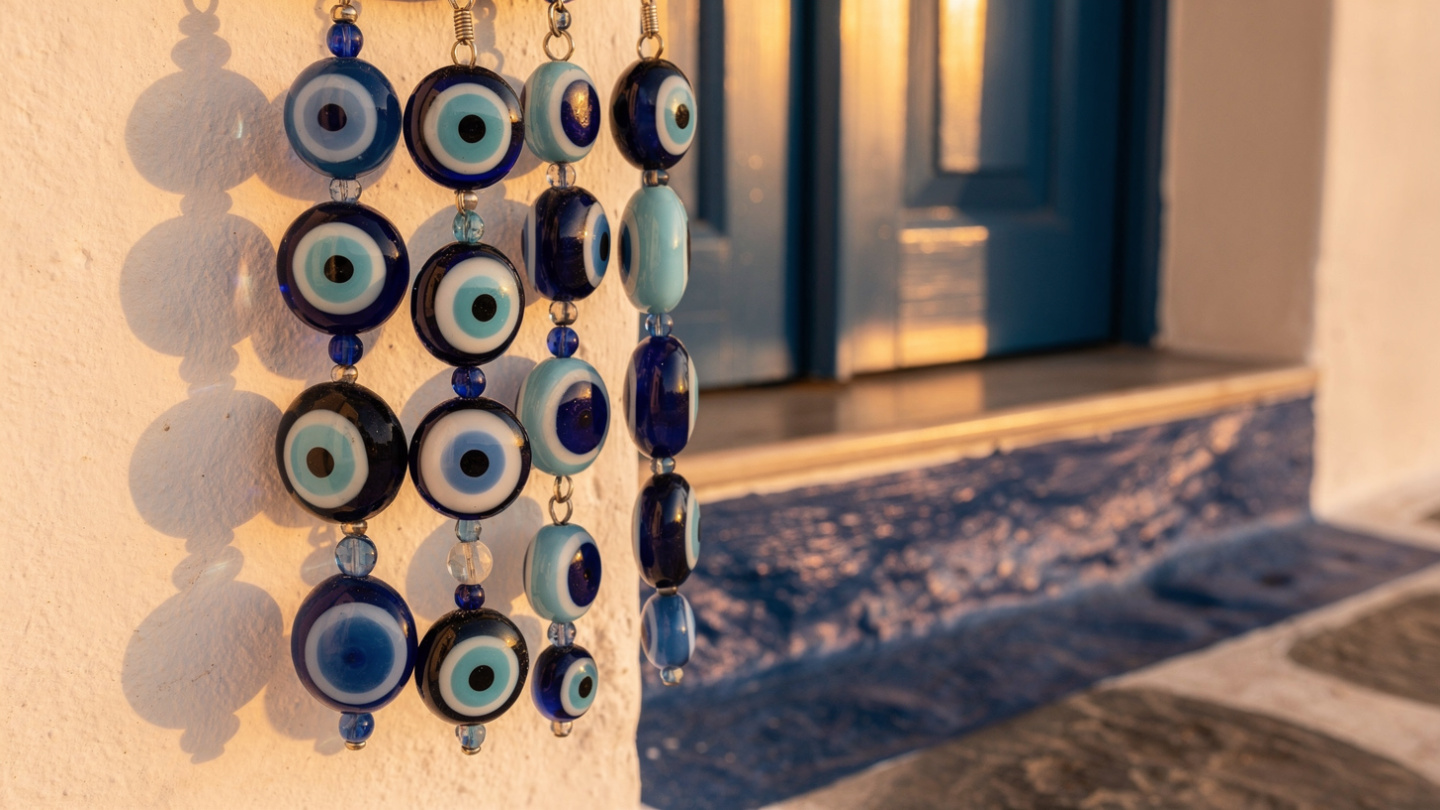
Archaeological evidence for the use of eye-shaped talismans in the Greek world extends back through the Bronze Age and into earlier periods, and the continuity of the practice across more than three thousand years of material culture is one of the more striking examples of persistent belief in the ancient Mediterranean. Excavations at Minoan sites on Crete have produced glass beads decorated with concentric rings of blue and white that follow the same visual logic as the mati sold in markets across Greece today. The form has remained essentially unchanged because its function has remained essentially unchanged: to present a counter-eye that meets the gaze of the Baskania and reflects it back before it can take hold.
The glass eye beads found in ancient contexts were not exclusively decorative objects. They appear as personal ornaments, as attachments to clothing and equipment, as architectural elements placed at the entrances to buildings and at the thresholds of significant spaces. Their placement was determined by an understanding of where the gaze was most likely to concentrate, at the entry point of a home, at the neck and chest of a person moving through public space, at the prow of a boat entering a harbor where the attention of onlookers would naturally fall.

The craft of producing these objects was itself a form of specialized knowledge. The glass workers of the Aegean, working in traditions that connected the Bronze Age workshops of the Cyclades to the later glassblowing traditions of the Hellenistic and Roman periods, understood how to work color and form into objects whose visual properties matched the requirements of their protective function. The combination of dark blue, light blue, and white that characterizes the mati produces a visual effect that draws and holds the eye of the observer, functioning as a point of concentrated attention that absorbs the looking rather than allowing it to pass through.
The Baskania in the Social Life of Ancient Greece
The practical management of the Baskania was understood in antiquity as a social skill as much as a spiritual practice. In the dense public environments of Classical Athens and the coastal trading cities of the Aegean, where prosperity was visible and the distinctions between households were subject to constant comparison, the risk of attracting envy was part of the ordinary texture of daily life. A newly built house, a healthy child, a successful business, a particularly fine crop: all of these were understood to attract the kind of attention that could turn harmful, triggering the divine corrective mechanism of Nemesis, which ensured that no singular excess could expand indefinitely without eventually meeting the structure that limits it.
The practices associated with managing this risk were correspondingly woven into the fabric of social interaction. Compliments were offered with care, and excessive praise of a child or a possession was understood as potentially dangerous, drawing attention to the object of admiration in ways that concentrated the public gaze upon it. The phrase spoken to deflect the Baskania after an admiring comment, the equivalent of the modern Greek expression ftou ftou, has roots in ancient apotropaic ritual: a sound and a gesture intended to break the circuit of the gaze before it could complete its harmful work.

Pliny the Elder, writing in the first century of the common era, compiled accounts of families and individuals known throughout the ancient world for the particular strength of their evil eye, people whose gaze was understood to wither plants, cause animals to fall ill, and bring misfortune to those they looked upon with envy. These accounts, gathered from sources across the Mediterranean and the Near East, reflect the universality of the belief in its ancient form. Within Greece specifically, the Baskania was not understood as an external magical force operating from outside the natural order. It was a consequence of the natural properties of the eye, amplified by the social conditions of envy, and managed through the same practical intelligence that the Greeks brought to other forms of environmental risk.
Sacred Uses and the Presence of Blue in Greek Ritual
The protective use of blue and of eye-shaped objects extended into the sacred architecture and ritual practice of the ancient Greek world in ways that connected the domestic management of the Baskania to the broader structures of religious life. At sanctuary sites across the Peloponnese and the Aegean islands, votive deposits include eye-shaped objects in terracotta, stone, and glass, offerings made by worshippers seeking divine protection against the harmful gaze or giving thanks for protection already received.
The color kyanos appears in the literary descriptions of divine spaces with a frequency that suggests its protective associations were understood to operate at the level of the sacred environment as well as the domestic one. The deep blue of the sea, of the clear sky above Olympus, and of certain precious stones carried associations with divine presence and protection that reinforced the practical use of blue in apotropaic contexts. The boundary between decorative, protective, and sacred uses of color in ancient Greek material culture was not sharp, and the kyanos that painted a shutter in a village of the Cyclades participated in the same symbolic field as the blue waters that surrounded the sanctuary islands of the Aegean.

In Delphi, the navel of the ancient world, the omphalos stone marked the center of the earth and the point of maximum divine attention. Pilgrims arriving at the sanctuary moved through a landscape already organized around the management of significant forces, including the force of concentrated looking. The architectural arrangement of the sanctuary, which controlled sight lines and required visitors to approach the temple through a sequence of spaces that gradually narrowed and focused attention, reflects the same understanding of the gaze as a force to be directed and managed that underpins the domestic practice of the Baskania.
Defensive Landscapes and the Design of Private Space
The architecture of traditional Greek settlements reflects, in its spatial organization, a coherent philosophy of the relationship between private and public life that the Baskania helps to illuminate. The narrow, winding streets of the older quarters of Hydra, Nafplio, or the mountain villages of the Zagori in Epirus are not simply the result of organic growth without planning. They are the product of a spatial logic that valued the protection of interior life from the unregulated attention of the public world.
Exterior surfaces were kept plain and undifferentiated. The gate to a courtyard revealed nothing of what lay beyond it. Interior spaces, gardens, decorated rooms, water features, were arranged to be invisible from the street. This spatial organization created a graduated sequence of exposure: the public face of the house presented minimal surface for the gaze to rest upon, while the domestic interior remained entirely protected from view.
The blue-painted elements, the shutters and doorframes and ceramic ornaments, functioned within this spatial system as threshold markers: points at which the transition between public and private space was acknowledged and protected. They were not placed at random but at the precise locations where the boundary between inside and outside was most permeable, where the gaze of a passerby could most easily penetrate without deliberate invitation.
This philosophy of domestic space, in which the interior life of a household is treated as something requiring active protection from the environmental pressure of the public world, is one of the most coherent and enduring contributions of Greek spatial thinking to the design of inhabited environments.
The Baskania in Contemporary Life
The conditions that produced the Baskania as a coherent cultural response to a genuine social phenomenon have not disappeared. The public display of private life, the compression of domestic and commercial space, the continuous exposure of personal circumstances to the attention and judgment of others: these are features of contemporary urban life that would have been recognizable, in their essential character, to a resident of Classical Athens or a merchant in the coastal towns of the Bronze Age Aegean. What has changed is not the underlying social dynamic but the contexts in which it operates and the tools available for managing it.

The mati that appears today on a keychain or a wall of a house in the Cyclades carries forward, in compressed form, a tradition of environmental management whose original logic was rigorous and specific. Its persistence across three thousand years of cultural change is not the persistence of superstition but the persistence of a genuine insight about the relationship between the human gaze, the social environment, and the need for protected interior space. The blue color that draws and deflects the eye, the enclosed courtyard that shields domestic life from public attention, the threshold ornament that marks the boundary between outside and inside: these are practical responses to a real condition, refined by generations of observation and maintained because they continue, in their quiet way, to work.
Continuity Across Landscape and Tradition
Across Greece, from the island settlements of the Aegean to the mountain villages of Epirus and the old harbor towns of the Peloponnese, the practice of the Baskania and its associated material culture remains part of the living texture of daily life. A blue bead at the entrance of a shop in Thessaloniki, a painted eye on a boat in the harbor at Kalamata, a mati hung near the cradle of a new child in a village of the Cyclades: these are gestures that connect the present moment to a tradition of attention and care that reaches back through the Minoan world and beyond.

The ancient theory of the emitting eye, refined by Plato and Empedocles and embedded in the natural philosophy of Classical Athens, may no longer be the framework through which most people understand the act of seeing. But the understanding it expressed, that the gaze is a force, that concentrated attention carries weight, that the interior life of a person or a household requires active protection from the unregulated looking of the world outside, remains as true and as practically relevant as it has ever been.

In the blue of the Aegean light, in the small glass bead that catches the eye of a passerby and holds it for a moment before releasing it, and in the whitewashed walls of a courtyard designed to keep its garden invisible from the street, the tradition continues, unhurried and unannounced, as it has always continued: through the accumulation of small, careful, daily acts of protection.
At Olympus Estate, Cultural Chronicles moves through the deeper currents of the Greek tradition. The extramission theory of vision held that the eye emits energy in the act of looking. Within this framework the Baskania was coherent and logical: a gaze charged with phthonos could transmit a harmful force to whatever it fell upon. The color kyanos absorbed and deflected the concentrated energy before it reached its target. The architectural logic of the enclosed courtyard was the same logic: present minimal surface to the public gaze and keep the interior life protected from view. The Minoan glass beads with concentric rings of blue and white follow the same visual logic as the mati sold in markets today. The form has remained essentially unchanged because the function has remained essentially unchanged. The blue bead at the entrance of a shop, the painted eye on the boat’s prow, the mati near a new child’s cradle: these gestures connect the present moment to a tradition whose original logic was rigorous and specific. In the blue of the Aegean light the tradition continues, unhurried and unannounced, as it has always continued.