

The mountain got its name from a giant who threw it, according to the story the peninsula itself has always told about its own name.
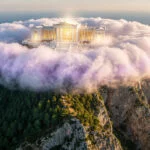
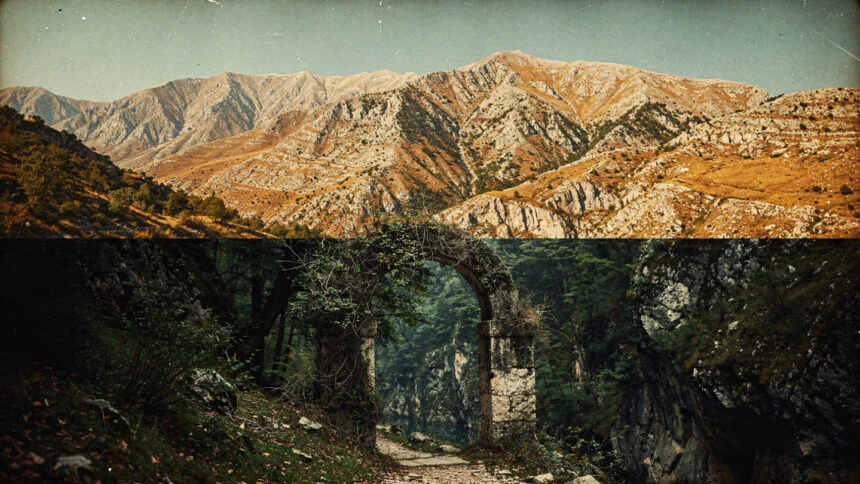
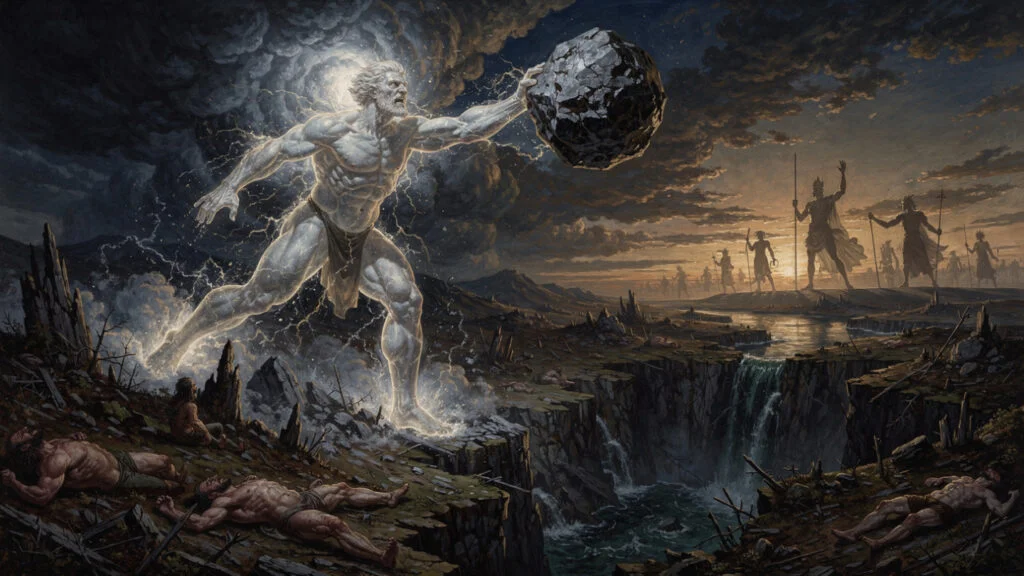
Athos, a giant of the Thracian world, hurled a massive boulder at the Olympian gods during the Gigantomachy, the cosmic war in which the Giants challenged the divine order Zeus and the Olympians had just established. The boulder missed its target and fell into the northern Aegean, becoming the mountain that dominates the easternmost of Halkidiki’s three peninsulas. The peninsula took its name from the mountain, the mountain kept the giant’s name, and the visual presence of the Athos peak, rising to 2,033 meters directly from the sea in one uninterrupted ascent visible from the Turkish coast and the islands of the northern Aegean alike, became the landscape’s own permanent monument to the myth it was already carrying.
The Athos naming legend belongs to the same broader category as the Polybotes-Nisyros story the Nisyros article in this collection develops, geological mythology, the way the ancient and later Greek imagination explained a landscape’s own dramatic features through the vocabulary of the Gigantomachy. That article develops the volcanic island of Nisyros as the rock Poseidon threw onto the fleeing giant Polybotes. The Athos story develops the mountain the giant Athos threw as a weapon whose failure to reach its target became, instead, a permanent landmark. Both stories dress genuine Aegean volcanic and tectonic violence, the forces that actually produced these dramatic landscapes, in the vocabulary of divine conflict.
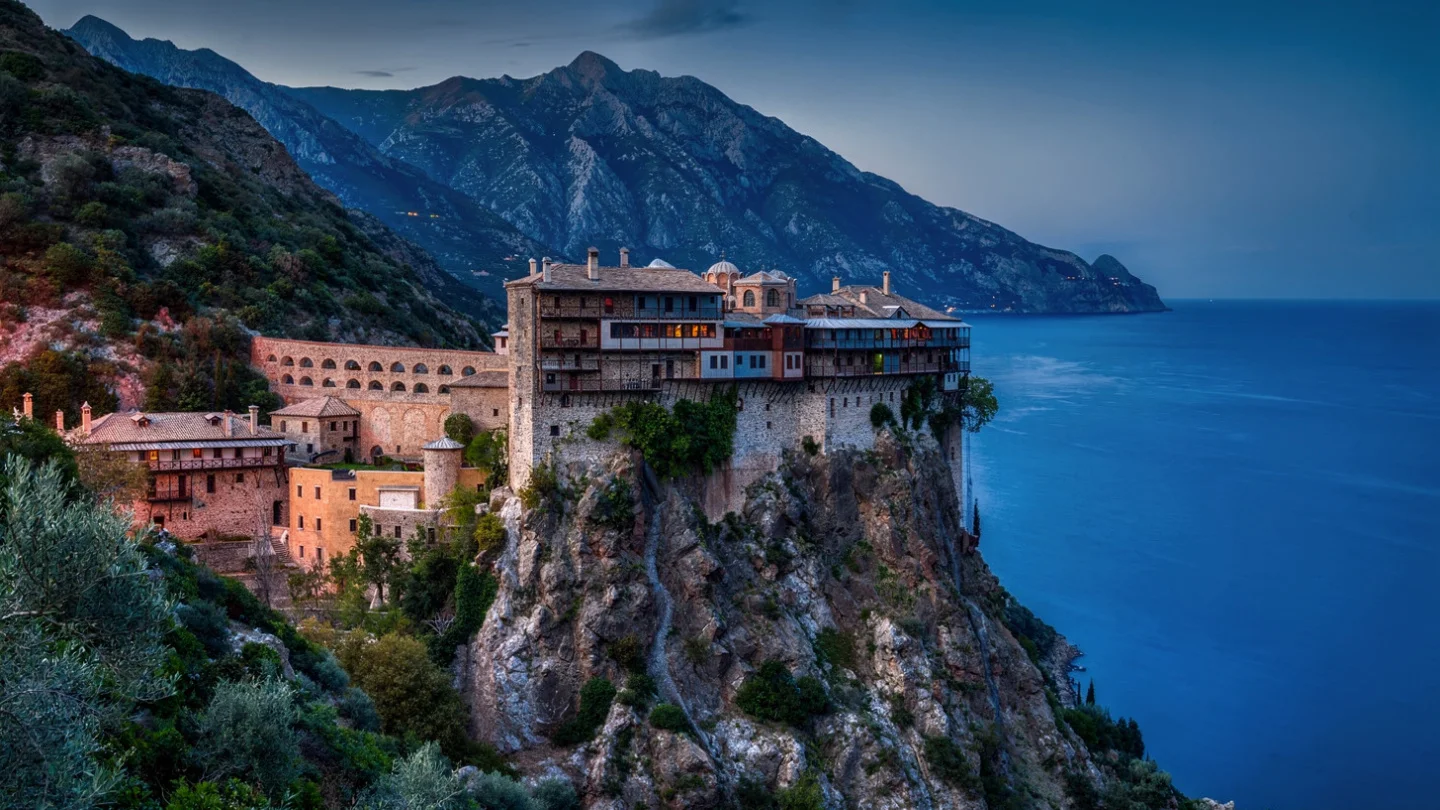
The mountain the giant Athos is said to have thrown is the mountain on whose slopes the most significant collection of Byzantine Orthodox monasteries in the world has been operating for more than a thousand years.
The Gigantomachy in Halkidiki
The stories connecting the Gigantomachy to Halkidiki extend well beyond the Athos naming legend alone, and the region’s fuller mythological geography distributes the war’s episodes across all three peninsulas, making the entire Halkidiki landscape a monument to the same conflict.
The Kassandra peninsula, westernmost of the three, has the deepest ancient pedigree of any of them. Under its older name, Pallene, it was identified as Phlegra, “the place of burning,” which Pindar and other early sources name directly as the birthplace of the Giants and the actual battleground of the Gigantomachy itself, an identification attested since the fifth century BCE. Local legend on the peninsula today goes further still, holding that the giant Enceladus specifically lies crushed and imprisoned beneath Kassandra, still struggling against the weight above him, his periodic movements producing the region’s earthquakes. This local version differs from the mainstream ancient mythographic tradition, in which Apollodorus and the Roman poets who followed him place Enceladus specifically under Sicily, buried beneath Mount Etna after Athena hurled the island itself onto the fleeing giant. What is genuinely ancient and well attested is Pallene’s own status as Phlegra, the Gigantomachy’s traditional home ground. The specific claim that Enceladus himself rests beneath Kassandra belongs to the peninsula’s own more local and more recent telling, layered onto a genuinely ancient foundation rather than replacing it.
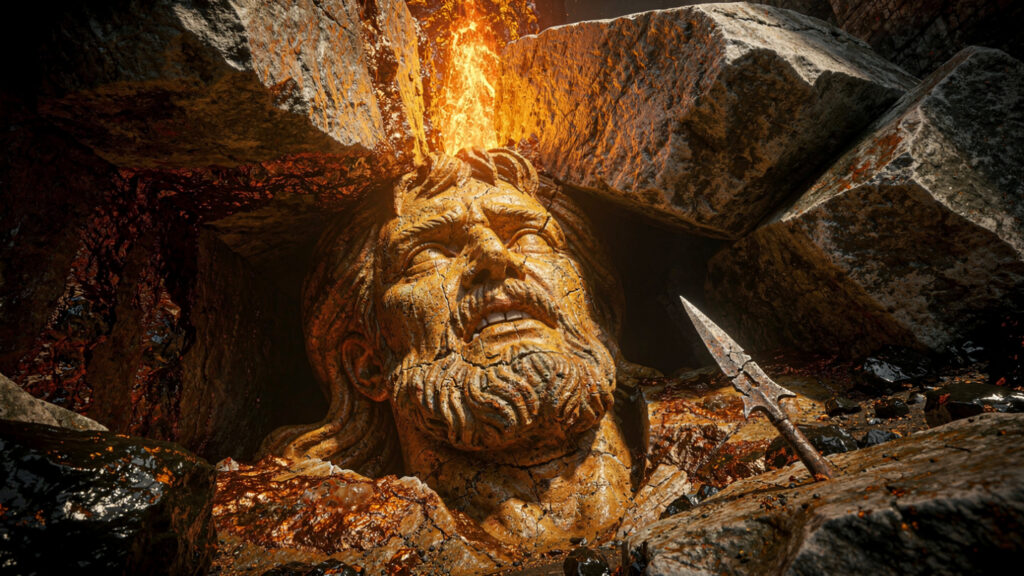
The Sithonia peninsula, the middle of the three, takes its name not from a giant but from Sithon, son of Poseidon and eponymous ancestor of the Sithonian people who inhabited the peninsula in antiquity. Sithonia’s naming story belongs to the register of divine genealogy rather than Gigantomachy combat, the territory of a divine bloodline rather than a battlefield.
The Akti peninsula, easternmost of the three and the one the Great Athos mountain dominates, carries the giant Athos’s own naming legend, the thrown rock that became the mountain, his defiance encoded permanently in the landscape’s most dramatic feature. Together the three peninsulas form a landscape later tradition understood as the direct product of that divine conflict, each one carrying the particular mythological character of the episode attached to it.
The Eight Ancient Cities of Akti
Long before the monastic community that now occupies the Akti peninsula, long before the Byzantine period when the first monasteries were established, the peninsula was home to a series of ancient Greek cities whose history Thucydides documents in the fifth century BCE as part of his account of northern Aegean political geography.
Thucydides names five cities on the peninsula specifically, Dion, Thyssos, Kleonai, Akrothooi, and Olophyxos, describing their population as a mixed community of Chalcidian Greeks alongside Pelasgians, Bisaltians, and other older Thracian peoples. He names a sixth city, Sane, separately, as a colony of Andros. Later sources add further settlements: Pliny records Apollonia among them, and the town of Ouranoupolis, whose name the modern gateway town preserves, was actually a later Hellenistic foundation, established by Alexarchus after Thucydides had already written, not one of the peninsula’s original archaic cities. These communities maintained real urban life through the archaic and classical periods before the political disruptions of the Macedonian and later Roman administrations began their gradual decline.
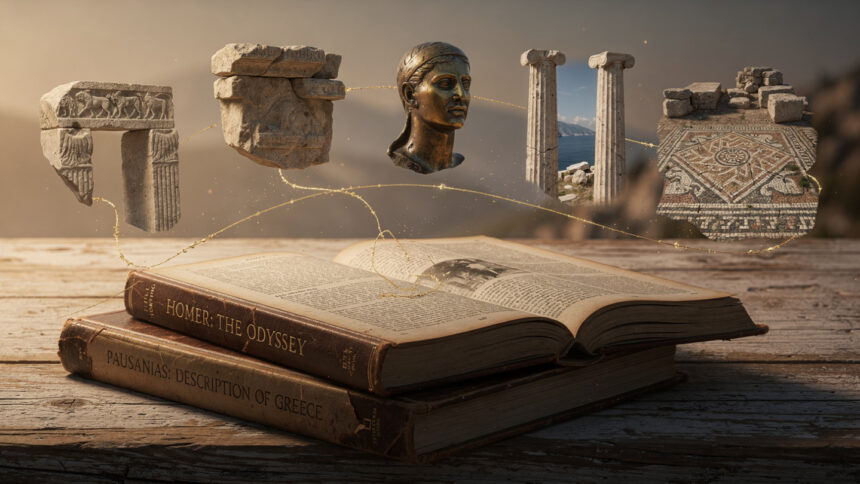
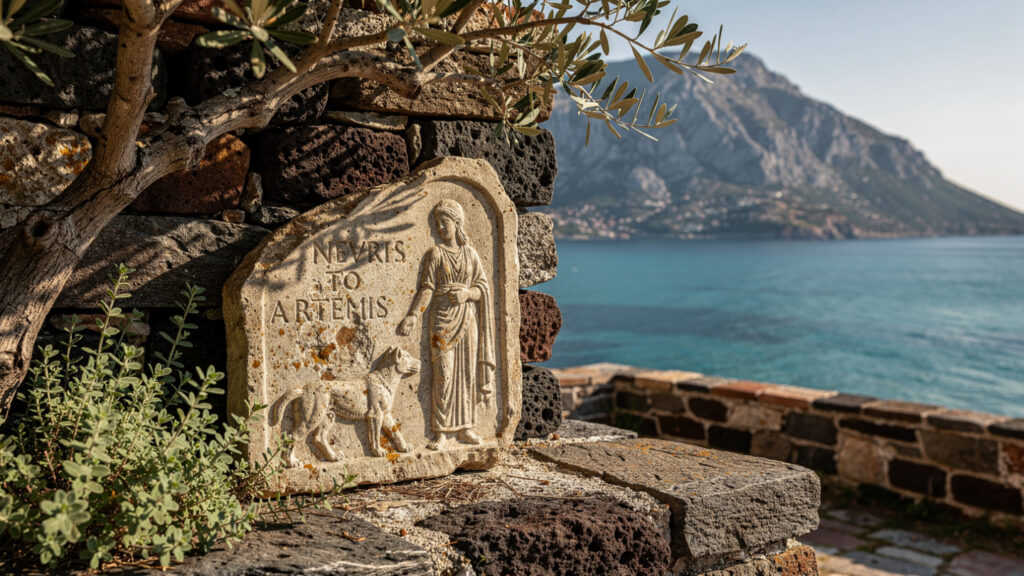
The city of Akrothooi, positioned at the peninsula’s southern tip in roughly the same location the Great Lavra monastery now occupies, is the ancient urban predecessor of the most significant Athonite monastery. The site where the ancient city stood became, centuries later, the site where the Christian community established itself, following a pattern of sacred geography that consistently placed the Christian sanctuary exactly where the ancient world had already marked the ground as significant. The Great Lavra was founded in 963 CE by Saint Athanasios the Athonite under the patronage of the Byzantine emperor Nikephoros II Phokas, and a votive relief dedicated to Artemis recovered from the monastery’s own site is the material evidence for the ancient cult activity at Akrothooi that preceded the Christian foundation by well over a thousand years.
The relief, inscribed with a dedication from Nevris to Artemis Agrotera, Artemis of the hunting grounds, is the object connecting the site’s ancient and Christian sacred histories most directly. Whoever made that dedication in the fifth or fourth century BCE was acknowledging the same quality of place the later monastic world would go on to acknowledge through the monastery’s own foundation, the sacred character of the southern Akti cape, mountain above, sea below, isolated from the ordinary world in a way that made it the fitting site for encountering the divine, in both the pagan world and the Christian one that followed it.
The ancient city of Ouranoupolis, at the isthmus where the Akti peninsula joins the wider Halkidiki mainland, was the gateway through which the peninsula was reached in antiquity, exactly as it still is today: the diamonitirion, the permit the autonomous monastic community requires for entry, is issued from the contemporary town of Ouranoupolis, which occupies precisely the strategic gateway position its ancient predecessor held in the classical and Hellenistic periods.
The Persian Catastrophe of 492 BCE
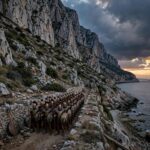
The waters around the Athos cape are among the most dangerous in the entire Aegean, and the meteorological and oceanographic conditions that make them dangerous produced the single largest naval catastrophe of the Persian Wars, well before the more famous battles historical memory has commemorated more extensively.
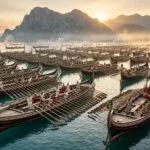
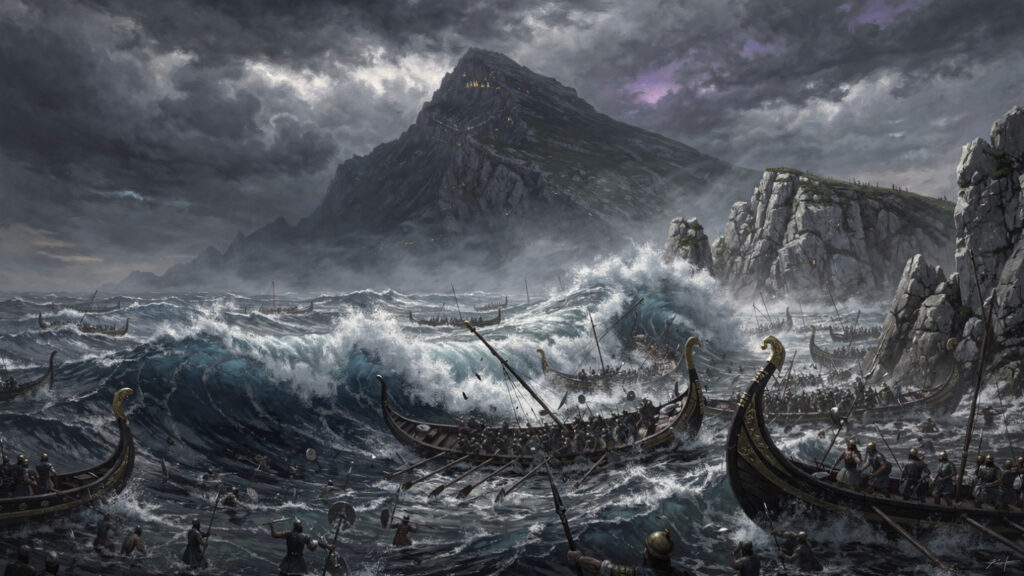
In 492 BCE, the Persian fleet under the general Mardonius was crossing the northern Aegean as part of the first Persian expedition against mainland Greece. Herodotus estimates the fleet at three hundred ships and twenty thousand men. Rounding the Athos cape, the combination of the headland’s open exposure, the depth of water immediately offshore, and the violence of the northern Aegean storms that same exposure to prevailing northern winds regularly generates, produced the disaster Herodotus documents in detail in the sixth book of the Histories.
The storm drove the ships against the rocks of the cape and against each other. Herodotus gives the same figures for the loss, roughly three hundred ships and twenty thousand men, which would make the Athos disaster one of the largest single maritime losses recorded anywhere in the ancient world up to that point. Its historical consequence was the abandonment of that first Persian expedition entirely, buying the Greeks the interval before the second expedition of 480 BCE in which to prepare their defenses, including the Themistoclean fleet-building program at Athens that ultimately defeated the Persian force at Salamis.
Xerxes’s response to Mardonius’s disaster, in the second expedition, remains significant in the history of ancient engineering. Determined not to repeat the same catastrophe by rounding the cape again, he had a canal cut across the isthmus where the Akti peninsula joins the Halkidiki mainland, roughly two kilometers long, letting his fleet pass through the isthmus rather than around the cape at all. Herodotus describes the construction in considerable detail: labor drawn from across the subject peoples of the Persian empire, roughly three years of work between about 483 and 480 BCE.
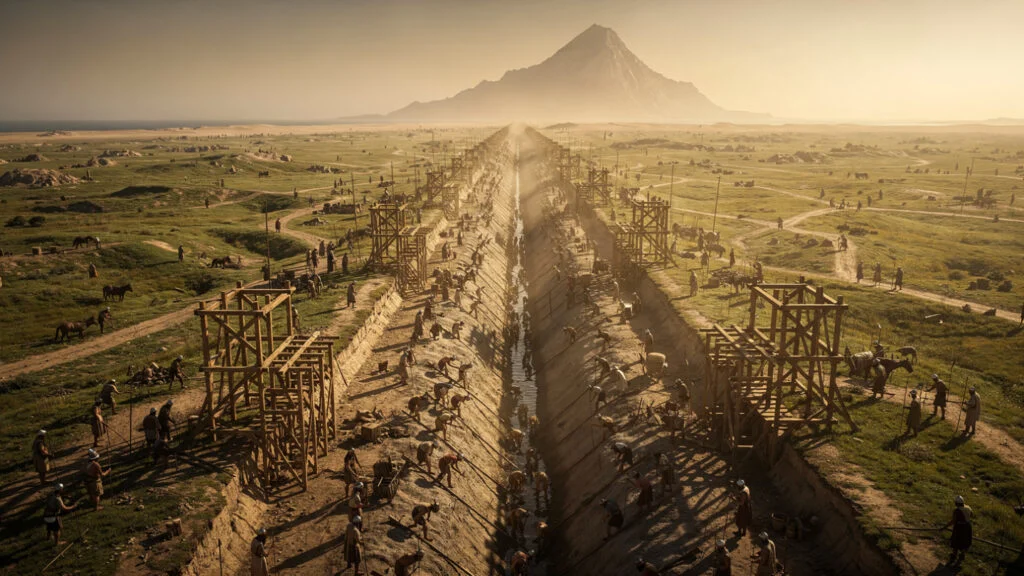
The Xerxes Canal’s physical traces are still visible in the isthmus landscape near Ouranoupolis today. Archaeological survey has identified the depression the canal once occupied, and subsurface investigation has confirmed it, a two-kilometer sea-level channel cut through the isthmus at the base of the Athos peninsula, among the most significant ancient hydraulic engineering projects anywhere in the Aegean world.
The Autonomous Monastic Community
The Mount Athos monastic community, the Agio Oros, has operated as an autonomous, self-governing community within the Greek state since 1913, when the Treaty of Bucharest assigned the Athos peninsula to Greece following the Balkan Wars, on condition that the community’s existing autonomy and self-governance would be preserved intact. That autonomy is formally guaranteed by the Greek constitution, by the monastic community’s own 1924 constitution, and by the European Union’s Treaty of Accession, which specifically exempted Mount Athos from the standard EU membership provisions that would otherwise have required it to admit women.
The ban on women entering the peninsula, the avaton, is the community’s most widely noted rule, and the historical record traces its origin to the Byzantine period: the prohibition is attributed to the Virgin Mary’s own consecration of the peninsula as her personal garden, and the community’s dedication to the Theotokos, the Mother of God, provides the theological foundation for excluding any other woman from ground consecrated to her. The rule has held consistently across the community’s entire millennium of operation, surviving both the Ottoman period and the European Union’s general commitment to non-discrimination.
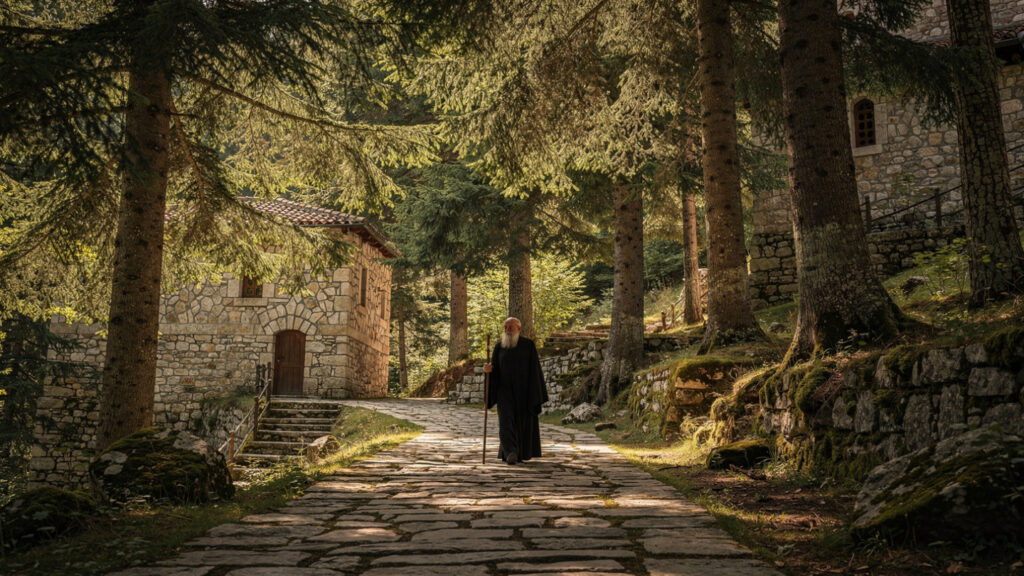
Twenty ruling monasteries govern the Athonite community as an autonomous republic, each sending representatives to the Holy Community, the governing council, and the Holy Epistasia, the executive committee. The monasteries range in age from the Great Lavra, founded in 963 CE and the oldest continuously operating monastery in the world, to Xenophontos, founded in the eleventh century and rebuilt in the nineteenth. Each maintains its own liturgical practice, its own library and archive of manuscripts and documents, and its own relationship to the wider Orthodox Christian world it serves.
The manuscript collections of the Athonite monasteries rank among the most significant surviving repositories of Byzantine Greek literature and theology anywhere. The combination of the community’s continuous operation right through the Ottoman period, when the monasteries served as the primary institutions preserving Byzantine intellectual life under Ottoman rule, and its sheer physical inaccessibility, which sharply reduced the looting and destruction that damaged other Byzantine institutional collections elsewhere, produced a survival rate that has made the peninsula’s libraries essential resources for the study of Byzantine culture as a whole.
The Diamonitirion and Visiting Athos
Access to the Mount Athos peninsula, for the male visitor only, since the avaton bars entry to women and children, requires the diamonitirion, a special permit whose name derives from the Greek for guest house, and whose practical function is capping the daily visitor count at a maximum of one hundred and ten Orthodox Christian visitors and ten non-Orthodox visitors.
The diamonitirion is issued through the Pilgrims’ Bureau in Thessaloniki or through the Ouranoupolis representative office, and the application requires the applicant’s passport details, nationality, and religious affiliation. Summer permits are in high demand, and with only ten non-Orthodox places available each day, advance application is essential for any non-Orthodox visitor hoping to enter the peninsula at all.
A visit to Athos is organized entirely around the guest facilities the individual monasteries provide for pilgrims: the arsanas, each monastery’s own landing port, serve as access points for boats moving along the coastline, while a network of monastery-to-monastery paths crosses the peninsula’s interior on foot. The monastic schedule, built around the Byzantine liturgical calendar the Athonite community still keeps in the Julian rather than the Gregorian form, and around the Byzantine clock that counts the hours from sunset rather than midnight, gives the whole peninsula a temporal character genuinely different from the world surrounding it.

A visitor entering through Ouranoupolis and reaching the Great Lavra at the southern tip, passing through the intermediate monasteries of Vatopedi, Iviron, Hilandar, Dionysiou, and a dozen others distributed along the peninsula’s eastern and western coasts, is moving through a landscape the monastic community has inhabited, in essentially the same form, for over a thousand years: Byzantine architecture, the gardens and vineyards each community maintains, forest the monastic administration has kept closer to natural Aegean woodland than any comparable stretch of the northern Greek mainland, and the particular silence of an interior where the path between two monasteries runs through old-growth forest with no sound of human activity beyond the path itself.
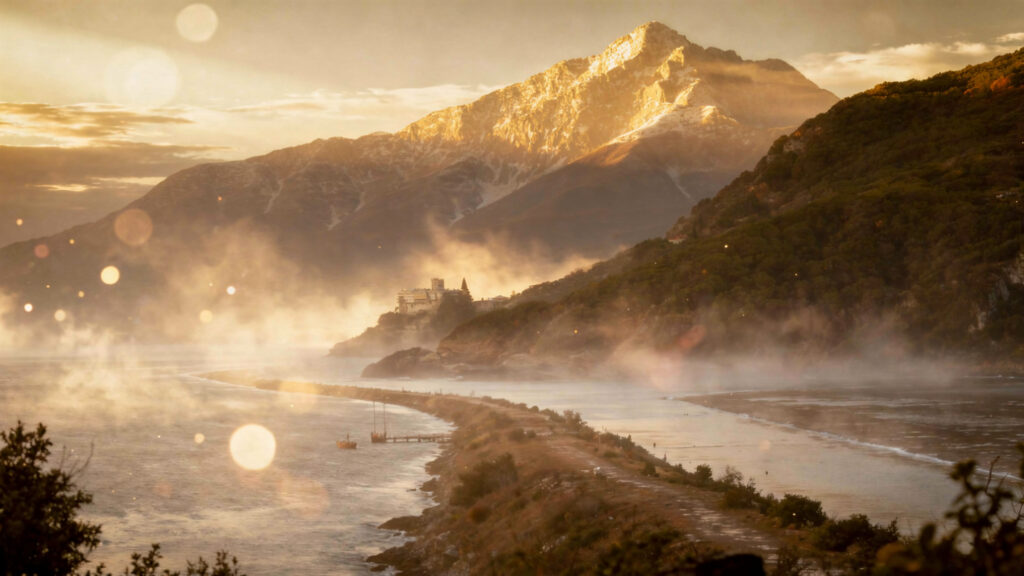
The boat from Ouranoupolis to Dafni, the peninsula’s main administrative port, runs daily throughout the permit season and is the route most visitors take for their first entry. The roughly hour-long crossing gives the first view of the monastery buildings from the sea, the angle from which the Athonite landscape reads most clearly: each monastery positioned above the water in exactly the relationship to its own site that the founders who chose the ground recognized as fitting for the community they were establishing there.
The Spiritual Significance
The Mount Athos community occupies a position in the Orthodox Christian world with no precise equivalent anywhere else in Christianity. It is simultaneously the most conservative surviving expression of the Byzantine liturgical and theological world, the primary living repository of Byzantine art and manuscript culture, and the community the Orthodox churches of Greece, Serbia, Russia, Bulgaria, Romania, and Georgia have all understood, across centuries, as the source of the most authoritative spiritual guidance available anywhere in the faith.
The Athonite community’s central theological legacy is hesychasm, developed and articulated by the fourteenth-century Athonite theologian Gregory Palamas: the claim that the uncreated light of God, the same light visible in Christ’s Transfiguration on Mount Tabor, is genuinely accessible to a human being through the practices of prayer and stillness the monastic world cultivates. This became the defining theological debate of the fourteenth-century Byzantine church, and it has remained the center of Athonite spiritual practice across every century since.
The Feast of the Dormition of the Virgin on August 15, which the Greek national calendar observes as its most significant summer religious holiday, and which the panegyri article in this collection develops through the community festival it produces across the country, is also the patronal feast of the Mount Athos community itself. The peninsula is dedicated to the Theotokos whose Dormition the feast commemorates, and the Great Lavra’s own patronal celebration, together with the liturgical character of the August observance across the whole peninsula, gives the Athos Assumption its particular weight within the broader Greek Orthodox world.
At Olympus Estate, Wanderlust Greece guides you across the sacred and storied terrain of the Hellenic world, from the thrown rock that became the mountain to the thousand-year monastery built at its base. Athos the giant hurled the mountain at the gods and missed. The rock fell into the Aegean. The Persian fleet was destroyed rounding it in 492 BCE. Xerxes cut a canal through the isthmus rather than face the cape again. The Great Lavra was founded on the site of the ancient city of Akrothooi. The Artemis votive relief was found at the monastery. The monastic community has operated for more than a thousand years. The mountain is still there. It still dominates the northern Aegean. Go to Ouranoupolis. Apply for the permit. Take the boat. The mountain explains itself.