



Troy did not fall to the wooden horse.
That is the version most people know, and it is not wrong exactly. The horse was real, the stratagem was Odysseus’s, and the night the Greeks poured out of its hollow belly into the dark streets of the city was indeed the night Troy ended. But the horse was not the cause of the fall. It was the delivery mechanism for a consequence that had already been decided weeks earlier, in a mission so quietly executed that most accounts of the Trojan War mention it in a single paragraph and move on.
The cause of Troy’s fall was a theft.
Not of gold, not of a weapon, not of a king’s life. A theft of a wooden statue small enough for one man to carry, sacred enough to have protected an entire civilization for generations, and old enough that its origins traced back not to Troy itself but to a tragedy on Olympus that Athena had never fully recovered from.
The Palladium was gone before the horse was built. Troy was already lost before the Greeks knew how to finish it.
This is the story of the night that actually ended the war, the two men who carried it out, and the question that Greek philosophy returned to for centuries afterward: when you steal a city’s divine protection, what exactly have you taken?
Ten Years and a Problem Nobody Could Solve
By the tenth year of the Trojan War, the Greeks had run out of ideas.
This requires some imaginative effort to appreciate. The army assembled on the plains of Troy was, by the standards of the ancient world, extraordinary. Achilles, the greatest warrior alive, had fought under its banner until his death. Agamemnon commanded it with the full weight of Mycenaean power behind him. Ajax had fought Hector to a standstill. Odysseus had outwitted every strategic problem the campaign had presented. And still Troy stood.


The walls held. The gates did not open. The city behind them continued to function, to be supplied, to resist with a stubbornness that a decade of siege had not broken and showed no signs of breaking.
The Greeks understood, in the way that people understand things they do not want to fully examine, that force alone was not going to finish this. Every direct assault had been turned back. Every attempt to starve the city had failed. The war had reached the condition that military campaigns reach when both sides have exhausted their capacity to win and neither has the wisdom or the authority to stop: a grinding, purposeless continuation sustained by the sunk cost of everything already spent.
What changed everything was a prisoner.
Helenus, son of King Priam of Troy and twin brother of Cassandra, was a prophet. Captured by Odysseus in a skirmish outside the walls, he found himself in a position that prophets in Greek mythology frequently find themselves in: knowing things that powerful men very much wanted to know, and having to decide how much that knowledge was worth to him.
What Helenus revealed, under circumstances the sources describe with varying degrees of coercion and persuasion, was the condition of Troy’s invincibility. The city could not fall, he said, as long as the Palladium remained within its walls. The sacred statue of Pallas Athena, the wooden idol that Zeus had cast from Olympus and that Apollo had guided to Troy, was the source of the city’s divine protection. Remove it, and Troy became a city like any other. Stout walls, brave defenders, determined king: but nothing more.
The Greeks had spent ten years trying to defeat the defenders.
They had not thought to steal the goddess.
Two Men for an Impossible Job
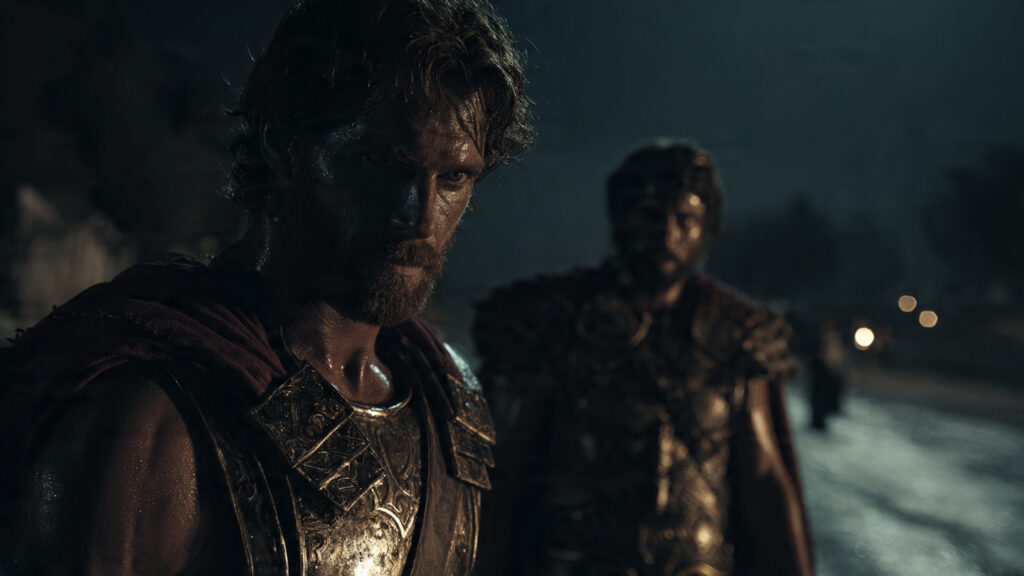
The mission required specific qualities, and the Greek command knew immediately which two men possessed them.
Diomedes was, by most ancient accounts, the finest warrior fighting on the Greek side after Achilles died. This is a claim that tends to surprise modern readers, who remember Achilles and Ajax and even Agamemnon more vividly, but the evidence in the Iliad is consistent: Diomedes is the Greek who wounds Ares, the god of war himself, in direct combat. He wounds Aphrodite. He fights Hector without retreating. He operates, throughout the poem, with a controlled ferocity that lacks Achilles’ emotional volatility and is, in many ways, more frightening for it.
He was chosen for this mission not for subtlety but for what would happen if things went wrong inside the walls.
Odysseus was chosen for everything else.
The king of Ithaca was the most complicated figure in the Greek army, a man whose reputation in the ancient world divided sharply along the question of whether cunning was a virtue or a corruption of virtue. He was, by every account, extraordinarily effective: a strategist, a manipulator, a man who understood human psychology with the precision of someone who had spent his entire life studying weakness. He was also, by those same accounts, willing to do things that other men would not do and to live with the consequences in a way that most men could not.
For a mission that required entering an enemy city, locating a sacred artifact in a fortified temple, removing it without detection, and returning through hostile territory in darkness, Odysseus was not a choice. He was the only option.
Together they made a pairing that the ancient sources clearly found fascinating: brute excellence beside calculating intelligence, the man who could fight anything beside the man who would try not to fight at all. Whether they trusted each other is a question the myths do not resolve cleanly. What is clear is that they went, and that they came back with what they went for.
The Competing Accounts | What Actually Happened That Night
Here is where the myth becomes genuinely interesting, because the ancient sources do not agree on what Odysseus and Diomedes actually did inside Troy, and the disagreement is not minor.
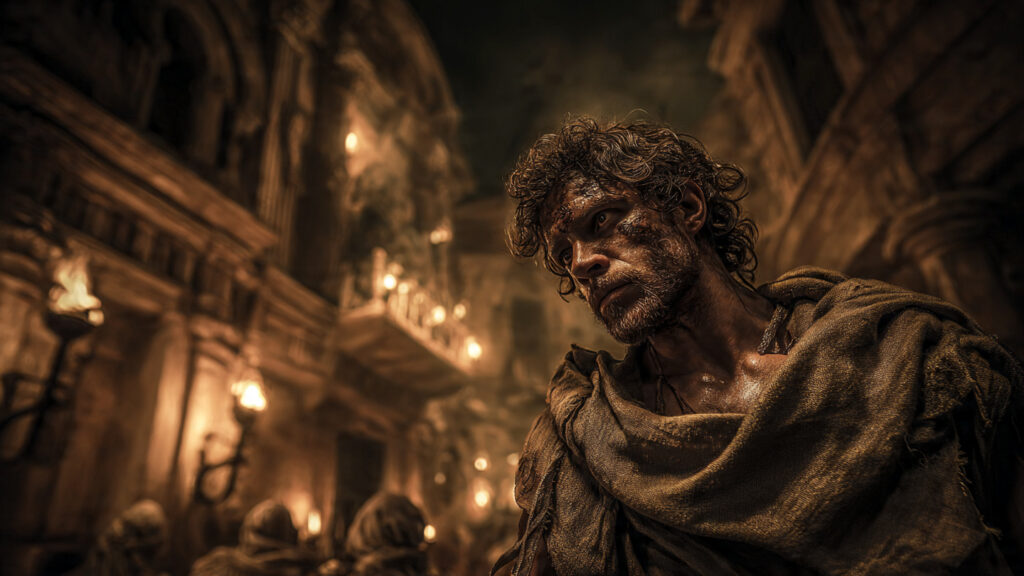
The version from Apollodorus is the most commonly cited. Odysseus disguised himself as a beggar, a disguise he would use again more famously in the Odyssey, and entered the city openly through the gates. Inside, he was recognised by Helen, who had by this point in the war developed a complicated relationship with the Greeks she had nominally caused to arrive. Helen did not betray him. She helped him. She showed him the location of the Palladium in Athena’s temple, and that night he and Diomedes, who had entered separately or waited outside the walls, took it and fled.
The version in the lost epic Iliou Persis, preserved only in summaries, is darker. In this account, Odysseus and Diomedes both enter Troy in disguise. They locate the Palladium. They take it. On the return journey in the dark, Diomedes walks ahead carrying the statue. Odysseus walks behind him. At some point, Odysseus draws his sword.
The ancient commentators who record this detail are divided on what it means. Some say Odysseus intended to kill Diomedes and take sole credit for the theft. Some say Diomedes saw the moonlight flash on the blade, understood immediately what was happening, and turned the tables: he disarmed Odysseus, and drove him back to the Greek camp at swordpoint, striking him repeatedly with the flat of his blade to keep him moving. This episode is the origin of the phrase “Diomedes’ compulsion”: being forced to do something against your will by someone behind you with a weapon.
A third version, associated with Diomedes alone, holds that Odysseus had no role in the theft whatsoever. In this telling, Diomedes accomplished the entire mission himself, possibly with the specific favour of Athena, who had always shown a preference for him almost as strong as her preference for Odysseus.
What should we make of these contradictions?
The Greeks, as it happens, made something quite deliberate of them. The competing versions of the Palladium theft were not a problem to be resolved. They were a meditation on the two men involved. The question of whether Odysseus tried to betray Diomedes in the dark is, at its core, the question of whether cunning, taken far enough, destroys the very alliances it depends on. It is a question the Greek tradition never stopped finding interesting. It is, in many ways, the central question of the Odyssey as well: how much is a man permitted to do in service of a goal before the goal is contaminated by the means?
What Was Actually in That Temple
Before examining what the theft meant, it is worth pausing on what, precisely, was taken.
The Palladium was not a grand cult statue in the manner of the great classical Athena figures. It was small, ancient, and by the standards of the later Greek artistic tradition, crude: a wooden figure, seated or standing depending on the source, holding a spear in one hand and a distaff or shield in the other. Its power was not in its beauty. It was in its origin.
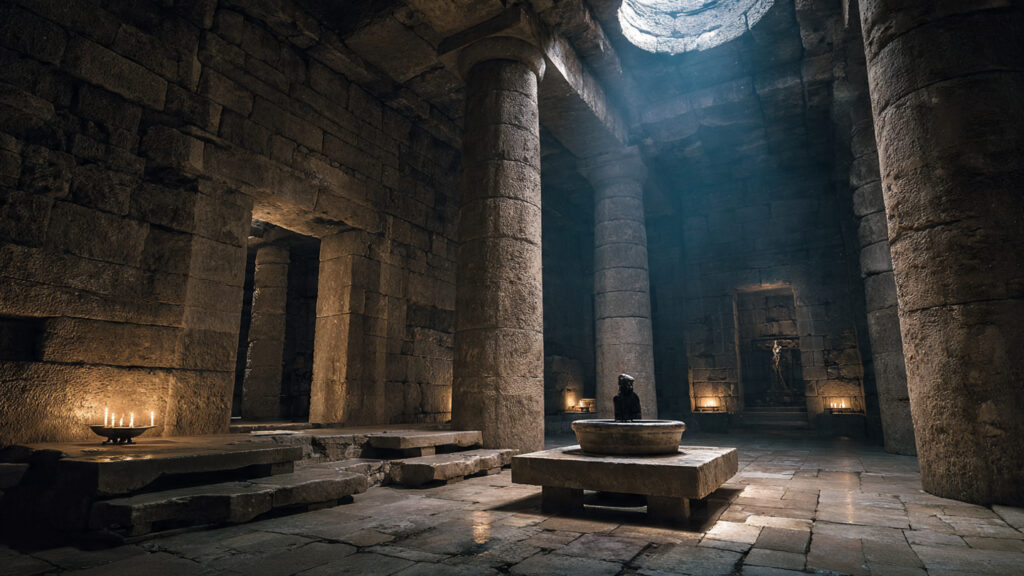
According to the myth preserved in the Pallas Athena article this essay accompanies, the statue was carved by Athena herself in the image of her dead companion Pallas, the friend she had accidentally killed during a sparring match in their youth. The statue was washed in Athena’s tears. It was dressed in the aegis. When Zeus cast it from Olympus in fury at the nymph Electra who had sheltered beneath it, it fell to earth and landed at Troy, where Apollo declared it the city’s protection.
Every element of this origin matters.
The statue was not merely a sacred object. It was Athena’s grief made physical, the permanent record of the moment when the goddess of wisdom caused the death of the person she loved most. It carried divine sorrow in its wood. And that sorrow, in the Greek theological imagination, was a form of power: a god’s guilt transformed into protective attention, a perpetual act of atonement expressed as guardianship over the city where the statue came to rest.
To steal it was not simply to remove a religious object. It was to withdraw that attention, to sever the connection between Athena’s grief and Troy’s walls, to leave the city in the condition of a house from which someone has removed the foundation stone without touching any of the walls above.
The walls would stand for a while. Then they would not.
What Athena Thought About It
This is the detail that the myth handles with great delicacy, and that most modern summaries of the theft skip entirely.
Athena helped.
Not reluctantly, not ambiguously, but with the focused assistance of a deity who had, for reasons the myth does not fully explain, shifted her allegiance from Troy to the Greeks at some point in the war and was now prepared to act on that shift in the most direct way available to her.
The Iliad establishes this clearly: Athena is a Greek partisan throughout the poem, intervening on their behalf with a consistency that contrasts sharply with the divine protection Troy was supposed to enjoy. She guides Diomedes in battle. She protects Odysseus. She is present, in the various accounts of the theft, as something between a guide and an accomplice.
This creates a theological problem that the ancient Greeks found genuinely troubling.
If Athena helped steal the Palladium, then Athena participated in removing her own protective presence from Troy. She was, in effect, withdrawing her own grief from the city it had been guarding. She was, for reasons connected to the judgment of Paris and the insult to Hera and the entire divine politics of the war’s origin, choosing to let go of the place where her guilt had been residing for generations.
What does it mean for a god to reclaim their own sorrow?
Greek philosophy does not answer this cleanly. What it does, in the various tragedies and reflections on the fall of Troy, is treat the theft of the Palladium not as a human act of cunning that overcame divine protection, but as a moment when the divine protection chose to end. Odysseus and Diomedes did not outsmart Athena. They were her instruments.
This reading makes the theft considerably more unsettling than the simpler version. Troy was not betrayed by its enemies. It was released by its guardian.
The Night of the Mission | A Reconstruction
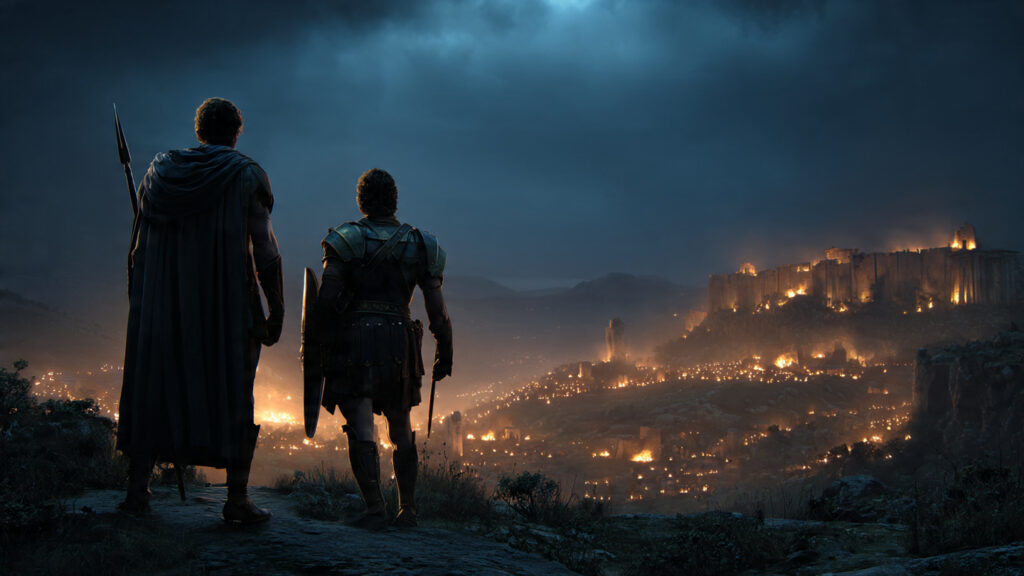
The ancient sources give us fragments. Between those fragments, the texture of the night can be reconstructed.
It would have been a moonless night, or close to it. Operations of this kind in the ancient world were timed by the lunar calendar with the same deliberateness that modern special operations are timed by satellite visibility. Darkness was the primary cover available to men without the technology of silence.
Odysseus’s disguise as a beggar was not merely a costume. It was a character sustained over time, possibly over multiple reconnaissance visits to the city before the night of the actual theft. The Odyssey references his earlier entry into Troy in the disguise, suggesting a familiarity with the city’s streets that could only have come from prior intelligence work. He knew where the temple was. He knew the watch patterns. He knew which gates were less carefully guarded and at what hours.
Diomedes’s role was insurance. He was the contingency plan made flesh: if Odysseus’s disguise failed, if a guard could not be avoided, if the exit route was blocked, Diomedes was there to ensure that the problem was resolved in the only way Diomedes resolved problems. The combination was not elegance paired with strength. It was elegance as the preferred option and strength as the guarantee that the preferred option was not necessary.
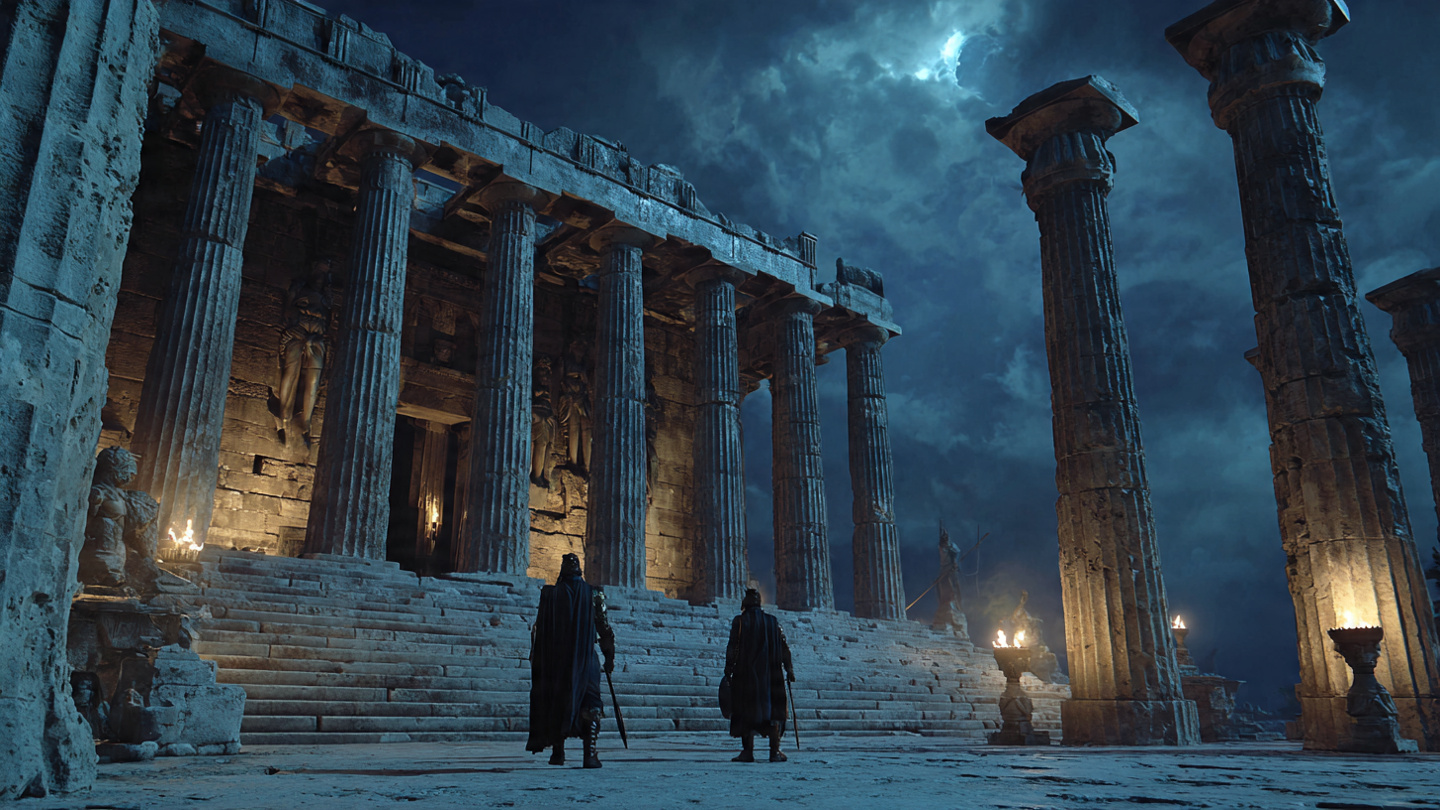
The temple of Athena inside Troy sat on the citadel, the high ground of the city, close to the palace. Getting there meant moving through the lower city without detection, climbing to the citadel, entering a sacred precinct without triggering whatever religious protections surrounded it, and then reversing the entire journey with a wooden statue that could not be concealed under a cloak.
That they succeeded is not in doubt. How they succeeded is the part the myth leaves to imagination, which is its own kind of answer. Some things are done in the dark and explained afterward, if at all.
What Happened to Troy After
The theft of the Palladium did not immediately produce the fall of Troy. That is important to understand. The city did not collapse the following morning. Its walls did not crumble. Priam did not wake to find his protection gone and surrender at the gates.
What changed was subtler and, in the Greek understanding, more final.
Troy became possible to defeat.
The sequence that followed moves with a certain mythological inevitability once the Palladium is gone. The wooden horse arrives. The Greeks conceal themselves inside it. The Trojans, debating whether to drag it within the walls, are manipulated by Sinon’s false story and by the ambiguous intervention of the priests, including the catastrophically ignored warning of Laocoon, who threw his spear at the horse and was silenced when sea-serpents killed him and his sons in full view of the assembled Trojans. They take the horse inside. That night, Troy burns.
Without the Palladium, the Greeks needed one more stroke of cunning to finish what the theft had made possible. With the Palladium still in its temple, no amount of cunning would have been sufficient.
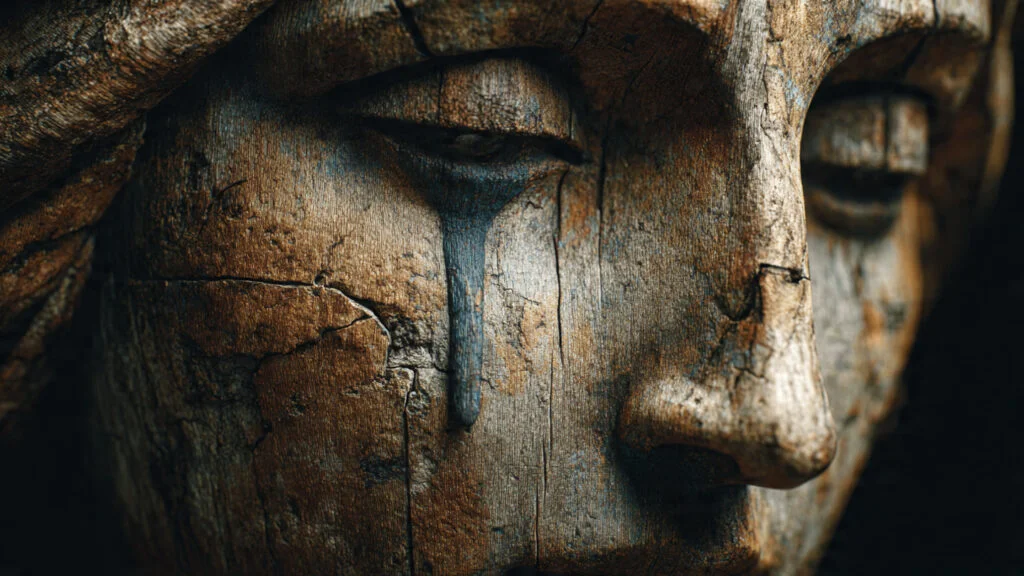
This is the structure the Greek tradition insists on: the theft was the turning point, the horse was the conclusion. Most people remember the horse. They have mostly forgotten the night that made the horse possible.
Two Men Who Never Recovered From Victory
Here is the part of the story that the triumphalist version of the fall of Troy tends to omit.
Neither Odysseus nor Diomedes returned home to uncomplicated glory.
Diomedes, by most accounts, arrived back in Argos to find his wife had taken a lover in his absence and his kingdom was in the hands of men hostile to him. He left Greece and settled in southern Italy, founding cities in what is now Apulia, spending the rest of his long life at a remove from the world he had helped reshape. He was honoured, eventually, as a hero and a minor deity in the regions where he settled. But he did not go home to what he left.
Odysseus’s return is the subject of the greatest poem in the Western tradition about the cost of being the man who does what other men cannot bring themselves to do. Ten years of wandering, every companion dead by the journey’s end, a home that had been waiting for him in a condition he had to fight to reclaim. The Odyssey is sometimes read as a celebration of Odysseus’s cleverness. It is more honestly read as an account of what cleverness costs: the isolation of the man who sees further than everyone around him, the loneliness of the person who cannot stop calculating even when calculation is destroying him.

Both men took the thing that ended Troy. Both men paid prices that the ancient tradition clearly understood as connected to that act, even if it does not state the connection explicitly.
The Greek moral imagination was too precise to call this coincidence.
What Was Really Stolen
The Palladium was recovered, if the myths are believed, and passed through centuries of custody: to Argos, to Athens, eventually to Rome, where it rested in the Temple of Vesta as the unseen guardian of the empire, visible only to the highest priests and the most sacred of Vestal Virgins.
But what Odysseus and Diomedes took from Troy that night was not, in the deepest reading of the myth, a statue.
They took the idea that Troy was protected.
A city whose people believe they cannot fall fights differently from a city whose people know they might. The walls of Troy had not changed when the Palladium left. The warriors defending them had not diminished. Hector was already dead, but the city had survived that. What the theft did, in the days and weeks between the mission and the night of the horse, was work on the Trojans in ways that had nothing to do with stone or bronze.
The myth does not tell us that the Trojans knew the Palladium was gone. Perhaps they did not. Perhaps the priests noticed and said nothing, understanding that some truths cannot be spoken aloud without becoming immediately fatal. Or perhaps the city simply felt different, in the way that places feel different when something essential has left them, without anyone being able to name exactly what changed.
The Greeks had understood something the Trojans had not: that the protection of a city lives as much in the minds of its defenders as in the walls around them. Remove the symbol and you begin to remove the confidence, and confidence, in a siege that has lasted ten years, is the only resource that cannot be resupplied.
Odysseus knew this. He always knew this. It was, in the end, the thing that made him more dangerous than any warrior.
Closing

The theft that ended Troy took one night.
The war it concluded had taken ten years. The mythology it generated has occupied the Western imagination for three thousand years after that. And the question it raises has never been fully answered, not in the ancient world and not now: is it possible to steal something sacred without the act of theft itself becoming sacred?
Odysseus and Diomedes went into a city under cover of darkness and took an object that did not belong to them. By every conventional measure, this was a crime. By the measure the Greek tradition applies to it, it was something else: the decisive act of a war whose moral architecture was so compromised on every side, from the judgment of Paris to the sacrifice of Iphigenia to the rage of Achilles, that the concept of clean hands had long since ceased to apply to anyone involved.
Troy deserved better than to fall to a theft.
But then, the Greeks would tell you, that is precisely why the theft was necessary. You do not take the Palladium from a city that deserves to fall. You take it from a city that would otherwise never fall at all.
Odysseus understood this. He went into the dark with that understanding in his hands, and he came back with the thing that changed everything.
Whether it made him great or whether it unmade him is the question the Odyssey spends ten thousand lines not quite resolving.
Perhaps that is the answer.
At Olympus Heritage Hub, Tales from Olympus explores the full architecture of Greek myth, from the radiant peaks of Olympus to the smoke of Troy. Some stories end with a city burning. The interesting question is always what happened the night before.