




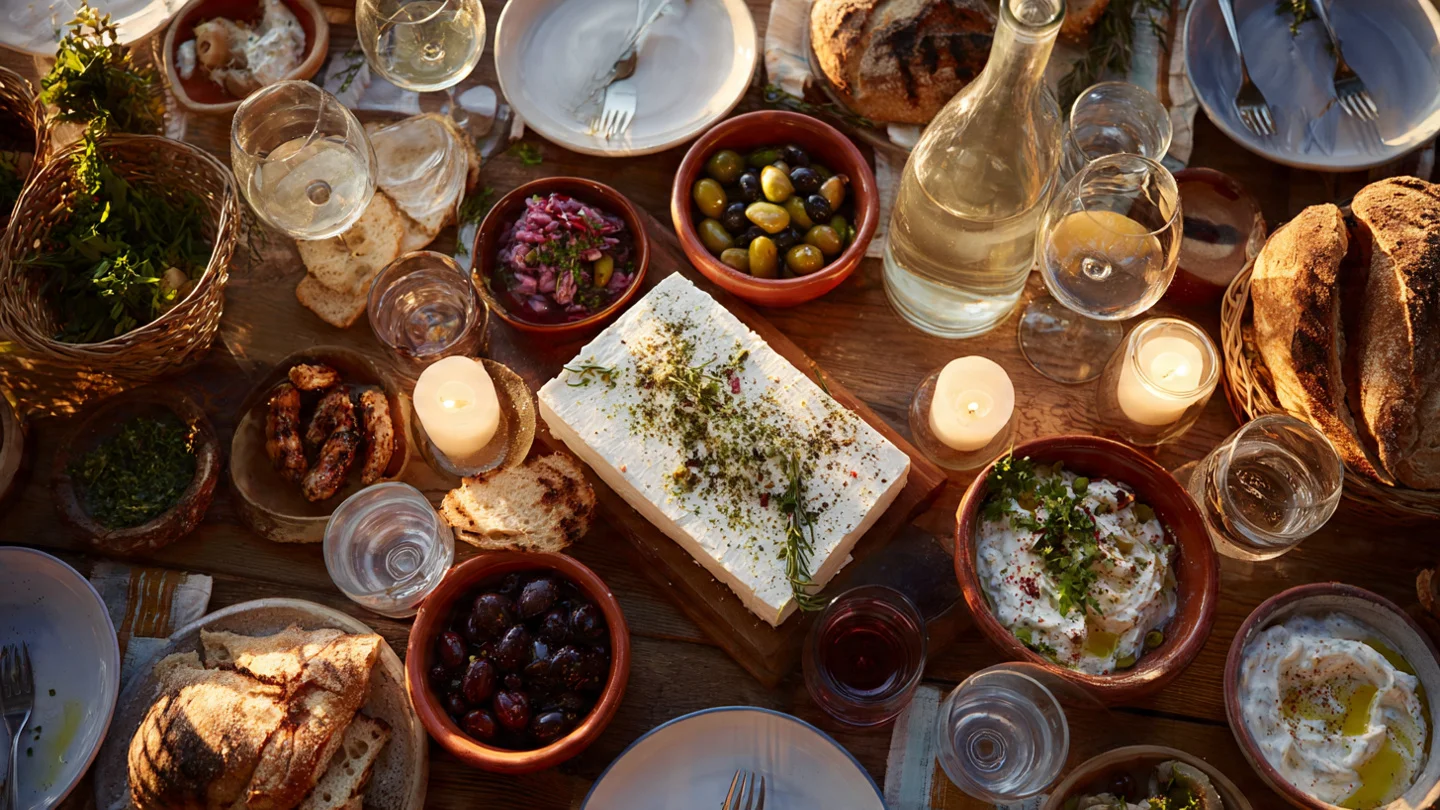
Nobody at a Greek table ever went hungry because there wasn’t enough food.
They may have gone home too full to sleep. They may have sat for three hours longer than they intended, caught in a conversation that kept finding new rooms to wander into. They may have poured one more glass of wine at midnight because someone’s grandmother appeared from the kitchen with a dish that had not been on any menu anyone had discussed. But hungry? No. Hungry is not a condition the Greek table permits.
This is the first thing you need to understand about a Greek mezze night before you plan a single dish or invite a single guest. It is not a dinner party in the sense that most of the Western world uses that phrase. It is not a meal with a beginning, a middle, and a considered end. It is not a showcase for the host’s culinary skill or a performance of a particular social register.
It is something older than all of those things. And considerably more enjoyable.
The word mezze comes from the Persian maza, meaning taste or snack, and arrived in the Greek culinary vocabulary through centuries of Aegean trade and Ottoman cultural overlap. But the practice it describes is as Hellenic as olive oil and argument: the placing of many small dishes at the centre of a table, the opening of wine, the expectation that the meal will find its own pace, and the understanding that the table is not simply where food is consumed but where something more essential to human life takes place.
The Greeks have a word for what that something is: paréa. The company. The quality of being with people you want to be with, eating food that was made with attention, in no particular hurry to be anywhere else.
A Greek mezze night, done properly, is the architecture of paréa.
Here is how to build it.
Philosophy First
Let’s be direct about something that most mezze guides miss entirely.
You can follow every recipe in this article to the letter. You can source the correct olive oil, find authentic Greek feta, toast your pita to the right colour and temperature. And you can still produce an evening that feels nothing like a Greek table.
Because the dishes are not the point.
The point is the disposition. The Greek host does not perform hospitality, they practice it, in the way that a craftsperson practices their skill: with ease born of long habit, with generosity that does not call attention to itself, with an attention to the comfort of guests that is so thoroughly naturalised it never feels like effort.
The ancient Greeks called this philoxenia, love of the stranger, love of the guest. It was not simply a social grace. It was a sacred obligation, protected by Zeus himself in his aspect as Zeus Xenios, the guardian of guests and hosts. To treat a guest poorly was not a matter of bad manners. It was an offence against the divine order.
You do not need to invoke Zeus at your dinner table. But you do need to internalise the spirit of what philoxenia means: the guest’s ease is more important than the host’s performance. The table is richer when people forget they are being hosted and simply feel that they are at home.
This is the rule that governs everything else.
What the Table Looks Like
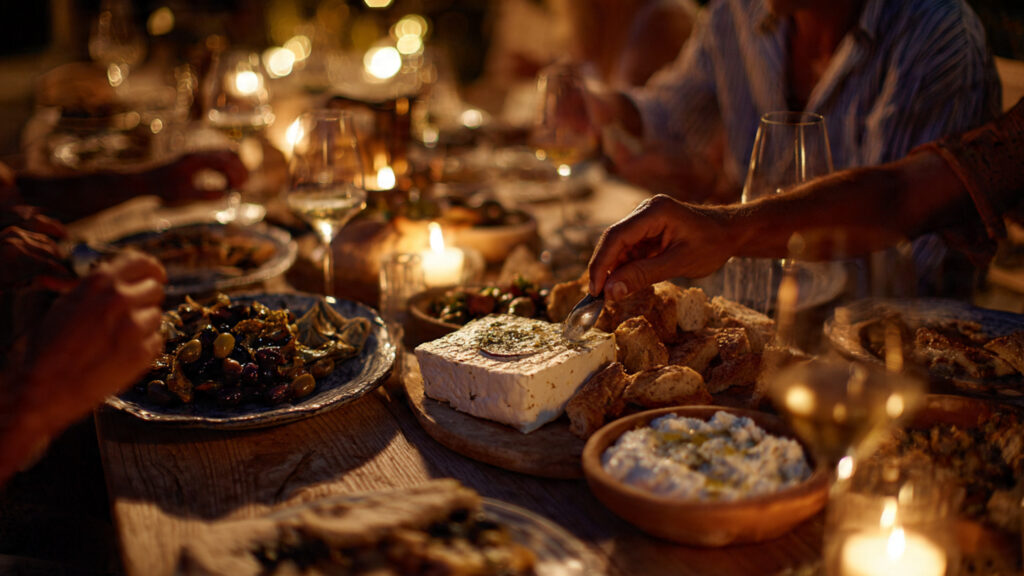
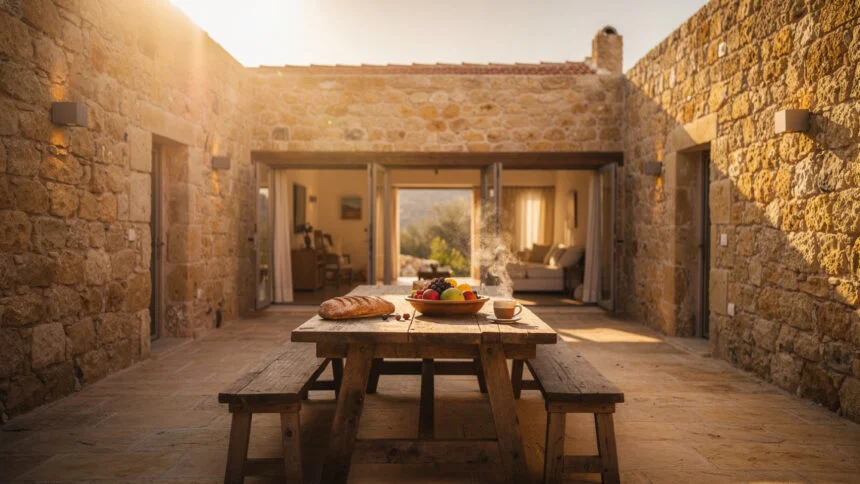
A Greek mezze table has a visual character worth understanding before you set a single plate down.
It is abundant without being crowded. It is varied without being chaotic. It has, at its centre, the quality of something that arrived naturally rather than being arranged, as though the dishes accumulated through the logic of appetite and season rather than through the planning of a host with a checklist.
This appearance of natural abundance is, of course, a considered achievement. But the consideration should not show.
The centre belongs to the communal dishes: the spreads, the dips, the salads, the shared plates that everyone reaches for simultaneously. These are placed on small plates and wide, shallow bowls, close enough to every seat that nobody has to ask for anything to be passed. The bread is in multiple places. There is always more bread than you think you will need. There is always less bread than the table will consume.
Individual plates are small, not the large dinner plates of a Western restaurant meal, but something closer to a side plate, acknowledging that a mezze meal is assembled course by course through individual choice rather than served as a predetermined portion.
The wine and the water arrive before the food. This is not incidental. It is a signal: the table is open, the evening has begun, whatever happens next is welcome.
Candles or low light, not as an aesthetic affectation but because the quality of attention at a Greek table is intimate. It belongs to the people sitting at it, not to the room they are sitting in.
What the table does not have: place cards, a fixed seating plan, a printed menu, any visual signal that what is about to happen has been staged rather than offered. The Greek table is generous, not theatrical. Know the difference.
Before a Single Dish Appears
In Greece, the evening begins before the food arrives.
This is not a pause before the main event. It is the first act of the evening, and it has its own logic and its own drinks.
Ouzo is the traditional aperitif of the Greek table, though its reputation in the wider world has suffered from association with tourist-strip versions that bear little resemblance to the real thing. A proper ouzo, from Lesbos ideally or from one of the serious Macedonian producers, is anise-forward but not aggressive, with a botanical complexity that opens the appetite rather than overwhelming it. It is served with ice and water, and always with something small to eat: a few olives, a cube of feta, a piece of dried octopus if you can find it.
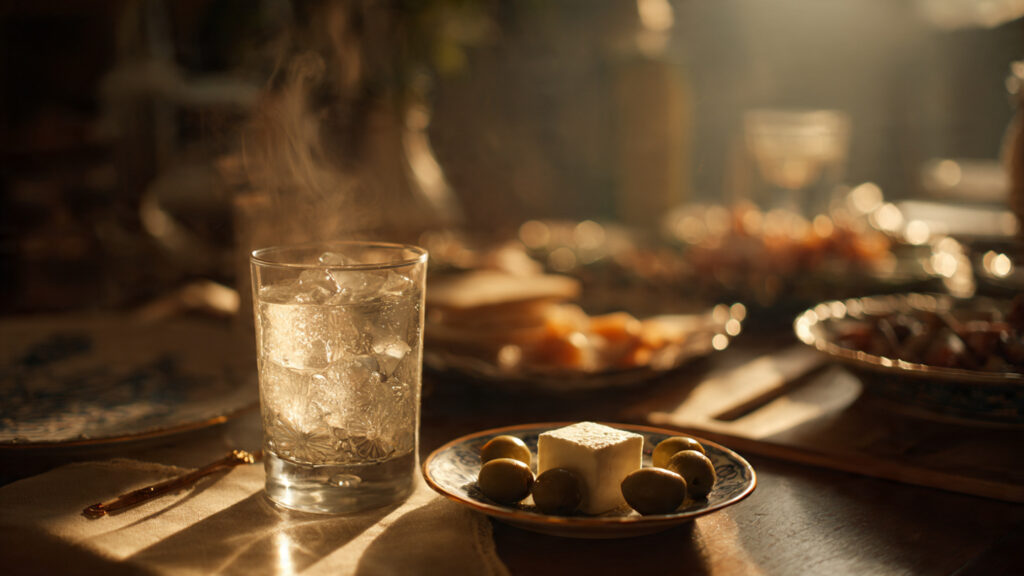
The ouzo ritual matters because it sets the pace of the evening. It says: we are not in a hurry. There is food coming, but first there is this, this moment of settling in, of the conversation finding its opening, of the table becoming itself before the dishes begin.
Tsipouro, the Greek pomace spirit and cousin of Italian grappa, has gained ground in recent years as an aperitif, particularly in northern Greece and Macedonia. Less sweet than ouzo, more direct, it suits those who prefer their spirits without the anise note.
Wine is, for most Greek tables, the companion of the meal itself rather than the aperitif. Greek wine deserves more attention than it receives internationally. The indigenous varieties are extraordinary and almost entirely unknown outside the country. Assyrtiko from Santorini is volcanic and mineral and capable of ageing with the seriousness of a Burgundy. Xinomavro from Naoussa in Macedonia is often called the Greek Barolo for its structure and tannic authority. Agiorgitiko from Nemea in the Peloponnese is generous and full-bodied and considerably more forgiving than Xinomavro for those new to Greek red wine.
For a mezze night, the table benefits from both a white and a red available from the beginning. Let guests choose their own pairing as the dishes evolve.
Water is always on the table, always cold, always refilled without being asked.
Cold Dishes | Where Every Mezze Night Begins
The cold dishes arrive first, and they are the heart of the Greek mezze table. These are the dishes that will be on the table for the entire evening, refilled when they run low, added to as the night deepens, present from the first ouzo to the last piece of bread.
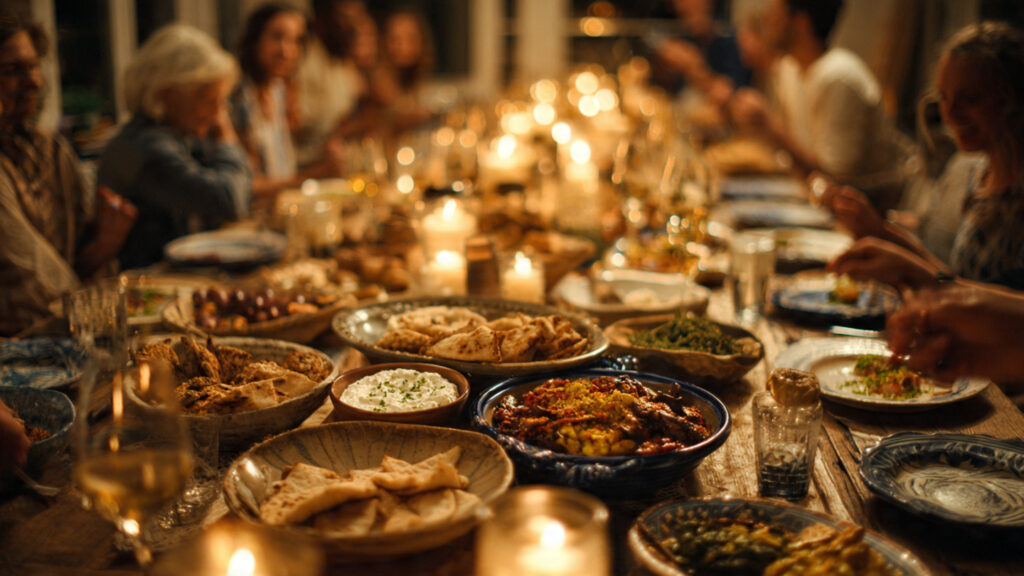
Get these right and the evening will take care of itself.
Tzatziki, and the version you know is probably not the version you should be making.
The difference between a Greek tzatziki and the pale supermarket approximation that has spread across the world is, at its core, the difference between strained yoghurt and unstrained yoghurt. Greek yoghurt, full-fat, strained overnight through muslin until it is thick enough to hold the shape of a spoon, is the foundation. Everything else is secondary.
Grate cucumber, salt it, and squeeze it in a clean cloth until it is genuinely dry, not damp but dry. Grate the garlic rather than crushing it, for a subtler distribution of flavour. Add good olive oil, a little white wine vinegar, fresh dill if you have it. The finished tzatziki should be thick enough to hold a well in the centre where you pour the olive oil at the last moment before serving. It should be made the day before. Everything about it improves overnight.
Taramasalata, which bears no resemblance to the pink fluorescent substance sold under its name in most international supermarkets.
Real taramasalata begins with tarama: cured carp roe or cod roe, available from Greek or Middle Eastern food suppliers in most major cities. The roe is blended with stale white bread soaked in water and squeezed dry, lemon juice, and olive oil added in a slow stream using the same emulsification technique as a mayonnaise. The result is pale blush in colour, not shocking pink, and its flavour is oceanic and savoury rather than sweet. A thin slice of raw onion, very finely chopped, stirred through at the end.
This is the dish most guests will ask about first. It is also the one where the gap between the authentic and the imitation is most dramatic.
Melitzanosalata, roasted aubergine spread, the Greek cousin of baba ghanoush, though less sweet and more austere in character.
Char the aubergines directly over a flame, a gas burner, a grill, a fire if you have one, until the skin is completely blackened and the flesh inside has collapsed. The smoke that enters the flesh during this process is not incidental. It is the dish. Scoop the flesh, drain it, chop it roughly, and dress it with garlic, lemon, olive oil, and flat-leaf parsley. It should be chunky, not smooth. It should taste of fire.
Feta, presented as a block, not crumbled. Drizzled with the best olive oil you have, scattered with dried oregano from the mountains, a few black olives alongside. The quality of the feta determines the quality of this dish entirely. Protected Designation of Origin feta, made from sheep’s milk and a small proportion of goat’s milk, aged in brine, produced in Greek regions, is not interchangeable with the white blocks sold under the name in countries that ignore the designation. Find the real thing.
Olives, marinated, not plain. Crack them lightly with the flat of a knife, and dress them a day ahead with sliced garlic, lemon zest, fresh thyme, a small dried chilli, and olive oil. They should have absorbed the marinade by the time the table is set.
Dolmades, stuffed vine leaves with rice and herbs inside, served cold with lemon. These are the dish that most repays buying from a good Greek or Cypriot delicatessen rather than making yourself, unless you have the patience for rolling two dozen neat cylinders. The homemade version is transcendent. The bought version from a good supplier is excellent. Know your source.
Warm Dishes | When Fire Joins the Table
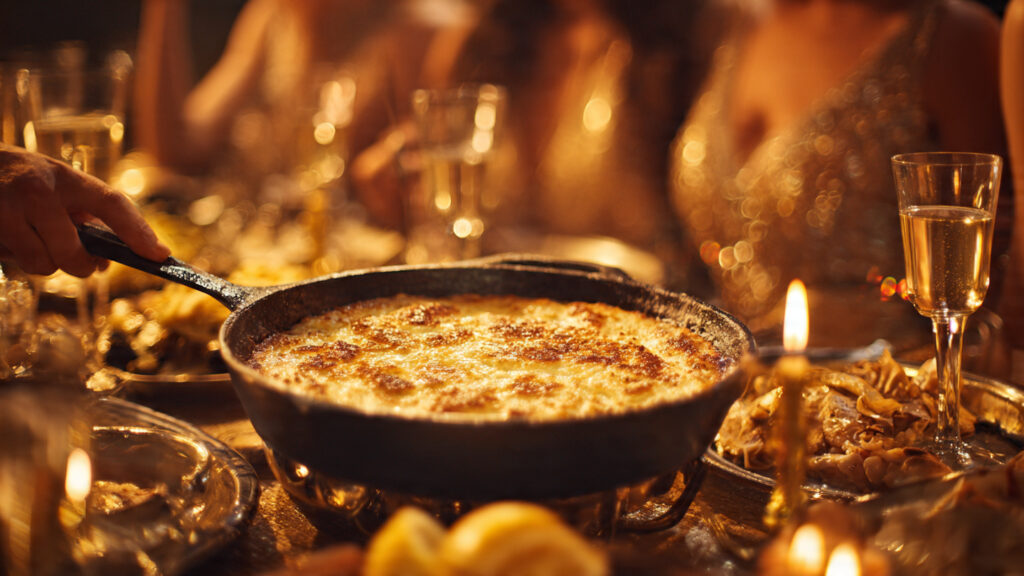
The cold dishes establish the table. The warm dishes deepen it.
These arrive in stages, not as courses in the formal sense, but as additions that change the temperature and register of the meal, that give the conversation a new thread each time a plate lands at the centre.
Saganaki, fried cheese, served immediately before it cools, which it will do quickly. Kefalograviera is the traditional choice: firm enough to hold its shape in the pan, salty enough to need nothing but a squeeze of lemon. The technique is simple and unforgiving. The pan must be very hot. The cheese goes in and stays until it is gold and beginning to blister, then turns once. It arrives at the table in its pan if possible, with lemon halves alongside. It is eaten immediately. There is no version of cold saganaki worth eating.
This is the dish that makes people stop talking for a moment. That pause is the signal it has been done correctly.
Spanakopita, spinach and feta in filo pastry, baked until the pastry is shattered-crisp and the filling is dense and deeply savoury. The distinguishing feature of a good spanakopita versus a mediocre one is the moisture content of the filling: spinach that has not been properly squeezed dry will steam the pastry from the inside and produce something soft where it should be architectural. Squeeze the spinach. Then squeeze it again. Cut into squares or triangles before serving. It should hold its shape when lifted. The layers of filo should audibly separate.
Keftedes, Greek meatballs, and the most personal dish on this list in the sense that every Greek family makes them differently and considers their version correct.
The constants: ground beef or a mix of beef and pork, finely chopped onion, dried mint (this is the flavour that makes a keftede a keftede, not the parsley, not the oregano, though both have their place), a little soaked bread to keep the interior tender, egg to bind. Fry them in batches in hot oil, drain on paper, serve warm. They are one of the rare mezze dishes that improve slightly with a brief rest: ten minutes out of the oil, the crust settling, the interior finishing its cooking in its own heat.
Grilled octopus, if you can find it and if your guests will eat it, is the dish that announces this is a Greek table and not a Mediterranean approximation of one. Freeze it first to tenderise the muscle fibres. Simmer it slowly in plain water, no salt, until a knife passes without resistance. Rest it. Then finish it over very high heat until the tentacles are charred and the skin is crisp while the interior remains tender. Dress with good olive oil, lemon, dried oregano. Nothing else. The octopus does not need assistance.
Tirokafteri, spiced feta dip whipped with roasted red pepper and fresh chilli until it is simultaneously creamy and sharp and hot. This is the dish that changes the temperature of the table, not just the physical temperature but the mood, the intensity of conversation, the willingness of guests to pour another glass and lean back and decide they are not going anywhere soon. Serve it warm or at room temperature. Make more than you think you need.
Bread Is Not Optional
This section exists because it needs to.
There is no Greek mezze table without bread. Not as an afterthought, not merely as a vehicle for the dips, but as a presence in its own right, as fundamental to the table as the wine and the olive oil.
In Greece, the bread at a mezze table is typically a simple white loaf with a good crust, sliced thickly, or a softer village bread baked with olive oil in the dough. What it is not: sourdough from a trendy bakery, focaccia, ciabatta, or any bread that calls more attention to itself than to what it is carrying.
The bread at a Greek table is generous and unpretentious. It serves the table. It does not compete with it.
Warm it briefly before serving. Keep more in the kitchen. Bring it out without being asked. When the bread basket looks like it might be running low, it is already too late.
What a Greek Table Actually Requires of You
By now you have a table, drinks, cold dishes, warm dishes, and bread. You have, in other words, all the physical components of a Greek mezze night.
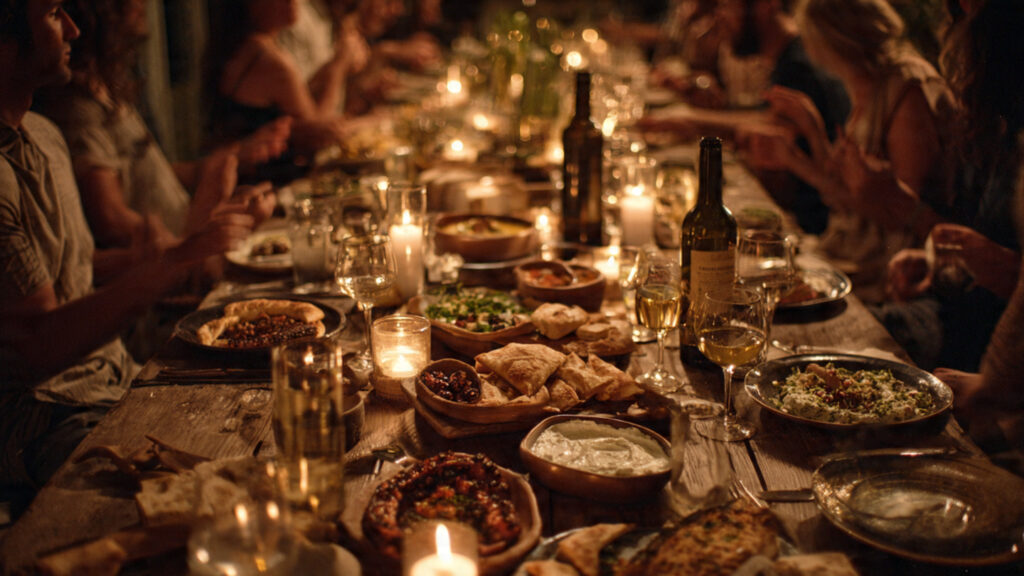
Here is what makes it Greek rather than merely Mediterranean.
Nobody eats alone. The dishes arrive at the centre of the table, not in front of individual guests. Everyone reaches. Everyone serves themselves and, more importantly, serves others. The act of placing food on someone else’s plate, ela, fae, eat, is a form of affection so habitual at the Greek table that guests unfamiliar with it sometimes find themselves with more food than they intended. This is correct. This is the table working as it should.
The host eats. A Greek host does not spend the evening disappearing into the kitchen. The preparation happens before the guests arrive. Once the evening begins, the host sits at the table, eats, drinks, and participates in the conversation. A host who is constantly absent is not hosting. They are catering. These are different activities.
The pace is set by the conversation, not the courses. If a story is reaching its most interesting point, the next dish waits. If a guest’s glass is empty, it is filled before any other consideration. The meal moves at the speed of the people eating it, not at the speed of any kitchen schedule. Build this into your planning: have dishes that can hold, that can be brought out warm or cold as the moment requires, that do not demand punctuality.
Arguments are welcome. The Greek table is not a place of enforced harmony. Strong opinions about food, politics, football, the correct way to prepare taramasalata: these are not disturbances to the evening. They are its content. A table where everyone agrees about everything is a table where the conversation has not yet properly started.
Complimenting the food is not enough. In Greece, the proper response to a good meal is not a polite compliment to the host. It is na sas zísi, may it give you life, or simply bravo said with the warmth that means something beyond the word itself. It is a participation in the meal, not an evaluation of it.
The evening ends when it ends. Not when the food runs out. Not when the wine runs out, and there is always more wine. Not when the host looks tired, which a good Greek host will never visibly allow. The evening ends when the paréa has finished what it needed to finish, when the conversation has reached a natural resting place, when the table has done its work. This may be midnight. It may be two in the morning. Plan accordingly.
Dessert Arrives Without Warning
The Greek mezze table does not formally end with a dessert course.
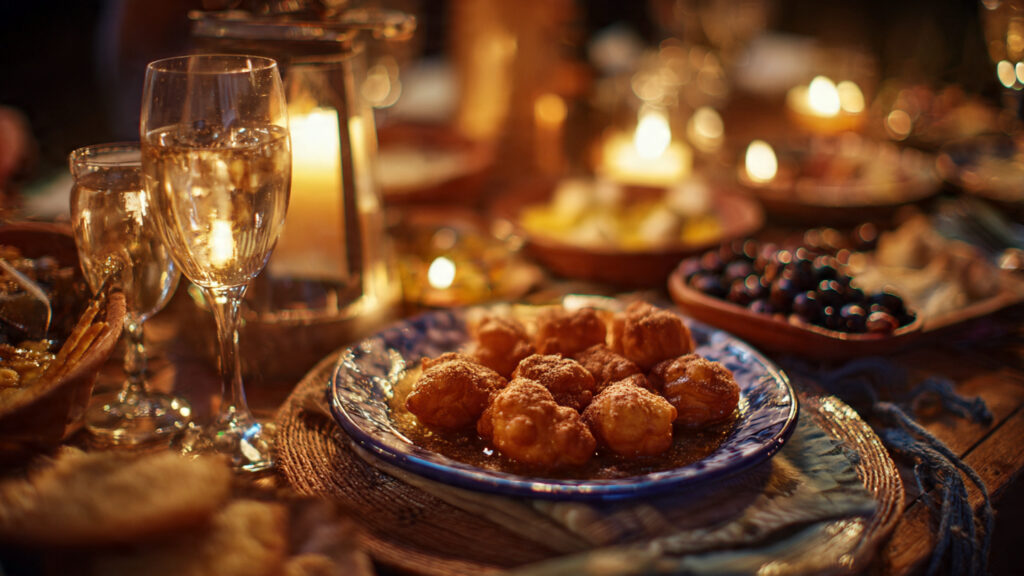
What happens instead is this: at some point in the late part of the evening, something sweet appears. Not announced, not preceded by the clearing of plates, which in any case happens gradually throughout a mezze meal rather than all at once, but simply placed on the table alongside whatever is still there.
Loukoumades, hot honey-drenched doughnut balls dusted with cinnamon, made in the kitchen and brought to the table immediately. These are the dessert that requires the most timing and the most courage, because they are only at their best for approximately four minutes after leaving the oil. But those four minutes justify the entire effort of the evening.
Baklava, if you are buying rather than making, buy from a Greek or Middle Eastern pastry shop, not a supermarket. Genuine baklava, made with good butter, thin hand-stretched filo, and honey that has flavour rather than just sweetness, is one of the great pastries of the world. Its supermarket version is a different product with the same name.
Fresh fruit: figs in season, watermelon in summer, pomegranate in autumn. The Greeks do not consider fruit a lesser dessert than pastry. They consider it the appropriate end to a meal that has already provided everything else.
Greek mountain tea (tsai tou vounou), made from dried ironwort flowers, pale gold in the cup, mildly sweet and herbal: the traditional close to a Greek meal and the gentlest possible transition from the table to the end of the evening.
What to Source, What to Make
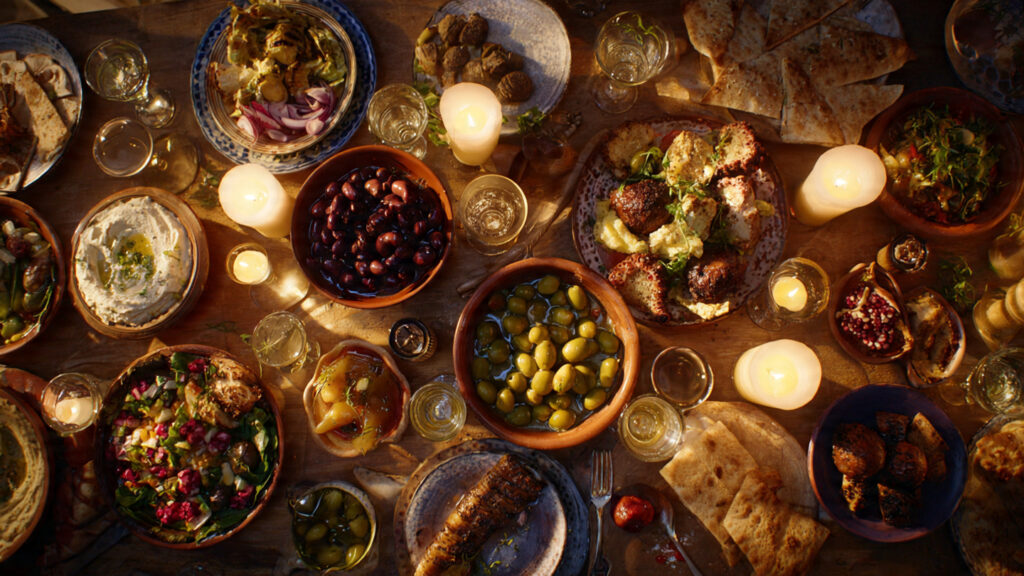
Not everything on a Greek mezze table needs to be made from scratch. Knowing which dishes reward homemade effort and which are better sourced from a good Greek or Cypriot deli is part of the intelligence of hosting.
Make yourself: tzatziki, taramasalata, melitzanosalata, keftedes, tirokafteri, and spanakopita if you have the time and patience. These are the dishes where the homemade version is transformatively better than anything you can buy.
Buy from a good source: dolmades, baklava, and always your feta in brine, PDO certified. Buy your olives plain and marinate them yourself the day before.
For the pantry, what you cannot do without: Greek extra virgin olive oil for finishing and for the table, not for cooking. Dried Greek oregano from the mountains, not the jar that has been sitting on a shelf since last year. Kalamata olives. Tarama, cured roe. Full‑fat Greek strained yoghurt. Kefalograviera for the saganaki. And either ouzo or tsipouro, ideally both.
What You Are Actually Hosting
Here is the honest truth about a Greek mezze night, the thing that no recipe or shopping list can fully convey.
The food is not the point.
Or rather, the food is the medium through which the point is delivered, in the same way that a letter is the medium through which a message travels. The food matters. The quality of the tzatziki matters, the freshness of the octopus matters, the temperature of the saganaki as it arrives at the table matters. None of this is incidental.
But what you are actually hosting is time. Unscheduled, unhurried, fully committed time. The luxury of an evening that has no agenda beyond being present at a table with people you want to be with, eating food that was made with attention, in a room lit low enough that the rest of the world recedes.
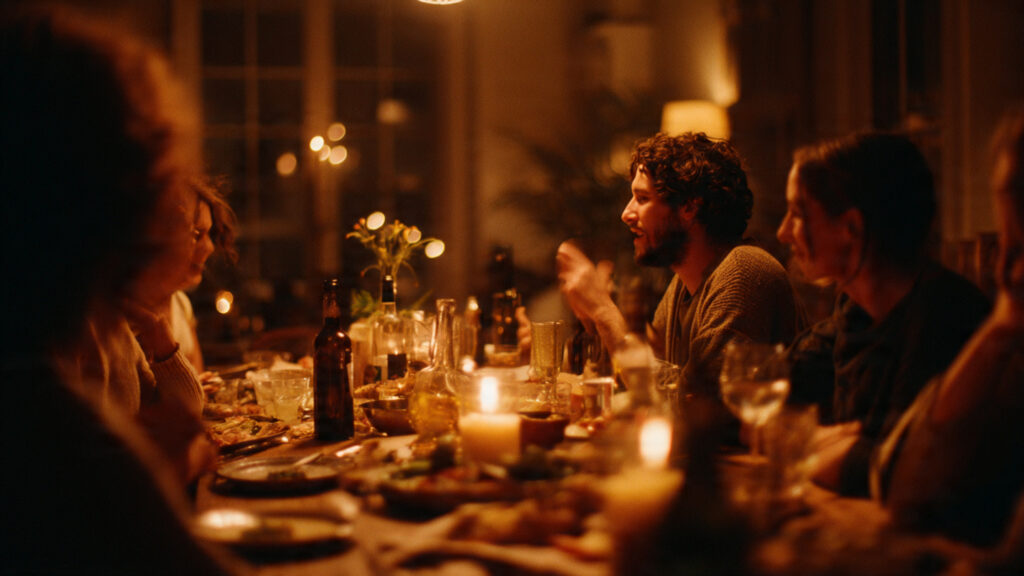
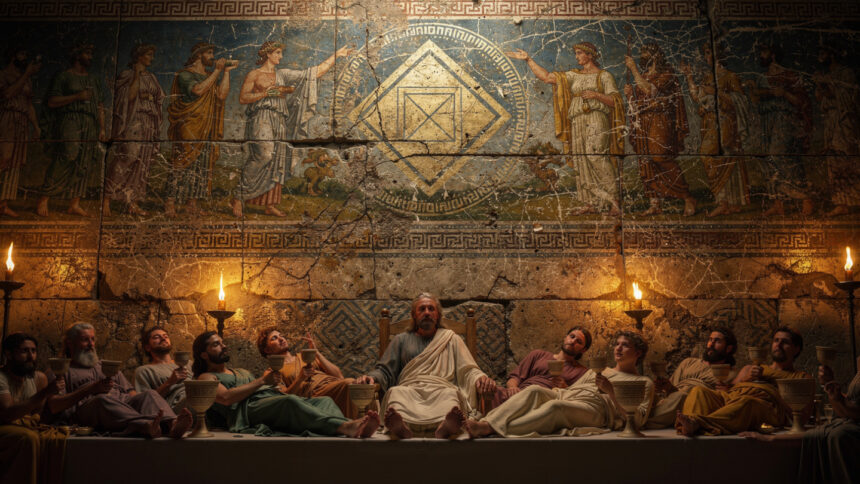
The ancient Greeks understood the table as a sacred space. Zeus Xenios protected it. Shared bread and shared salt bound people to each other with obligations that outlasted the meal. The symposium, literally the drinking together, was the arena where philosophy, poetry, music, and the most important conversations of the ancient world took place. Not in academies. Not in courts. At a table.
Your mezze night will not be a symposium. But it participates in the same logic: the idea that the table is where something essential to human life takes place, something that cannot be replicated by any other arrangement of food and people.
Set the table. Open the wine before the guests arrive. Make more tzatziki than you think you need.
Then sit down, eat, and let the evening find its own pace.
It will know where to go.
At Olympus Estate, Greek Living explores the customs, etiquette, and unwritten rules that shape life in Greece today. A Greek mezze night is built on philoxenia, the ancient and still-living obligation of hospitality once protected by Zeus Xenios himself. The dishes matter, but the real architecture of the evening is paréa, the company, the unhurried time spent at a table with people you want to be with.