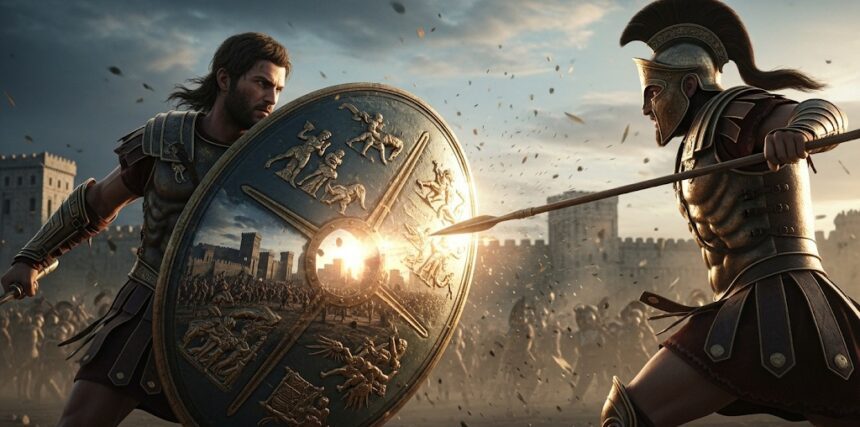


Some countries tell stories, but Greece lives inside its stories. In this ancient land, myth is not a distant memory—it is a geographical reality stitched into the very fabric of the mountains, lakes, caves, and coastlines.
To trace the ancient roots of Greek mythology on the map is to wander through a living archive. Every region is a chapter, every rock a whisper, and every valley a reminder that mortals and gods once shared the same terrain. This is “mapped storytelling”, a journey that blends archaeology, folklore, and the rugged landscapes that shaped the world’s oldest legends.
Here are 12 essential destinations where Greek myths still breathe today.
1. Mount Olympus: The Throne of the Twelve Gods

If there is one place where myth and geography perfectly merge, it is Mount Olympus. Rising 2,917 meters above the Aegean Sea, it is the towering home of the Olympian Gods. The mountain is often shrouded in clouds, fueling the ancient belief that the gods lived just out of mortal sight.
- The Plateau of the Muses: A high-altitude plain where Apollo was said to inspire the arts.
- The Throne of Zeus: Known as Mytikas, this jagged peak looks sculpted by lightning and offers a panoramic view of the world below.
- The Enveloping Mist: Even today, hikers describe a “divine” energy when the clouds roll through the ancient pine forests.
2. Delphi: The Navel of the World

The ancient Greeks believed the Omphalos (the center of the earth) was located at Delphi. This was the spiritual heart of the Mediterranean, where the high priestess, the Pythia, delivered the cryptic word of Apollo.
The landscape here pulses with a magnetic, golden silence. Walking the Sacred Way toward the Temple of Apollo, you can almost hear the rustle of the laurel leaves and the murmurs of kings seeking prophecies that would change the course of history.
3. Knossos, Crete: The Labyrinth of the Minotaur

Under the Cretan sun lies the sprawling Palace of Knossos. This site is synonymous with King Minos, the clever Ariadne, and the monstrous Minotaur.
The architecture of Knossos is famously complex. With its multi-storied rooms, light wells, and winding corridors, it’s easy to see how the legend of the Labyrinth was born. The vibrant frescoes of bulls and dolphins suggest a civilization where myth and daily palace life were inseparable.


4. Lake Stymphalia: The Realm of the Man-Eating Birds
Tucked away in the mountains of Arcadia, this quiet lake was the site of Hercules’ sixth labor. Legend says the lake was infested with the Stymphalian Birds—creatures with bronze beaks and metallic feathers they could shoot like arrows.
Today, the lake is a peaceful sanctuary for rare waterfowl. However, when the mountain mist settles over the reeds, the stillness belies the ancient terror that once lived in the Greek imagination.
5. Cape Sounion: Where the Aegean Got Its Name

The white marble columns of the Temple of Poseidon stand on the edge of a precipitous cliff at Cape Sounion. This is a place of deep tragedy.
It was from these rocks that King Aegeus scanned the horizon for his son Theseus. When he saw black sails—a signal of death—he leapt into the depths in despair. The water turned dark beneath him, giving the sea its name: the Aegean. Watching the sunset here feels like witnessing that ancient heartbreak unfold again.
6. Naxos: The Island of Divine Romance
On Naxos, the largest of the Cyclades, the landscape tells the story of Dionysus, the god of wine and ecstasy. Legend says he found Ariadne abandoned on these shores by Theseus and made her his queen.
- The Portara: The massive marble gate of an unfinished temple stands as a sentinel over the harbor.
- Fertile Valleys: The island’s rich vineyards are a living tribute to the god who taught humanity how to make wine.
7. Epidaurus: The Sanctuary of Sacred Dreams
The ancient world’s most advanced medical center was the Sanctuary of Asklepios, the god of healing. Here, medicine and mythology were born together.
Patients would travel from across the Mediterranean to enter the Abaton, a sacred hall where they slept in hopes that Asklepios would visit them in their dreams with a cure. The nearby theater, famous for its “supernatural” acoustics, was used to soothe the souls of the sick through drama and music.
8. Lerna: The Swamp of the Multi-Headed Hydra
Near the ancient city of Argos lies the marshy region of Lerna. This was the lair of the Lernaean Hydra, a serpent with many heads that grew back twofold when cut.
Local springs and wetlands still feel primordial. Archaeologists have uncovered “The House of the Tiles” here, dating back to 2500 BC, proving that this marshy terrain has been a center of human (and mythic) activity for millennia.
9. Dodona: Zeus’s Whispering Oracle
Before Delphi rose to prominence, the world’s greatest oracle was at Dodona. Here, Zeus did not speak through a priestess, but through the rustle of the leaves of a Sacred Oak tree.
Pilgrims would listen to the wind and the clanging of bronze cauldrons to interpret the divine will. Today, the site remains one of Greece’s most tranquil ancient ruins, where nature itself still feels like a delivery system for prophecy.
10. Mycenae: The Kingdom Cursed by the Gods

Home to Agamemnon and the ill-fated House of Atreus, Mycenae is where myth becomes stone. Passing through the Lion Gate, you enter a citadel built with “Cyclopean” walls—so massive that later Greeks believed only giants could have moved the rocks.
The gold death masks and beehive tombs (Tholos) found here reflect a culture obsessed with legacy, power, and the dark family sagas that define Greek tragedy.
11. Samothrace: Island of the Mystery Cults
Samothrace is a wild, rugged island in the northern Aegean, dominated by Mount Saos. It was the site of the Great Gods’ Mysteries, a cult so secretive that its rituals remain a mystery to this day.
The island’s wind-sculpted mountains and dramatic coastline feel enchanted. It is famously the home of the “Winged Victory of Samothrace” (now in the Louvre), a statue that perfectly captures the divine energy of this remote sanctuary.
12. The Springs of Thermopylae: The Hot Gates
While famous for the stand of the 300 Spartans, Thermopylae literally translates to “Hot Gates.” According to myth, these steaming hot springs were created by Hephaestus at the request of Athena so that Hercules could rest and heal after his labors.
Visiting today offers a rare chance to soak in the same sulfurous waters mentioned in ancient texts, standing on ground where history and legend are indistinguishable.
In Greece, the landscape is a mythscape. You cannot separate the mountain from the god, the island from the nymph, or the spring from the hero. Traveling through these sites allows you to walk through two timelines at once, the living present and the eternal past.
Every site on this list is more than a destination; it is a portal to a story that never truly ended.