




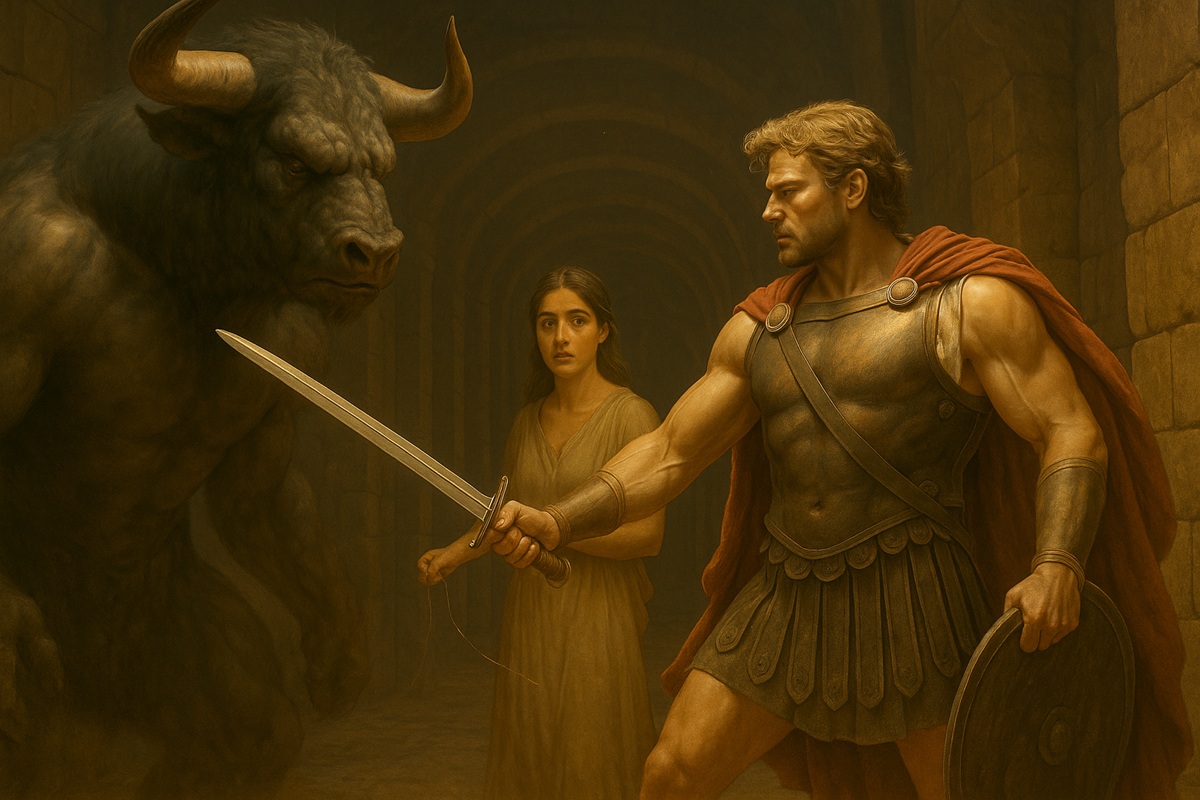
From the moment we hear the name Theseus, vivid images spring to life—labyrinthine corridors deep beneath the palace of Knossos, a monstrous Minotaur lurking in the shadows, and a young Athenian prince armed only with courage, cunning, and a thread. This ancient myth, passed down for millennia, is far more than just a fantastical tale for children. It pulses with historical undercurrents, cultural symbolism, and the evolving identity of Athens itself. But what exactly does the myth of Theseus reveal to us—not just as spectators of ancient lore, but as readers seeking to uncover the meaning and message beneath the legend?
Theseus: A local Hero
While Theseus is most widely remembered for slaying the Minotaur, this story is just one chapter in a much broader saga. To the people of ancient Attica—modern-day Athens—Theseus was a national symbol, a cultural archetype, and, perhaps, a distant echo of a real historical figure.
Originally a local hero of Attica, Theseus gradually rose to pan-Hellenic fame, transcending regional folklore to become a defining icon of Athenian identity. Over centuries, his character evolved, transforming from a monster-slaying warrior into a wise king and unifier of the Athenian state.
This evolution wasn’t accidental. It mirrored the political and social aspirations of Athens itself—emerging from obscurity, resisting foreign domination, and asserting itself as a powerful, democratic city-state. In essence, Theseus became the personification of Athenian greatness.
The Minotaur and the Labyrinth: Symbols of Subjugation and Triumph
On the surface, the myth reads like a classic adventure: a hero enters a maze, defeats a beast, and escapes with the help of a clever princess. But hidden within this gripping narrative is a story of political struggle and resistance.
The Minotaur—half-man, half-bull—represents more than just a monster. To many scholars, it symbolizes the oppressive dominance of Crete over Athens during the Bronze Age. The tribute of Athenian youths sent to Crete to be sacrificed isn’t just an act of horror, but a metaphor for submission, taxation, or cultural dependency.

Theseus’ victory, then, isn’t simply heroic—it’s revolutionary. It marks the turning point when Athens rejects subjugation and asserts its autonomy. His escape from the labyrinth with Ariadne’s thread reflects not just cleverness, but a break from the political entanglements and domination of the past.
Through this lens, the myth becomes a narrative of liberation. It speaks to the spirit of a people rising against oppression, reclaiming their destiny, and forging a new identity through courage, unity, and intellect.
More Read

A Hero Who Became a Ruler
Unlike many Greek heroes who live fast and die young, Theseus matures. He survives his trials and becomes king of Athens. This transformation is rare in Greek mythology and significant.
As king, Theseus was credited with unifying the many scattered communities of Attica into a single political entity—Synoikismos. He wasn’t just a conqueror; he was a builder, a reformer, a symbol of civic order. This evolution of character reveals a deep societal yearning for leadership that is both brave and wise—someone capable of both defending the people and organizing them into a thriving polity.
Thus, Theseus bridges the gap between the mythological and the political. He is a template for the ideal leader: courageous yet thoughtful, strong yet just. His myth doesn’t merely entertain; it instructs.
Could There Have Been a Real Theseus?
It may sound fantastical, but many ancient writers believed Theseus was not merely a figment of poetic imagination. Historians like Plutarch and Eusebius of Caesarea placed him within historical timelines, treating him as a legitimate ruler—possibly even the tenth king of Athens. Eusebius pinpointed his reign around 1234 BCE, which, if accurate, places Theseus among the very earliest of legendary kings, straddling the threshold between myth and history.
Although archaeological evidence does not definitively confirm his existence, the belief in a historical Theseus was strong in ancient Greece. Shrines were built in his honor, and festivals like the Theseia celebrated his deeds. Whether man or myth, his presence in the cultural memory of Athens was as real as any monarch’s legacy.
An Evolving Character for an Evolving City
The Theseus we meet in the earliest myths is bold, brash, and driven by physical valor. But as Athenian society evolved, so too did his portrayal. Later depictions present him as more introspective, even philosophical—a ruler who seeks justice, not just glory.
This shift reflects the broader transformation of Athens itself—from a warrior society to a democratic polis guided by laws, reason, and discourse. In becoming more humane and thoughtful, Theseus became the perfect embodiment of Athens’ ideal citizen and sovereign.

His transformation speaks volumes. It shows that the myth of Theseus is not static—it has grown and adapted, just as the city he represents has done. And that adaptability is key to his continued relevance.
Theseus as a Symbol
Perhaps the most profound truth the myth reveals is that Theseus is not just a person; he is a symbol—a metaphor for change, resistance, unity, and progress. His myth encodes the victory of human intellect over chaos, of civic order over tyranny, of light over darkness.
The labyrinth is more than just a maze—it represents the tangled complexity of political turmoil and societal struggle. The Minotaur isn’t simply a monstrous creature—it stands for the looming force of oppression and control. And Theseus? He embodies the spirit of a people who believe that with courage, intelligence, and determination, they can overcome adversity and take back their destiny.
Myths are Never Just Stories
Even after thousands of years, the story of Theseus continues to resonate—not because we take its monsters or mazes literally, but because it speaks to something deeper and enduring. At its core, it reminds us that oppressive power can be resisted, that freedom is worth fighting for, and that true leadership lies not only in bravery, but in wisdom and vision.
It tells us that myths are never just stories—they are reflections of the values, struggles, and aspirations of the people who told them.
In the myth of Theseus, we find a mirror held up to ancient Athens, but also, perhaps, to ourselves.