
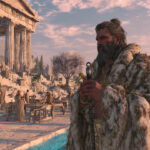





The wine flowed freely through the streets of Ilion, washing away ten years of blood, dust, and fear. To the weary citizens, the war was finally over. The Greeks had vanished, leaving behind nothing but the deserted beach and a colossal wooden tribute to the gods. Laughter echoed against the high walls for the first time in a decade, and the people danced in the shadow of the Trojan Horse, believing it to be a symbol of their divine victory. Yet, amidst the jubilation and the drunken toasts to peace, one voice screamed in terror. It was a voice that cracked with desperation, begging her people to burn the gift rather than drag it inside the gates.
Cassandra, the daughter of King Priam and sister to the fallen hero Hector, stood alone against the tide of history. She saw not wood and offerings, but a belly full of armed men and a city reduced to ash. She clawed at her clothes and wept before the elders, detailing the slaughter that would come with the night. But instead of fear, she was met with pity, scorn, and laughter. They called her mad. They waved her away as a hysteric dampening the mood of triumph. As the sun set and the heavy gates creaked open to admit the instrument of their doom, Cassandra of Troy was proven right in the most horrific way possible.

Her story is the eternal tragedy of the truth-teller who is cursed to never be believed. It asks us a haunting question that resonates thousands of years later: what good is wisdom if no one will listen to it?
The Curse of Apollo and the Burden of Truth
To understand why a princess of royal blood was treated like a lunatic by her own kin, we must look to the source of her power. In the rich tapestry of Greek mythology, gifts from the gods rarely come without a terrible price. Cassandra was born with breathtaking beauty, a radiance that rivaled Aphrodite herself. This allure caught the eye of the god Apollo, the lord of light, music, and prophecy.

In his desire to woo the mortal princess, Apollo bestowed upon her the divine ability to see the future. He granted her the sight that belongs only to the immortals. However, Cassandra rejected the god’s advances. Whether out of chastity or fear, she denied him the love he sought. Spurned and vengeful, Apollo could not revoke a divine gift once given, but he could twist it into a torment. He spat into her mouth, sealing her fate with a cruel curse: she would retain her accurate foresight, but no soul on earth would ever believe a word she said.
This created a unique form of psychological torture. Cassandra did not speak in riddles or vague metaphors like the Oracle at Delphi. She saw the future with crystal clarity. She knew exactly what Prince Paris would bring upon them when he sailed for Sparta. She saw the blood, the fire, and the ruin long before the first Greek ship appeared on the horizon. Yet, to her family and her people, her warnings sounded like the ravings of a broken mind. The gift of prophecy became her prison, isolating her from everyone she loved.
The Night Troy Burned
The most famous moment of her tragic life occurred at the very end of the Trojan War. The Greeks, realizing the city could not be taken by force, resorted to the cunning of Odysseus. They constructed the Trojan Horse, hid their elite warriors inside, and sailed their fleet behind the island of Tenedos. To the exhausted Trojans, it looked like a miraculous surrender.

Cassandra rushed to the wooden beast. She felt the vibrations of the living men inside; she saw the future where the city was engulfed in flames. She screamed that the horse was a trap, a vessel of death. She grabbed an axe and a burning torch, attempting to destroy the idol right there on the beach. But the citizens, desperate for relief and blinded by hope, restrained her. They dragged her away, locking her up so her “insanity” would not spoil the celebrations.




That night, as the city slept in a drunken stupor, the belly of the horse opened. The fall of Troy was swift and brutal. The very scenes Cassandra had described to her father played out in real-time. Men were slaughtered in their beds, women were enslaved, and the great towers of Ilion crumbled under the weight of Greek fire. The vindication of being right brought her no comfort, only the horror of watching her nightmare manifest.
Violation in the Temple of Athena
As the city collapsed, Cassandra fled to the Temple of Athena, seeking sanctuary at the foot of the goddess’s statue. It was here that the brutality of war stripped away her final protections. Ajax the Lesser, a Greek warrior consumed by bloodlust, found her clinging to the sacred image. Ignoring the laws of gods and men which forbade violence in a holy sanctuary, he dragged her away.

The violation of Cassandra was so egregious that it shocked even the Greek commanders. It is said that the eyes of the statue of Athena looked away in shame. This act of sacrilege would eventually doom the Greek fleet on their return journey, but for Cassandra, the damage was done. The princess who had foreseen it all was now a spoil of war, stripped of her dignity and her home.
The Final Prophecy and the Death of Kings
Her suffering did not end with the burning of her city. In the division of the spoils, Cassandra was awarded to King Agamemnon, the leader of the Greek forces, as his concubine. As she was forced to board his ship and sail for Mycenae, the curse of Apollo continued to haunt her. She began to see visions not of Troy, but of her new master’s homecoming.

She saw the red carpet rolled out not for honor, but for blood. She saw Clytemnestra, Agamemnon’s vengeful wife, waiting with a blade and a net. She saw her own death intertwined with the king’s. Upon arriving in Mycenae, Cassandra stood before the palace gates and went into a prophetic trance. She wailed of the smell of slaughter that hung over the house of Atreus. She explicitly warned Agamemnon that his wife was plotting to murder him in his bath.

True to form, the victorious king, arrogant and secure in his power, ignored the “mad” woman. He walked willingly into the palace and to his death. Cassandra, accepting the inevitability of fate, followed him inside, walking with her head high to meet the end she had seen coming for weeks.
The Modern Relevance of the Prophetess
The story of the Trojan princess resonates so deeply today because it touches on a universal frustration: the human refusal to accept uncomfortable truths. Psychologists and philosophers have even coined the term “Cassandra Complex” to describe situations where valid warnings are dismissed or disbelieved.

We see the spirit of Cassandra in the scientists who warn of environmental collapse while the world continues business as usual. We see it in the economic analysts who predict market crashes only to be laughed at until the bubble bursts. We see it in our own lives, in that gut instinct—the voice of reason—that tells us a decision is wrong, yet we suppress it because we prefer the comfortable lie to the difficult truth.

The ancient storytellers used Cassandra to personify the conflict between fate and free will, but also to highlight the blindness of society. The Trojans did not ignore her because they couldn’t hear her; they ignored her because they didn’t want to hear her. They preferred the “rose-colored glasses” of victory over the stark reality of survival.
Learning to Listen to Reason
If there is a lesson to be mined from the ruins of Troy, it is the importance of piercing through our own denial. Cassandra represents the intuition and critical thinking that is often drowned out by the noise of the crowd or the desire for an easy outcome.

When we dismiss the warnings of experts, or when we silence our own internal alarms because they are inconvenient, we are repeating the mistake of King Priam. The myth reminds us that truth is not dependent on a majority vote. Reality does not bend just because we refuse to look at it.
To honor the memory of the seer of Troy, we must learn to value the uncomfortable warning over the comforting lie. We must learn to listen before the horse is inside the gates.