

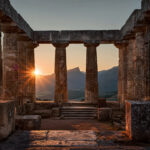


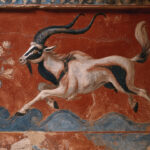

Winter in the Greek high country carries a gravity that feels unfamiliar to the modern world. It unfolds as a long pause between autumn’s fading warmth and the sudden surge of Mediterranean spring. In Epirus or in the shadowed ridges of the Peloponnese, January is never treated as a blank beginning. There was no tradition of imagining the year as something that erased what came before. The land simply continued forward, narrowing into colder light and stone. This passage through contraction and stillness marked a crossing, and it was here that Hermes Psychopompos became most present in Greek thought. He was understood as the god of thresholds, not as a judge at the end of the road but as the one who knew how to move through change without damaging what passed through it.
For the ancient Greeks, the soul was not meant to confront darkness alone. Transition required knowledge and companionship. Movement from the visible world toward the unseen demanded a guide who understood both territories. This role belonged to Hermes, the god of roads and passage. Popular memory often reduces him to a quick messenger or trickster, yet winter reveals his more contemplative aspect. He was associated with inward movement and with Persephone’s seasonal descent, a pattern of withdrawal and return. Within the stone houses of traditional Greek estates, January became a month for reflection. As the noise of outward life softened, attention turned inward, toward memory and continuity.
The God Born in Motion
Hermes entered mythology already in motion. Born to Zeus and Maia in a cave on Mount Cyllene, he left his cradle before the day had fully begun. His theft of Apollo’s cattle and his creation of the lyre were not simply acts of mischief but expressions of a logic that treated boundaries as skills to be learned rather than limits to obey. From the beginning, he moved easily between divine and human worlds. Neither Olympus nor the earth alone could contain him. Roads, markets, and dreams became his domains. He spoke to gods and to the dead with the same ease. This ability to navigate different realms without losing coherence was central to Greek spiritual imagination.

His title Psychopompos, guide of souls, named his most serious responsibility. He escorted the dead to the underworld, not through force but through presence. Death was understood as a transition that required a companion who knew the route. Hermes carried the kerykeion, his staff, which symbolized safe passage and continuity. Through him, identity and memory were preserved across boundaries. Ancient art often shows him leading figures calmly toward the unseen. These scenes are marked by composure rather than fear. The guide is already waiting, seated near the edge of the boundary, prepared for the journey to unfold without rupture.
Liminality as a Lived Reality
Hermes presided over liminal spaces: crossroads, doorways, and the borderlands between waking and sleep. His winged sandals represented motion without disruption. The Greeks placed hermai, stone pillars bearing his head, at entrances to cities and homes. These markers did not block movement but acknowledged it. A crossing left unrecognized was considered dangerous, while one that was named and honored remained whole.

This awareness extended to the seasons. Winter functioned as the Mediterranean’s great interval. Light diminished, growth retreated into the soil, and attention turned toward reckoning and assessment. There was no expectation of dramatic reinvention. What was required instead was consciousness. Hermes governed all who crossed boundaries—travelers, merchants, speakers, even thieves—because exchange itself belonged to him. In winter, when physical movement slowed, inner movement became more pronounced. Dreams carried messages. Insight emerged quietly. Without the distractions of summer, his guidance felt closer. This was not a time for spectacle but for mental architecture: observation, preparation, and inward mapping before spring demanded outward action.
Winter in the Attic Calendar
The ancient calendar moved at a different pace from modern timekeeping. It began in midsummer with Hekatombaion, and the winter months included Poseideon and Gamelion. No major January festival was dedicated to Hermes, yet his presence permeated the season through rituals of thresholds and household observances. Liminal periods naturally belonged to him.

The Greeks did not share the modern obsession with radical renewal in January. They did not seek to discard the former self in favor of a new one. Their view emphasized continuity. The year unfolded in phases connected by crossings, and Hermes ensured that movement between them remained intact. He did not command or pressure; he accompanied. The long nights of winter encouraged listening. With fewer external demands, the inner world became clearer. Foundations were laid in shadow rather than sunlight, and stability was secured before growth resumed.


Travel as Sacred Passage
In Greek culture, travel was never merely geographic. Leaving one place and arriving in another altered the traveler’s identity. Hermes protected this movement because it carried risk. Change without ritual led to confusion. This was why gates and boundaries were marked and honored. Recognition restored meaning and transformed ordinary movement into sacred passage.

Life transitions followed the same pattern: shifts in work, experiences of loss, aging, and transformation. These were understood as crossings rather than failures. The gods were not asked to prevent change but to guide it. Hermes appeared wherever certainty dissolved—at dawn and dusk, at places where no path felt fully shaped. January belonged to this terrain of ambiguity, where quiet attention mattered more than loud intention.
Walking the January Threshold
To honor Hermes Psychopompos is to respect the process of passage itself. January does not require the creation of a new identity. It calls for companionship with one’s own movement through uncertainty. Greek wisdom located meaning not in arrivals or departures but in the steps taken between them, with the guide walking close by.

The winter light becomes a map of restraint and patience. The land rests. Vines hold their sap. The world waits. This waiting is not empty. Hermes is imagined still moving along mountain paths and narrow streets, present for those willing to cross with awareness. He remains the guardian of thresholds, the quiet protector of the space between what has been and what is about to come.


